Table of Contents
Himali is a beautiful and meaningful name of Sanskrit origin that evokes the majesty of the world’s highest mountain range. Primarily used as a feminine name in Hindu communities, it carries deep cultural and geographical significance. The name connects the bearer to the spiritual and natural grandeur of the Himalayas, symbolizing purity, strength, and enduring beauty. Choosing Himali for a child reflects an appreciation for nature, tradition, and the profound symbolism of mountains in South Asian culture.
Meaning of Himali
Himali derives directly from the Sanskrit word ‘Himalaya’, which is composed of two elements: ‘hima’ meaning ‘snow, frost, or ice’ and ‘ālaya’ meaning ‘abode, dwelling, or home’. Thus, the name literally translates to ‘abode of snow’ or ‘from the snowy mountains’. Unlike the oversimplified translation as just ‘ice’, Himali specifically references the Himalayan mountain range, encompassing its geographical, cultural, and spiritual significance. In linguistic context, this name appears in various modern Indian languages including Hindi, Bengali, Nepali, and Gujarati with consistent meaning. The Himalayan range itself holds immense importance in Hindu mythology as the dwelling place of gods and sages, adding layers of sacred meaning to the name.
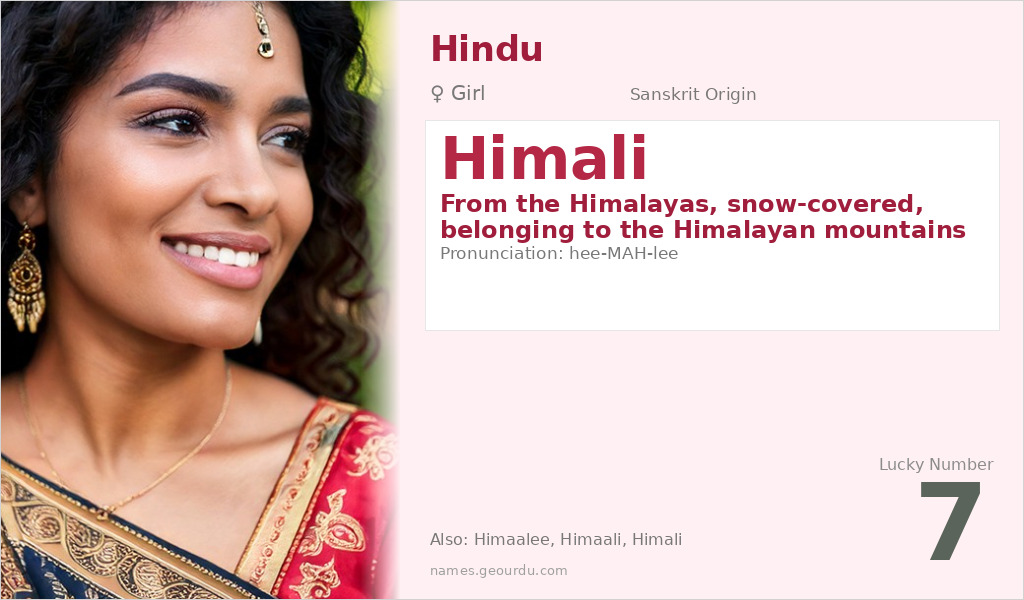
| 📛 Name | Himali |
| 💎 Meaning | From the Himalayas, snow-covered, belonging to the Himalayan mountains |
| 👤 Gender | Girl |
| 🕌 Religion | Hindu |
| 🌍 Origin | Sanskrit |
| 🗣 Pronunciation | hee-MAH-lee |
| ✍️ Urdu | ہمالی |
| ✍️ Arabic | هيمالي |
| 🔢 Numerology | 7 |
| ✨ Spellings | Himaalee, Himaali, Himali, Himalie |
Origin & Cultural Significance
Himali originates from Sanskrit, the classical language of ancient India, and is deeply rooted in Hindu culture and geography. The name directly references the Himalayan mountain range that stretches across northern India, Nepal, Bhutan, and Tibet. In Hindu tradition, the Himalayas are considered sacred, mentioned in ancient texts like the Vedas and Puranas as the home of Shiva and other deities. The name gained popularity as a given name in the 20th century, particularly in India and Nepal, reflecting pride in natural heritage and cultural identity. While primarily associated with Hindu communities, the name is sometimes used by people of other faiths in South Asia who appreciate its geographical and aesthetic significance.
Personality Traits
Those named Himali are often associated with qualities reminiscent of mountains: stability, strength, and serene beauty. They may exhibit a calm and composed demeanor, with deep-rooted values and spiritual inclinations. Like the enduring Himalayas, individuals with this name often demonstrate resilience in facing life’s challenges while maintaining grace and dignity. Their connection to nature and tradition through their name’s meaning can manifest as environmental consciousness, appreciation for heritage, and a grounded perspective on life.
Similar Names
If you like Himali, consider: Himani, Himadri, Himani, Himanshi, Himani
Famous People Named Himali
- Himali Sayani — Indian radio presenter and voice artist known for her work on Radio Ceylon and Vividh Bharati
- Himali Kothari — Indian classical dancer and choreographer specializing in Bharatanatyam
Frequently Asked Questions About Himali
What does Himali mean?
Himali means 'from the Himalayas' or 'snow-covered like the Himalayas'. It comes from Sanskrit words 'hima' (snow) and 'ālaya' (abode), literally translating to 'abode of snow'.
Is Himali a boy or girl name?
Himali is primarily used as a feminine name in Hindu and South Asian cultures, though names based on geographical features can sometimes be unisex in different contexts.
What is the origin of Himali?
Himali originates from Sanskrit, the classical language of ancient India, and specifically references the Himalayan mountain range that holds great cultural and spiritual significance in South Asia.