
Table of Contents
Griva is a distinctive name with deep roots in ancient Sanskrit language and Hindu culture. While relatively uncommon today, this name carries centuries of linguistic history and cultural significance. Derived from classical Sanskrit, Griva offers a connection to India’s rich literary and spiritual heritage. Understanding its true meaning reveals why this name has endured through generations.
Meaning of Griva
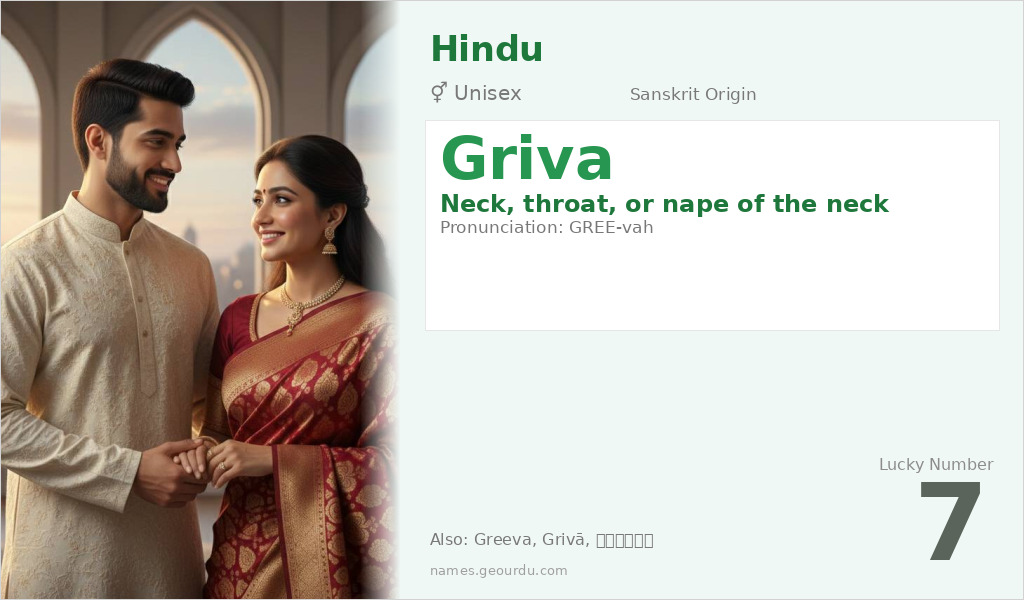
Griva originates from the Sanskrit word ग्रीवा (grīvā), which literally translates to ‘neck,’ ‘throat,’ or ‘nape of the neck.’ In Sanskrit literature, this term appears in classical texts like the Mahabharata and various poetic works, often used both literally and metaphorically. The name is linguistically straightforward without the poetic embellishments sometimes attached to it in modern interpretations. Unlike many Sanskrit names that combine multiple roots, Griva is a simple, direct noun that has been adopted as a personal name. Its usage as a name likely developed from the metaphorical associations of the neck with grace, support, and vocal expression in Indian culture.
| 📛 Name | Griva |
| 💎 Meaning | Neck, throat, or nape of the neck |
| 👤 Gender | Unisex |
| 🕌 Religion | Hindu |
| 🌍 Origin | Sanskrit |
| 🗣 Pronunciation | GREE-vah |
| ✍️ Urdu | گریوا |
| ✍️ Arabic | غريفا |
| 🔢 Numerology | 7 |
| ✨ Spellings | Greeva, Grivā, ग्रीवा |
Origin & Cultural Significance
Griva has its origins in classical Sanskrit, one of the oldest Indo-European languages with documented use dating back over 3,500 years. As a Sanskrit term, it appears in Vedic texts, epic poetry, and classical Indian literature. While the name is used within Hindu communities today, its linguistic origin precedes specific religious associations. The name’s usage as a personal name likely developed from the cultural practice of naming children after body parts or natural features, which is common in many Indian naming traditions. In contemporary India, the name remains relatively rare but continues to be used by families seeking traditional Sanskrit names with clear, meaningful roots.
Personality Traits
In Indian naming traditions, names often carry symbolic personality associations. For Griva, the connection to the neck suggests qualities of support, expression, and grace. The neck serves as both a structural support for the head and a channel for voice, potentially indicating someone who is both strong and communicative. Those named Griva might be perceived as having artistic or musical inclinations, given the throat’s role in singing and speech. These associations, while cultural rather than scientific, reflect how names shape identity in many traditions.
Similar Names
If you like Griva, consider: Kantha, Gala, Gardan, Cervix, Kandhara
Famous People Named Griva
- Griva Prasad — Indian classical musician known for vocal performances
- Griva Sharma — contemporary Indian poet and writer
Frequently Asked Questions About Griva
What does Griva mean?
Griva means 'neck' or 'throat' in Sanskrit, the ancient Indian language. It is a direct noun without additional poetic meanings.
Is Griva a boy or girl name?
Griva can be used for both boys and girls, though it appears more commonly as a feminine name in modern usage. In Sanskrit, the word itself is grammatically feminine but can be applied as a name to any gender.
What is the origin of Griva?
Griva originates from Sanskrit, one of the oldest Indo-European languages. It is specifically derived from the Sanskrit word ग्रीवा (grīvā), meaning 'neck,' and has been used in Indian literature and culture for millennia.