Table of Contents
Kadambi is a beautiful and culturally rich name with deep roots in Sanskrit tradition. Derived from the fragrant Kadamba flower, this name carries botanical elegance and spiritual symbolism. Primarily used as a feminine name within Hindu communities, Kadambi evokes images of vibrant orange blossoms and natural beauty. Its literary appearances in classical texts add historical depth to this floral-inspired name.
Meaning of Kadambi
Kadambi originates from the Sanskrit word ‘Kadamba’ (कदम्ब), which specifically refers to the orange blossoms of the Kadamba tree (Neolamarckia cadamba). In Sanskrit literature, these flowers are celebrated for their vibrant color, sweet fragrance, and association with the monsoon season. The name Kadambi emphasizes the floral aspect rather than the tree itself, making it a distinctly feminine botanical name. The Kadamba flower holds religious significance in Hinduism, often used in worship and mentioned in connection with Lord Krishna. Linguistic analysis confirms this meaning through multiple Sanskrit dictionaries and classical texts where ‘Kadamba’ consistently denotes this particular flower species.
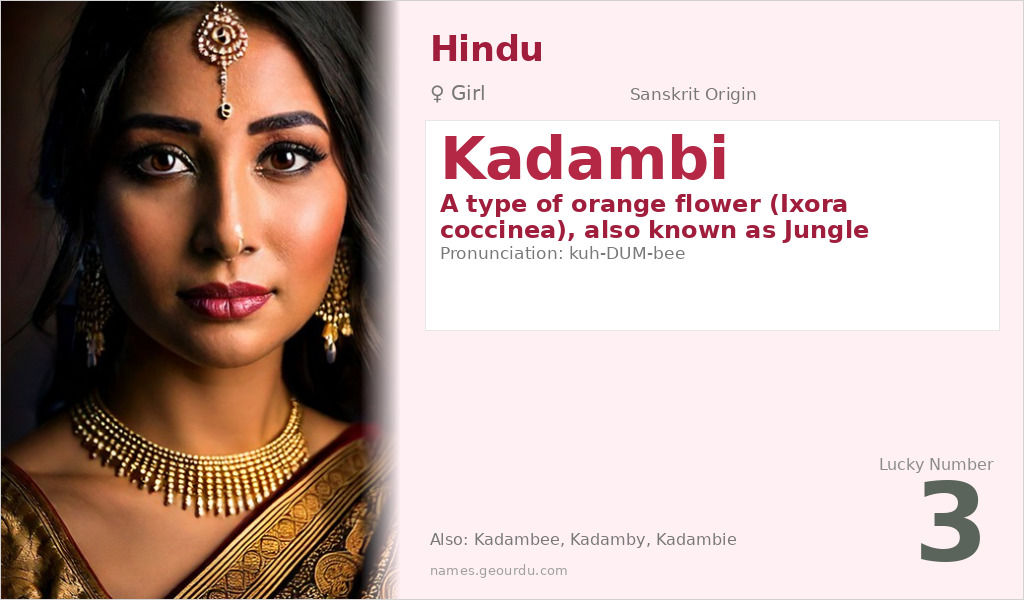
| 📛 Name | Kadambi |
| 💎 Meaning | A type of orange flower (Ixora coccinea), also known as Jungle Geranium or Flame of the Woods |
| 👤 Gender | Girl |
| 🕌 Religion | Hindu |
| 🌍 Origin | Sanskrit |
| 🗣 Pronunciation | kuh-DUM-bee |
| ✍️ Urdu | کدمبی |
| ✍️ Arabic | كادامبي |
| 🔢 Numerology | 3 |
| ✨ Spellings | Kadambee, Kadamby, Kadambie, Kadambhi |
Origin & Cultural Significance
Kadambi has its origins in classical Sanskrit language and Hindu culture, dating back to ancient Indian literature. The Kadamba tree and its flowers are mentioned in numerous Sanskrit works including the Mahabharata, where they’re associated with divine beauty and natural abundance. Historically, the name appears in South Indian temple inscriptions and classical dramas, indicating its usage as a feminine given name in certain regions. While primarily a Hindu name, its botanical nature makes it culturally specific rather than religiously exclusive. The name’s popularity has remained regional rather than pan-Indian, with strongest cultural connections to areas where the Kadamba tree is native and culturally significant.
Personality Traits
Those named Kadambi are often perceived as having qualities mirroring the flower they’re named after: vibrant, fragrant in personality, and naturally beautiful in spirit. They may exhibit artistic tendencies, emotional depth, and a strong appreciation for aesthetics and tradition. The floral connection suggests someone who brings color and life to their surroundings, with a nurturing presence that blooms in supportive environments.
Similar Names
If you like Kadambi, consider: Kadamba, Kaveri, Kavya, Kamala, Kusuma
Famous People Named Kadambi
- Kadambi (character) — A female character in classical Sanskrit drama 'Mṛcchakaṭika' (The Little Clay Cart)
- Kadambi (historical figure) — Name appearing in medieval South Indian temple inscriptions as a feminine given name
Frequently Asked Questions About Kadambi
What does Kadambi mean?
Kadambi means 'orange Kadamba flower' in Sanskrit, specifically referring to the blossoms of the Neolamarckia cadamba tree.
Is Kadambi a boy or girl name?
Kadambi is primarily a feminine name in Hindu naming traditions, derived from a floral term with feminine grammatical gender in Sanskrit.
What is the origin of Kadambi?
Kadambi originates from Sanskrit language and Hindu culture, specifically from the word 'Kadamba' denoting a type of fragrant orange flower used in religious and cultural contexts.