Table of Contents
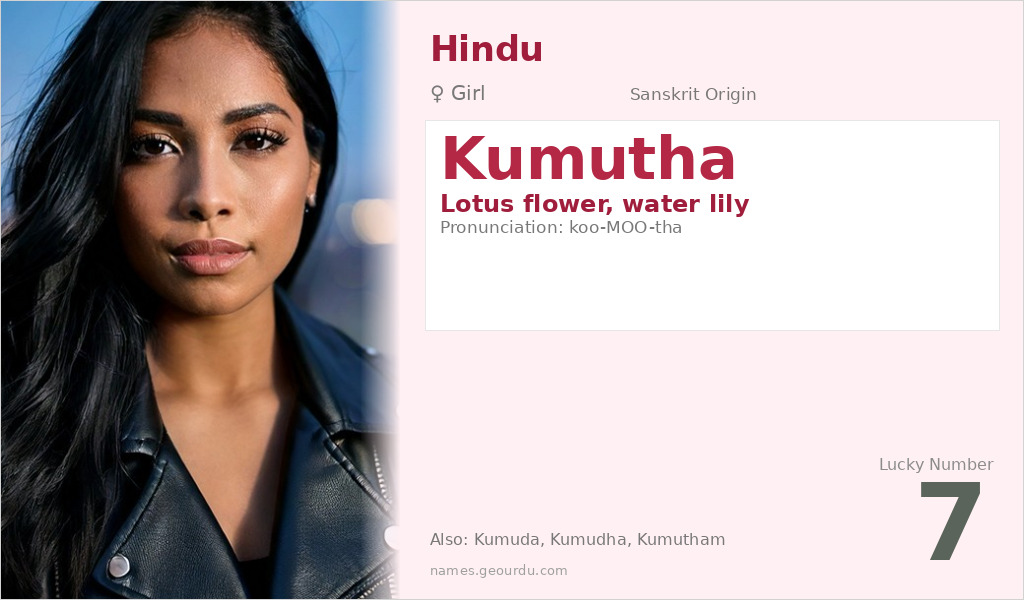
Kumutha is a beautiful Sanskrit name that carries deep cultural and spiritual significance in Hindu tradition. Derived from the word for ‘lotus flower’ or ‘water lily,’ this name evokes images of purity, beauty, and spiritual awakening. Popular particularly in South Indian communities, Kumutha represents the ideal of remaining unstained by worldly impurities while blossoming into one’s full potential. This name connects its bearer to ancient Sanskrit literature and Hindu philosophical traditions.
Meaning of Kumutha
Kumutha originates from the Sanskrit word ‘Kumuda’ (कुमुद), which specifically refers to the white lotus or water lily (Nymphaea alba). In Sanskrit etymology, ‘Ku’ means earth or water, and ‘muda’ means delight or joy, collectively suggesting ‘that which brings joy from the water.’ The lotus holds profound symbolic meaning in Hinduism, Buddhism, and Jainism, representing purity, spiritual enlightenment, and divine beauty. In classical Sanskrit literature, Kumuda appears in works like Kalidasa’s poetry and the Mahabharata, often used metaphorically for beautiful eyes or pure hearts. The name’s Tamil adaptation, Kumutham, maintains the same botanical and symbolic meaning while fitting South Indian linguistic patterns.
| 📛 Name | Kumutha |
| 💎 Meaning | Lotus flower, water lily |
| 👤 Gender | Girl |
| 🕌 Religion | Hindu |
| 🌍 Origin | Sanskrit |
| 🗣 Pronunciation | koo-MOO-tha |
| ✍️ Urdu | کمُوتھا |
| ✍️ Arabic | كوموثا |
| 🔢 Numerology | 7 |
| ✨ Spellings | Kumuda, Kumudha, Kumutham, Kumud |
Origin & Cultural Significance
Kumutha has its roots in ancient Sanskrit, one of the oldest Indo-European languages and the liturgical language of Hinduism. The name appears in classical Hindu texts dating back over two millennia, particularly in poetic descriptions and character names. While used throughout India, it gained particular popularity in Tamil-speaking regions where it was adapted as Kumutham. In Hindu tradition, the lotus (Kumuda) symbolizes the unfolding of spiritual consciousness and is associated with deities like Lakshmi, Vishnu, and Brahma. The name’s usage reflects the cultural importance of nature symbolism in Indian naming traditions, where floral names often carry philosophical and spiritual connotations.
Personality Traits
Those named Kumutha are often perceived as possessing the qualities of their namesake flower—graceful, pure, and spiritually inclined. They tend to approach life with calm deliberation and aesthetic sensitivity, often demonstrating resilience in challenging circumstances. Like the lotus that rises above muddy waters, individuals with this name frequently show an ability to maintain their integrity and positivity despite external difficulties. Their personality often combines practical wisdom with philosophical depth, making them both grounded and spiritually aware.
Similar Names
If you like Kumutha, consider: Kamala, Padma, Padmini, Neeraja, Sarojini
Famous People Named Kumutha
- Kumutha Ramanathan — Malaysian actress and television host known for her work in Tamil-language media
- Kumutha — Character in ancient Sanskrit literature, often representing purity and beauty
Frequently Asked Questions About Kumutha
What does Kumutha mean?
Kumutha means 'lotus flower' or 'water lily' in Sanskrit. It derives from the Sanskrit word 'Kumuda' (कुमुद), which specifically refers to the white lotus (Nymphaea alba).
Is Kumutha a boy or girl name?
Kumutha is primarily a feminine name in Hindu naming tradition. While Sanskrit nouns are grammatically gendered, Kumutha/Kumuda is consistently used as a female name in contemporary practice, though historically it could appear as a descriptive term for anyone beautiful or pure.
What is the origin of Kumutha?
Kumutha originates from Sanskrit, one of the oldest Indo-European languages and the classical language of Hinduism. The name appears in ancient Hindu texts and has been particularly popular in South Indian communities where it was adapted into Tamil as Kumutham.