Table of Contents
Mamatha is a beautiful Sanskrit name that carries profound emotional significance in Hindu culture. Derived from ancient Indian roots, this name embodies the essence of affection, tenderness, and maternal love. Popular across India and among Hindu communities worldwide, Mamatha represents the deep bonds that connect families and loved ones. Its cultural resonance makes it a meaningful choice for parents seeking a name with emotional depth.
Meaning of Mamatha
Mamatha originates from the Sanskrit word ‘mamata’ (ममता), which literally translates to ‘affection’, ‘love’, or ‘tenderness’. The term is composed of ‘mam’ meaning ‘mine’ or ‘my’ and the abstract noun-forming suffix ‘-tā’. In Hindu philosophical contexts, mamata refers to the sense of attachment or possessiveness, particularly the deep bond between mother and child. This name specifically conveys maternal love and emotional connection, distinguishing it from more general terms for love like ‘prema’ or ‘priya’. The concept appears in classical Sanskrit literature and Hindu scriptures, where mamata represents both positive familial bonds and the spiritual challenge of worldly attachment.
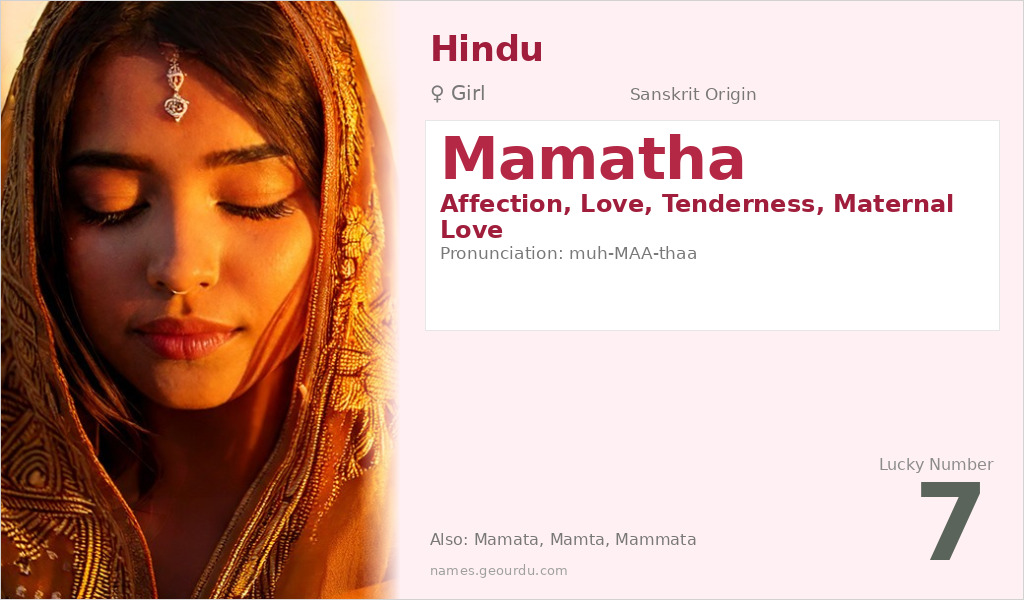
| 📛 Name | Mamatha |
| 💎 Meaning | Affection, Love, Tenderness, Maternal Love |
| 👤 Gender | Girl |
| 🕌 Religion | Hindu |
| 🌍 Origin | Sanskrit |
| 🗣 Pronunciation | muh-MAA-thaa |
| ✍️ Urdu | مامتا |
| ✍️ Arabic | ماماتا |
| 🔢 Numerology | 7 |
| ✨ Spellings | Mamata, Mamta, Mammata |
Origin & Cultural Significance
Mamatha has its roots in ancient Sanskrit, the classical language of Hinduism, Buddhism, and Jainism. As a Sanskrit feminine noun, it entered various Indian languages including Hindi, Bengali, Marathi, and Telugu with consistent meaning. The name gained particular cultural significance through Hindu religious texts and philosophical discussions about attachment (mamata) and detachment (vairagya). While primarily used in Hindu communities, the name’s appeal transcends religious boundaries in South Asia due to its universal emotional resonance. Historical usage shows it appearing in medieval Indian literature and continuing through modern times as both a given name and a common noun for maternal affection.
Personality Traits
Those named Mamatha are often associated with nurturing qualities and emotional intelligence. They typically exhibit strong protective instincts toward family and friends, creating environments of warmth and security. Their compassionate nature makes them excellent listeners and reliable confidants, while their sense of responsibility often leads them to caregiving roles. These individuals balance tenderness with resilience, demonstrating both sensitivity and strength in challenging situations.
Similar Names
If you like Mamatha, consider: Prema, Priya, Anuraga, Sneha, Karuṇa
Famous People Named Mamatha
- Mamata Banerjee — Indian politician and current Chief Minister of West Bengal
- Mamata Mohandas — Indian film actress who works in Malayalam, Tamil, Telugu, and Kannada cinema
Frequently Asked Questions About Mamatha
What does Mamatha mean?
Mamatha means 'affection', 'love', 'tenderness', or specifically 'maternal love' in Sanskrit. It comes from the root 'mam' (mine) with the abstract suffix '-tā', representing the feeling of attachment or possessiveness.
Is Mamatha a boy or girl name?
Mamatha is exclusively a feminine name in all cultural contexts where it is used. In Sanskrit grammar, the '-ā' ending typically indicates feminine gender, and the name has always been associated with female bearers in Hindu tradition.
What is the origin of Mamatha?
Mamatha originates from Sanskrit, the ancient classical language of India. It is a well-documented Sanskrit noun that entered various Indian languages and is primarily associated with Hindu culture, though its emotional meaning has broad appeal across South Asian communities.