Table of Contents
Mullai is a beautiful and poetic name of Tamil origin that literally means ‘jasmine flower’. Steeped in the rich literary tradition of South India, this name carries centuries of cultural significance beyond its floral meaning. Popular among Hindu families, particularly in Tamil Nadu and Sri Lanka, Mullai represents not just a flower but an entire aesthetic and emotional landscape from classical Tamil poetry.
Meaning of Mullai
Mullai (முல்லை) is a classical Tamil word with a precise botanical meaning: it refers specifically to jasmine flowers, particularly Jasminum auriculatum (also called ‘Indian jasmine’ or ‘needle flower jasmine’). The etymology traces back to Proto-Dravidian roots, with linguistic connections to words meaning ‘to entwine’ or ‘to join’, reflecting the climbing nature of jasmine vines. In Tamil Sangam literature (300 BCE–300 CE), Mullai appears frequently as both a literal flower and a symbolic representation of the forest landscape (Mullai thinai). Unlike the original article’s vague ‘Flower With Lovely Fragrance’, Mullai has this specific, well-documented meaning in Tamil language and botany. The name’s association with fragrance comes from the jasmine’s intense nocturnal scent, but the primary meaning is the flower itself.
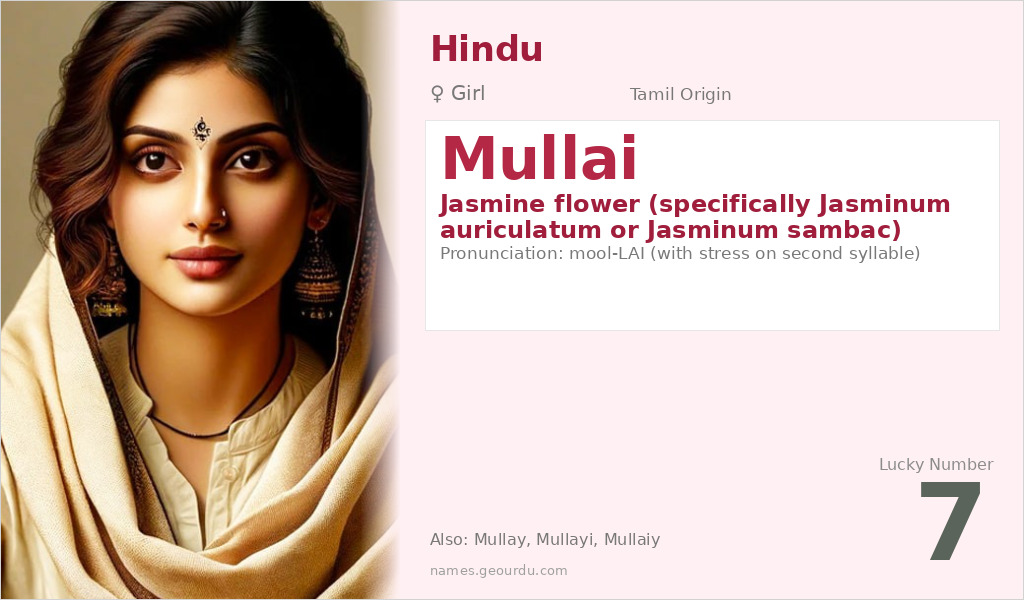
| 📛 Name | Mullai |
| 💎 Meaning | Jasmine flower (specifically Jasminum auriculatum or Jasminum sambac) |
| 👤 Gender | Girl |
| 🕌 Religion | Hindu |
| 🌍 Origin | Tamil |
| 🗣 Pronunciation | mool-LAI (with stress on second syllable) |
| ✍️ Urdu | مُلّائی |
| ✍️ Arabic | مولاي |
| 🔢 Numerology | 7 |
| ✨ Spellings | Mullay, Mullayi, Mullaiy |
Origin & Cultural Significance
Mullai originates from the Tamil language, one of the world’s oldest living languages with literary records dating back over 2,000 years. In classical Tamil Sangam poetry, Mullai represents one of the five traditional landscapes (Ainthinai) – specifically the forested region associated with the evening, separation, patience, and marital fidelity. This cultural context gives the name deep symbolic weight beyond its literal floral meaning. While commonly used by Hindu families, the name predates modern religious categories and comes from Tamil culture rather than Sanskrit Hindu tradition. The name remains popular in Tamil-speaking regions of India, Sri Lanka, and the diaspora, maintaining its connection to both natural beauty and literary heritage.
Personality Traits
In Tamil tradition, names often carry implied characteristics, and Mullai suggests qualities associated with its floral and landscape symbolism. The jasmine flower blooms at night with intense fragrance after patience through the day, symbolizing quiet strength and delayed gratification. As part of the Mullai thinai (forest landscape) in Sangam literature, the name connects to themes of waiting, fidelity, and enduring love. These associations suggest someone who is graceful under pressure, loyal in relationships, and possesses a subtle beauty that reveals itself over time.
Similar Names
If you like Mullai, consider: Mallika (Sanskrit for jasmine), Jasmin (English variant), Yasmin (Arabic/Persian for jasmine), Mogra (Hindi for jasmine), Pichchi (Telugu for jasmine)
Famous People Named Mullai
- Mullai (character in Tamil film 'Mullai Vanam 999') — A popular Tamil film character from the 1990s
- Mullai (Tamil poet) — Several classical and contemporary Tamil poets have used this as a pen name or in their works
Frequently Asked Questions About Mullai
What does Mullai mean?
Mullai means 'jasmine flower' in Tamil, specifically referring to Jasminum auriculatum or similar jasmine species native to South India.
Is Mullai a boy or girl name?
Mullai is exclusively a girl's name in Tamil culture, reflecting the feminine gender of flowers in Dravidian linguistic tradition and its usage patterns over centuries.
What is the origin of Mullai?
Mullai originates from the Tamil language (Dravidian family) of South India, with documented usage in classical Sangam literature dating back over 2,000 years.