
Table of Contents
Nag is a powerful name with deep roots in South Asian mythology and spirituality. Derived from the Sanskrit word for ‘snake’ or ‘serpent’, this name carries centuries of cultural significance. Unlike ordinary snake references, Nag connects to divine nāga beings worshipped in Hindu and Buddhist traditions. Whether chosen for its mythological resonance or symbolic meaning, Nag remains a distinctive choice with rich heritage.
Meaning of Nag
Nag comes directly from the Sanskrit term ‘nāga’ (नाग), which translates to ‘snake’, ‘serpent’, or specifically ‘cobra’. In Sanskrit literature and Hindu mythology, nāgas are not ordinary reptiles but semi-divine beings with supernatural powers, often depicted as guardians of treasures, water sources, and the underworld. The word appears in ancient texts like the Mahabharata and Puranas, where nāgas like Shesha, Vasuki, and Takshaka play significant roles. Linguistically, the term has cognates in other Indo-European languages through the Proto-Indo-European root *sneg- meaning ‘to crawl’ or ‘creep’, though the Sanskrit form is distinctly South Asian in its mythological development.
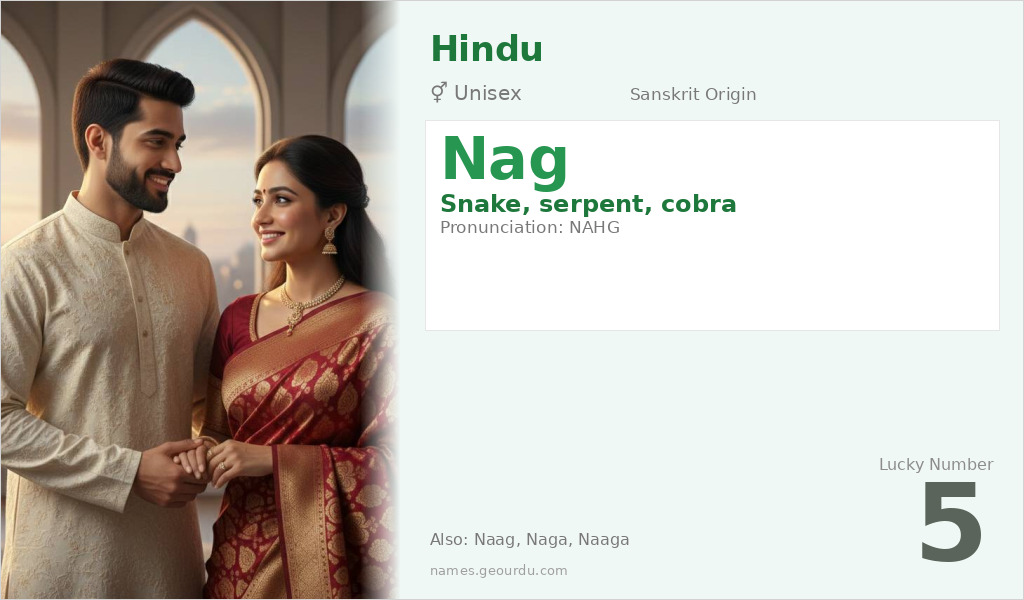
| 📛 Name | Nag |
| 💎 Meaning | Snake, serpent, cobra |
| 👤 Gender | Unisex |
| 🕌 Religion | Hindu |
| 🌍 Origin | Sanskrit |
| 🗣 Pronunciation | NAHG |
| ✍️ Urdu | ناگ |
| ✍️ Arabic | ناغ |
| 🔢 Numerology | 5 |
| ✨ Spellings | Naag, Naga, Naaga |
Origin & Cultural Significance
The name Nag originates from ancient Sanskrit and Hindu traditions, where nāgas occupy an important place in mythology and folklore. These serpent deities are worshipped across India, Nepal, and Southeast Asia as protectors and bringers of rain. Historically, several Indian dynasties and tribal groups have claimed nāga ancestry or used nāga symbolism in their heraldry. In contemporary usage, Nag is found primarily among Hindu communities in India, though it also appears in Buddhist contexts in countries like Sri Lanka, Thailand, and Cambodia. The name’s unisex nature reflects its mythological usage for both male and female nāga beings.
Personality Traits
In naming traditions, Nag suggests qualities associated with its serpentine symbolism: wisdom, transformation, protection, and hidden power. Those named Nag might be seen as intuitive individuals with strong survival instincts and the ability to adapt to changing circumstances. The mythological connection implies spiritual depth and a connection to ancient knowledge, while the snake symbolism can represent both creative energy and protective fierceness.
Similar Names
If you like Nag, consider: Nagendra, Nagina, Nagraj, Vasuki, Shesh
Famous People Named Nag
- Nag (born Nageshwara Rao Akkineni) — Legendary Indian actor and producer in Telugu cinema, considered one of the founding pillars of the South Indian film industry
- Nagavalli — Mythological nāga princess in Hindu and Buddhist traditions, often depicted in temple sculptures and literature
Frequently Asked Questions About Nag
What does Nag mean?
Nag means 'snake', 'serpent', or 'cobra' in Sanskrit, specifically referring to the divine or semi-divine nāga beings of Hindu and Buddhist mythology.
Is Nag a boy or girl name?
Nag is historically a unisex name in Hindu tradition, used for both males and females, though in modern times it may be more commonly given to boys in some regions.
What is the origin of Nag?
Nag originates from Sanskrit and Hindu mythology, with the word 'nāga' appearing in ancient Indian texts dating back thousands of years.