Table of Contents
Padmaroopa is an exquisite Sanskrit name that carries the poetic imagery of lotus-like beauty and purity. Primarily used for girls in Hindu families, this name embodies one of the most cherished symbols in Indian spirituality and aesthetics. With its roots in classical Sanskrit literature, Padmaroopa represents not just physical beauty but spiritual awakening and divine grace. This name continues to inspire parents seeking a meaningful connection to India’s rich cultural heritage.
Meaning of Padmaroopa
Padmaroopa derives from the Sanskrit words ‘padma’ (lotus) and ‘roopa’ (form or appearance), creating a compound meaning ‘one who has the form of a lotus’ or ‘lotus-like in essence’. The lotus holds immense symbolic weight across Dharmic traditions, representing purity, beauty, spiritual enlightenment, and divine birth despite growing in muddy waters. In Hindu iconography, deities like Lakshmi, Vishnu, and Brahma are often depicted with lotus associations. The name appears in various Hindu texts and classical literature, describing beings with lotus-like qualities. Linguistically, it follows Sanskrit’s sophisticated compound word formation, specifically as a bahuvrihi compound indicating possession of a particular characteristic.
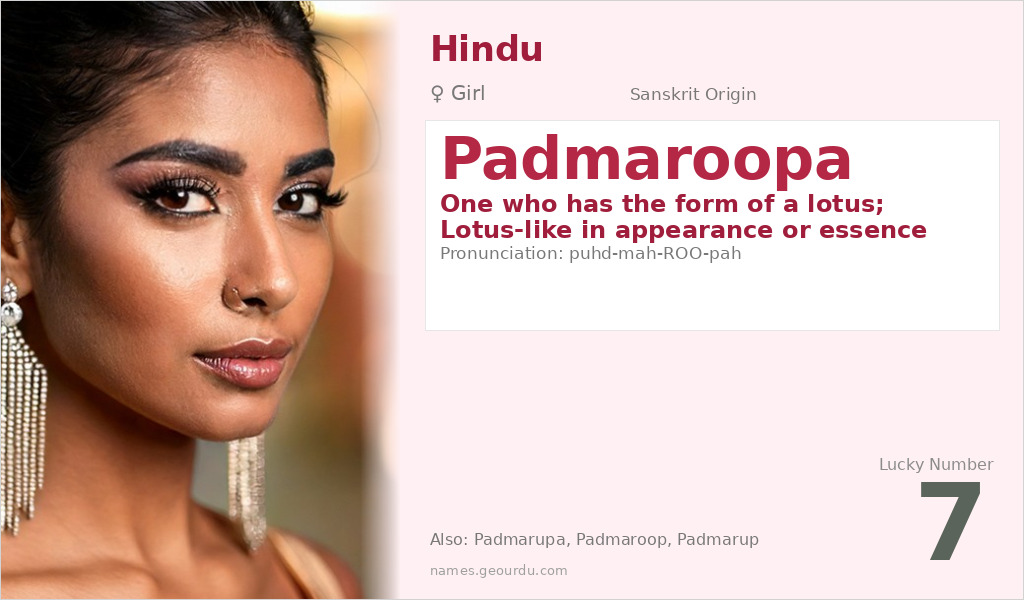
| 📛 Name | Padmaroopa |
| 💎 Meaning | One who has the form of a lotus; Lotus-like in appearance or essence |
| 👤 Gender | Girl |
| 🕌 Religion | Hindu |
| 🌍 Origin | Sanskrit |
| 🗣 Pronunciation | puhd-mah-ROO-pah |
| ✍️ Urdu | پدماروپا |
| ✍️ Arabic | بادماروبا |
| 🔢 Numerology | 7 |
| ✨ Spellings | Padmarupa, Padmaroop, Padmarup |
Origin & Cultural Significance
Padmaroopa originates from classical Sanskrit, the ancient liturgical language of Hinduism, Buddhism, and Jainism. As a compound name, it reflects the sophisticated linguistic traditions of India where meaningful elements combine to create poetic names. The name is predominantly used within Hindu communities across India, particularly in regions with strong Sanskrit traditions like Karnataka, Tamil Nadu, Maharashtra, and Uttar Pradesh. While primarily a Hindu name, the lotus symbolism makes it appreciated across Buddhist and Jain communities as well. The name’s usage spans centuries, appearing in classical literature, religious texts, and continuing in modern times as parents seek names with deep cultural and spiritual resonance.
Personality Traits
Those named Padmaroopa are often perceived as embodying the qualities of the lotus itself—graceful, pure, and spiritually inclined. They tend to exhibit calm composure and inner strength, able to maintain beauty and dignity even in challenging circumstances. With artistic sensibilities and a contemplative nature, they often gravitate toward creative or spiritual pursuits. Their presence is typically described as soothing and uplifting, much like the lotus flower that brings beauty to its surroundings.
Similar Names
If you like Padmaroopa, consider: Padmavati, Padmalaya, Padmasri, Kamalini, Padmini
Famous People Named Padmaroopa
- Padmaroopa — Indian classical dancer and choreographer known for Bharatanatyam performances
- Padmaroopa — Character in Hindu mythology and literature, often representing divine feminine beauty
Frequently Asked Questions About Padmaroopa
What does Padmaroopa mean?
Padmaroopa means 'one who has the form of a lotus' or 'lotus-like in appearance/essence'. It is a Sanskrit compound name from 'padma' (lotus) and 'roopa' (form).
Is Padmaroopa a boy or girl name?
Padmaroopa is primarily a feminine name in Hindu naming traditions, though Sanskrit names can sometimes be gender-neutral in different contexts. In contemporary usage, it is almost exclusively given to girls.
What is the origin of Padmaroopa?
Padmaroopa originates from Sanskrit, the classical language of ancient India. It is a compound name deeply rooted in Hindu culture and symbolism, with the lotus representing purity, beauty, and spiritual awakening in Dharmic traditions.