Table of Contents
Nina is a beautifully versatile name with rich cultural roots spanning continents and languages. From Spanish-speaking countries to Eastern Europe and beyond, this name carries different but equally meaningful interpretations. Its global popularity reflects its timeless appeal and cross-cultural adaptability.
Meaning of Nina
The name Nina derives from multiple linguistic sources, each with distinct meanings. In Spanish, it comes from ‘niña,’ meaning ‘little girl’ or ‘daughter,’ functioning as both a given name and a term of endearment. In Hebrew tradition, it’s considered a variant of names meaning ‘grace’ or ‘God is gracious,’ related to Hannah/Anna. Slavic versions trace back to Saint Nino, the 4th-century evangelist who brought Christianity to Georgia. Additionally, in Quechua (Native American languages of the Andes), Nina means ‘fire’ or ‘mighty,’ while in Persian, it signifies ‘nice’ or ‘pleasant.’ This diversity makes Nina truly multicultural.
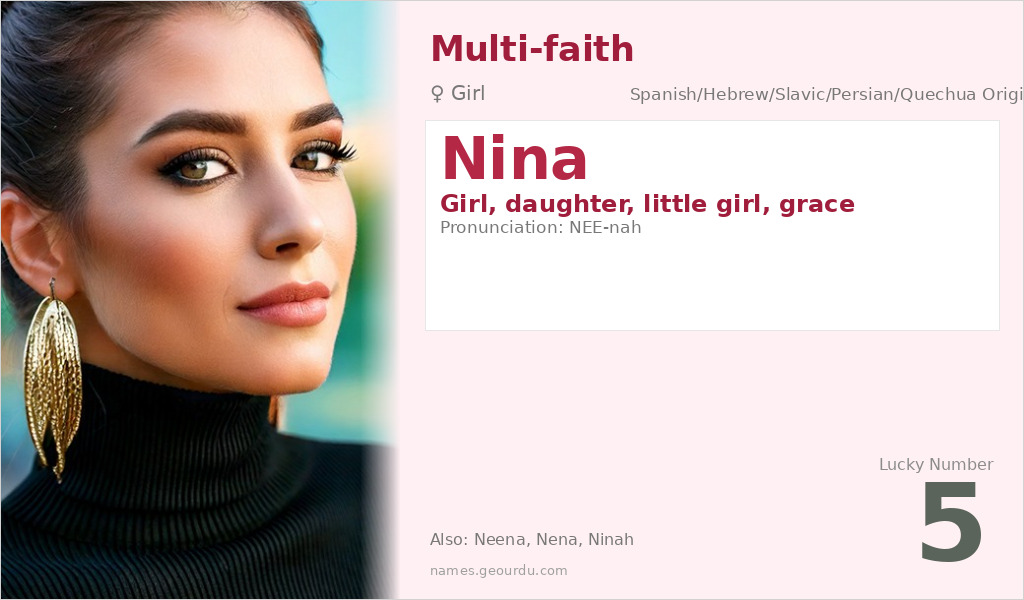
| 📛 Name | Nina |
| 💎 Meaning | Girl, daughter, little girl, grace |
| 👤 Gender | Girl |
| 🕌 Religion | Multi-faith |
| 🌍 Origin | Spanish/Hebrew/Slavic/Persian/Quechua |
| 🗣 Pronunciation | NEE-nah |
| ✍️ Urdu | نینا |
| ✍️ Arabic | نينا |
| 🔢 Numerology | 5 |
| ✨ Spellings | Neena, Nena, Ninah, Nyna |
Origin & Cultural Significance
Nina’s origins are remarkably global. The Spanish version emerged as a diminutive of ‘niña’ and became popular throughout Latin America and Spain. The Hebrew variant developed independently through Jewish naming traditions. The Slavic version gained prominence through Eastern Orthodox Christianity, particularly in Russia and Georgia where Saint Nino is venerated. The Persian interpretation appears in Iranian and Central Asian cultures, while the Quechua meaning originates from indigenous South American languages. This cross-cultural journey explains why Nina appears in so many different naming traditions worldwide.
Personality Traits
People named Nina often exhibit traits associated with exploration and communication. Their numerological association with number 5 suggests adaptability, curiosity, and a love for freedom. They typically possess artistic sensibilities and social intelligence, making them effective communicators who can navigate diverse social situations with grace and charm.
Similar Names
If you like Nina, consider: Nia, Nora, Lina, Mina, Anina
Famous People Named Nina
- Nina Simone — American singer, songwriter and civil rights activist
- Nina Dobrev — Bulgarian-Canadian actress known for 'The Vampire Diaries'
Frequently Asked Questions About Nina
What does Nina mean?
Nina has multiple meanings depending on origin: 'little girl' in Spanish, 'grace' in Hebrew, and 'fire' in Quechua (Native American). It also means 'nice' in Persian and has Christian significance in Slavic cultures through Saint Nino.
Is Nina a boy or girl name?
Nina is almost exclusively a feminine name across all cultures where it appears, though spelling variations exist. The meaning 'little girl' in Spanish and its use as a feminine diminutive reinforce its gender association.
What is the origin of Nina?
Nina has multiple independent origins: Spanish (from 'niña'), Hebrew (as a variant of grace-related names), Slavic (from Saint Nino), Persian (meaning 'nice'), and Quechua (meaning 'fire'). It's truly a multicultural name.