Table of Contents
Nirmalakumari is a beautiful and meaningful Sanskrit name for girls that combines two elegant elements: ‘nirmala’ meaning pure, and ‘kumari’ meaning maiden or princess. This classical name has been cherished in Hindu communities for generations, embodying ideals of purity, grace, and virtue. With its poetic construction and profound meaning, Nirmalakumari represents a timeless choice that connects modern naming with ancient linguistic traditions. The name continues to be used in India and among Hindu diaspora communities worldwide.
Meaning of Nirmalakumari
Nirmalakumari is a compound Sanskrit name with a clear and well-documented meaning. The first component, ‘Nirmala,’ derives from the Sanskrit roots ‘nir’ (without) and ‘mala’ (impurity, dirt, stain), literally meaning ‘without impurity’ or ‘completely clean.’ This word appears in classical Sanskrit literature and religious texts to describe purity in both physical and spiritual contexts. The second component, ‘Kumari,’ comes from the Sanskrit word for a young girl, maiden, or princess, often used as an honorific. When combined, Nirmalakumari creates a poetic name meaning ‘pure maiden,’ ‘pure princess,’ or ‘pure daughter,’ suggesting someone of impeccable character and grace. The name follows traditional Sanskrit compounding patterns where descriptive adjectives modify nouns to create meaningful personal names.
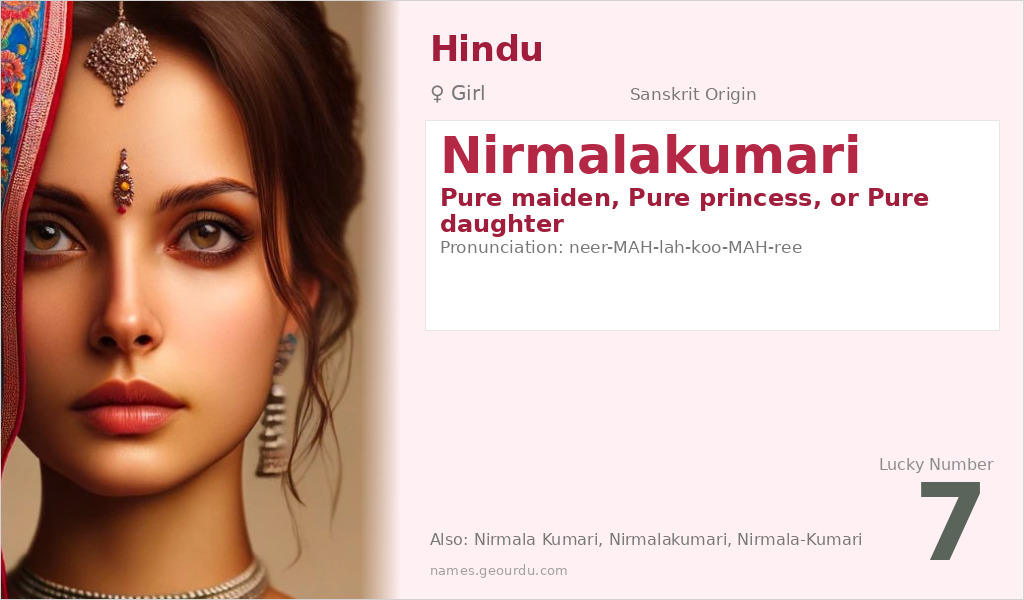
| 📛 Name | Nirmalakumari |
| 💎 Meaning | Pure maiden, Pure princess, or Pure daughter |
| 👤 Gender | Girl |
| 🕌 Religion | Hindu |
| 🌍 Origin | Sanskrit |
| 🗣 Pronunciation | neer-MAH-lah-koo-MAH-ree |
| ✍️ Urdu | نرملا کماری |
| ✍️ Arabic | نيرمالاكوماري |
| 🔢 Numerology | 7 |
| ✨ Spellings | Nirmala Kumari, Nirmalakumari, Nirmala-Kumari |
Origin & Cultural Significance
Nirmalakumari originates from classical Sanskrit, the ancient liturgical language of Hinduism that has influenced numerous Indian languages. As a compound name, it represents a traditional naming practice in Hindu culture where meaningful elements are combined to create names with specific virtues or qualities. The name is particularly associated with Hindu communities in India, especially in regions where Sanskrit-derived names are common, including South India where compound names ending in ‘kumari’ are traditional. While not among the most common names, Nirmalakumari appears in historical records, literature, and continues to be used by families seeking names with deep cultural and linguistic roots. The name reflects the enduring influence of Sanskrit on Indian naming traditions centuries after the language ceased to be a spoken vernacular.
Personality Traits
The name Nirmalakumari suggests personality traits aligned with its meaning of purity and grace. Those bearing this name are often perceived as having a clean, honest character with straightforward intentions. They may exhibit a natural elegance and dignity in their demeanor, combined with traditional values and a respectful approach to relationships. The ‘kumari’ element adds a sense of youthful vitality and nobility to the purity implied by ‘nirmala,’ creating a balanced personality profile.
Similar Names
If you like Nirmalakumari, consider: Nirmala, Kumari, Shubhalakshmi, Pavitra, Saraswati, Lakshmikumari, Shantikumari
Famous People Named Nirmalakumari
- Nirmalakumari — Indian classical dancer and choreographer from Kerala
- Nirmalakumari — Character in traditional Indian literature and folklore
Frequently Asked Questions About Nirmalakumari
What does Nirmalakumari mean?
Nirmalakumari means 'pure maiden' or 'pure princess' in Sanskrit. It is a compound name combining 'nirmala' (pure, without impurity) and 'kumari' (maiden, princess, young girl).
Is Nirmalakumari a boy or girl name?
Nirmalakumari is exclusively a girl's name in Hindu naming tradition. The 'kumari' component specifically means 'maiden' or 'young girl,' making it feminine by construction.
What is the origin of Nirmalakumari?
Nirmalakumari originates from classical Sanskrit, the ancient language of Hindu scriptures. It is a traditional compound name used primarily in Hindu communities, particularly in India where Sanskrit-derived names are culturally significant.