
Table of Contents
Plava is a distinctive name with deep roots in Sanskrit language and Hindu culture. Meaning ‘floating’ or ‘swimming’, this name carries aquatic symbolism and natural elegance. While uncommon as a personal name today, it represents an important concept in ancient Indian thought. Discover the rich linguistic heritage and cultural significance behind this meaningful appellation.
Meaning of Plava
Plava originates from the Sanskrit word प्लव (plava), which fundamentally means ‘floating’, ‘swimming’, or ‘moving on water’. The term derives from the Sanskrit root ‘plu’ (प्लु), meaning ‘to float, to swim, to move through liquid’. In classical Sanskrit literature, ‘plava’ appears in various contexts: describing boats navigating rivers, aquatic birds like ducks floating on ponds, and certain types of floating vegetation. The word also has astronomical significance in Vedic texts, where ‘Plava’ appears as a year name in the 60-year Jupiter cycle. While sometimes translated as ‘a kind of tree’, this refers specifically to aquatic plants like water hyacinth that float on water surfaces, not terrestrial trees.
| 📛 Name | Plava |
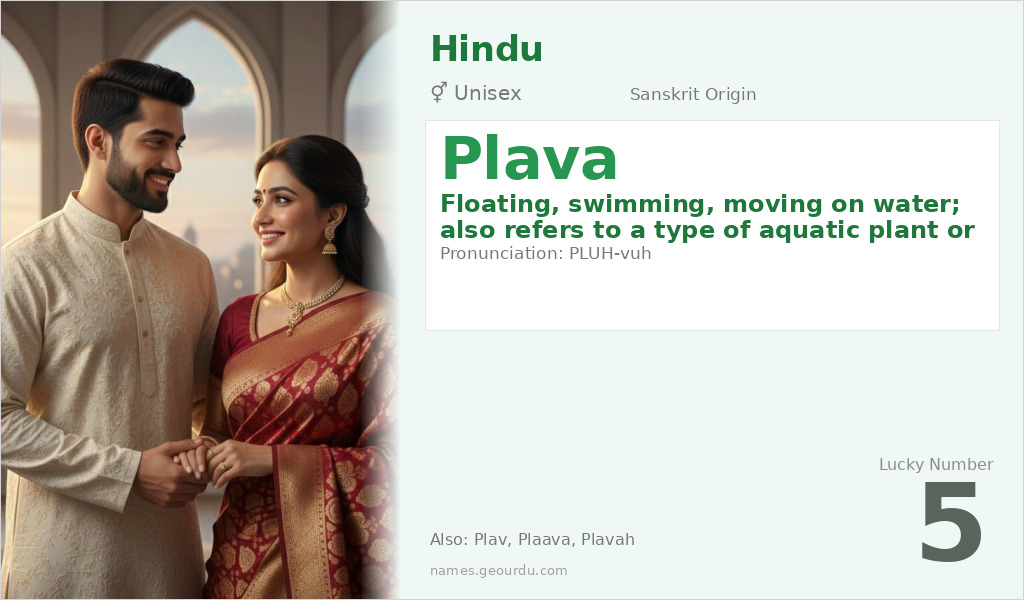
| 💎 Meaning | Floating, swimming, moving on water; also refers to a type of aquatic plant or floating vegetation |
| 👤 Gender | Unisex |
| 🕌 Religion | Hindu |
| 🌍 Origin | Sanskrit |
| 🗣 Pronunciation | PLUH-vuh |
| ✍️ Urdu | پلاوا |
| ✍️ Arabic | بلافا |
| 🔢 Numerology | 5 |
| ✨ Spellings | Plav, Plaava, Plavah |
Origin & Cultural Significance
Plava has its origins in ancient Sanskrit, the classical language of India that dates back over 3,500 years. As a concept, it appears in numerous Hindu scriptures including the Mahabharata, where it describes floating objects and movement across waters. In Ayurvedic medicine, certain ‘plava’ plants were used for their medicinal properties. While primarily a descriptive term rather than a common personal name historically, it represents important natural phenomena in Hindu philosophy. The name connects to water symbolism that appears throughout Hindu mythology, from the primordial waters of creation to sacred rivers like the Ganges. Its usage reflects the Sanskrit language’s precise categorization of natural phenomena.
Personality Traits
Those named Plava are often perceived as adaptable and fluid in their approach to life, mirroring the water symbolism of their name. They typically demonstrate emotional intelligence and the ability to navigate changing circumstances with grace. Their personality combines depth with transparency, and they often excel in situations requiring flexibility and creative problem-solving. Like water finding its level, they possess natural equilibrium and intuitive understanding of their environment.
Similar Names
If you like Plava, consider: Plavan, Plavini, Plavana, Taranga, Nimna
Famous People Named Plava
- No widely known contemporary figures with this name found in records
- Historical references to 'Plava' appear in Sanskrit literature as descriptive terms rather than personal names
Frequently Asked Questions About Plava
What does Plava mean?
Plava means 'floating', 'swimming', or 'moving on water' in Sanskrit. It can also refer to aquatic plants that float on water surfaces.
Is Plava a boy or girl name?
Plava is historically a unisex name in Sanskrit tradition, though in modern usage it might be given to any gender. The original Sanskrit word is grammatically masculine but used conceptually for all genders.
What is the origin of Plava?
Plava originates from Sanskrit, the ancient classical language of India. It appears in Hindu scriptures dating back thousands of years as a descriptive term for floating objects and aquatic phenomena.