Table of Contents
Princess is a name that carries immediate regal connotations, evoking images of royalty, grace, and nobility. While traditionally a title rather than a given name, it has gained popularity as a feminine name in modern times, particularly in English-speaking countries. This name embodies elegance and status, making it a distinctive choice for parents seeking a name with royal flair. Its adoption as a personal name reflects contemporary naming trends that embrace aspirational and symbolic meanings.
Meaning of Princess
The name Princess has a clear and well-documented etymology tracing back to Latin and French roots. It originates from the Old French word ‘princesse’, which entered English in the 14th century. This French term derives from the Latin ‘princeps’, meaning ‘first, chief, or sovereign’, composed of ‘primus’ (first) and ‘capere’ (to take). As a feminine form, Princess specifically denotes a female member of royalty, typically the daughter or wife of a king or queen. Unlike many traditional given names that evolved from descriptive terms or virtues, Princess began as an official title that was later adopted as a personal name, particularly in the 20th and 21st centuries in Western cultures.
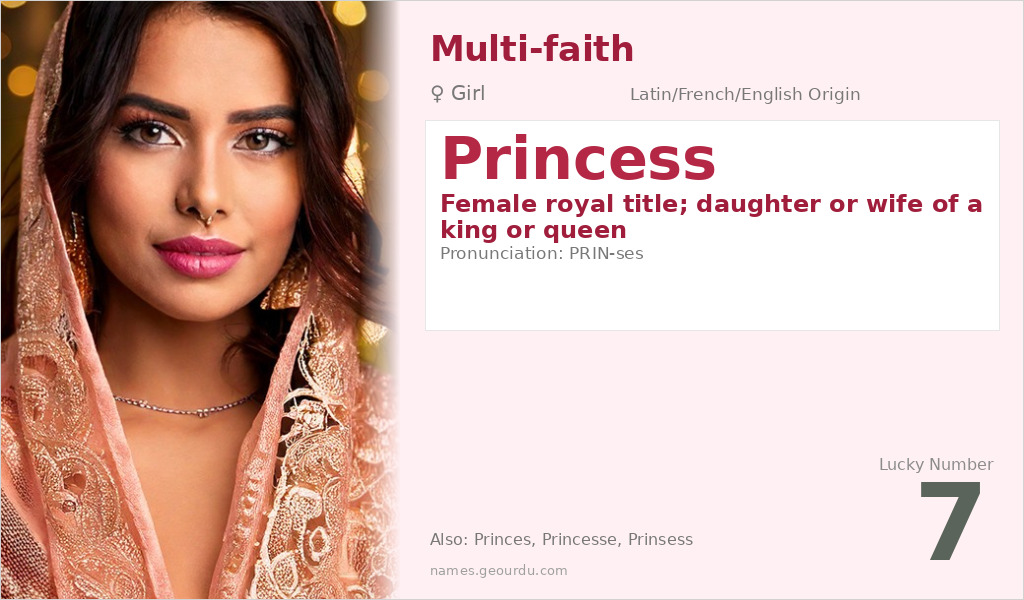
| 📛 Name | Princess |
| 💎 Meaning | Female royal title; daughter or wife of a king or queen |
| 👤 Gender | Girl |
| 🕌 Religion | Multi-faith |
| 🌍 Origin | Latin/French/English |
| 🗣 Pronunciation | PRIN-ses |
| ✍️ Urdu | شہزادی |
| ✍️ Arabic | أميرة |
| 🔢 Numerology | 7 |
| ✨ Spellings | Princes, Princesse, Prinsess |
Origin & Cultural Significance
Princess originated as a royal title in European monarchies, with linguistic roots in Latin through French. It was not traditionally used as a personal name in historical contexts but rather as an honorific for female royalty. The adoption of Princess as a given name began in English-speaking countries during the 20th century, influenced by celebrity usage and changing naming conventions. This represents a modern naming trend where titles, occupations, and abstract concepts become personal names. While the name has no specific religious origins, it has been used by families of various faiths who appreciate its regal connotations and elegant sound.
Personality Traits
Those named Princess often develop personality traits that align with their name’s royal associations. They may exhibit natural confidence, leadership qualities, and a sense of dignity in their interactions. The name can inspire high self-esteem and ambitious goals, as bearers often feel motivated to live up to its noble implications. While individual personalities vary, the name Princess tends to encourage grace, poise, and a certain regal bearing in its owners.
Similar Names
If you like Princess, consider: Prince, Regina, Royale, Queen, Duchess
Famous People Named Princess
- Princess Diana — Former Princess of Wales and humanitarian icon
- Princess Beatrice — Member of the British royal family
- Princess Nokia — American rapper and singer
- Princess Margaret — Countess of Snowdon and sister of Queen Elizabeth II
Frequently Asked Questions About Princess
What does Princess mean?
Princess means 'female royal' or 'daughter/wife of a king/queen'. It originates from the Latin word 'princeps' through Old French 'princesse', with roots meaning 'first' and 'to take'.
Is Princess a boy or girl name?
Princess is exclusively a girl's name, being the feminine form of the royal title. The masculine equivalent is 'Prince', which is also used as a given name.
What is the origin of Princess?
Princess originates from Latin and French linguistic traditions as a royal title. It entered English from Old French 'princesse', which derived from Latin 'princeps'. It has been adopted as a personal name primarily in English-speaking cultures.