
Table of Contents
Pamela is a beautifully melodic name that has graced generations of girls since its literary debut in the 16th century. Created from ancient Greek elements meaning ‘all honey’, this name evokes sweetness and charm. While often used globally including in India, its origins are firmly rooted in Western literature rather than Eastern traditions. Discover the fascinating journey of this invented name that became a worldwide favorite.
Meaning of Pamela
Pamela’s meaning derives directly from its constructed Greek etymology: combining πᾶν (pan), meaning ‘all’ or ‘every’, with μέλι (meli), meaning ‘honey’. Thus, the name literally translates to ‘all honey’ or ‘all sweetness’. This poetic construction was intentional by Sir Philip Sidney, who sought a name that embodied pastoral idealization in his romance ‘Arcadia’. The honey reference carries connotations of natural sweetness, pleasantness, and desirability. Unlike organic names that evolved through language development, Pamela represents a rare case of a successfully invented name with transparent, meaningful components.
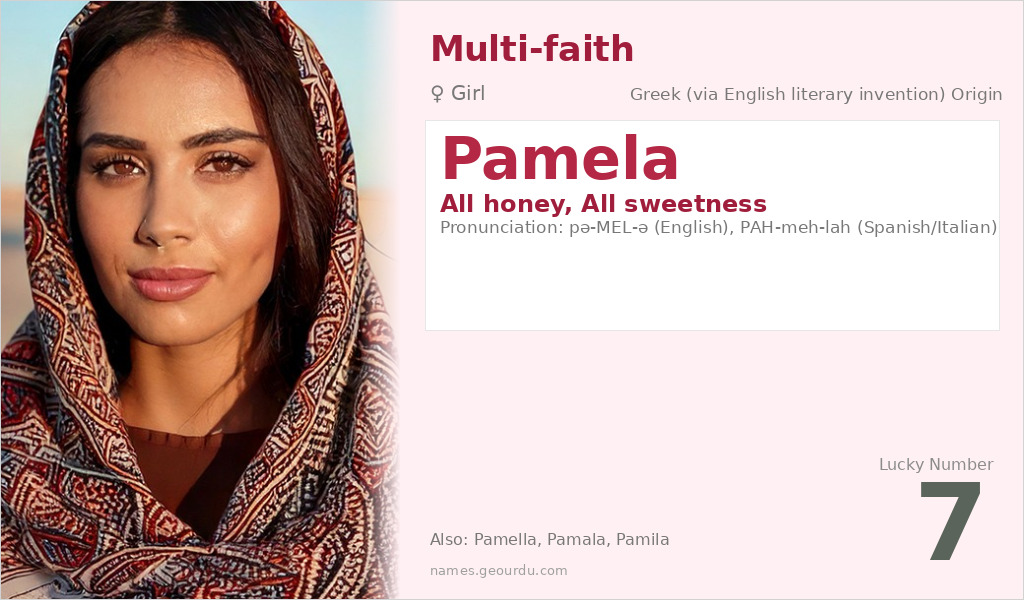
| 📛 Name | Pamela |
| 💎 Meaning | All honey, All sweetness |
| 👤 Gender | Girl |
| 🕌 Religion | Multi-faith |
| 🌍 Origin | Greek (via English literary invention) |
| 🗣 Pronunciation | pə-MEL-ə (English), PAH-meh-lah (Spanish/Italian) |
| ✍️ Urdu | پیملا |
| ✍️ Arabic | باميلا |
| 🔢 Numerology | 7 |
| ✨ Spellings | Pamella, Pamala, Pamila |
Origin & Cultural Significance
Pamela originated not from any traditional naming culture but from English literary invention. Sir Philip Sidney first used it in his 1590 work ‘Arcadia’ for a shepherdess character. The name remained obscure until Samuel Richardson’s 1740 novel ‘Pamela; or, Virtue Rewarded’ catapulted it to popularity. From England, it spread throughout the English-speaking world and eventually to other cultures through colonialism and globalization. While used by some Hindu families in India, this represents cultural adoption rather than indigenous origin, similar to how Western names like Linda or Jessica are used globally without connection to local traditions.
Personality Traits
Those named Pamela often embody the sweetness suggested by their name’s meaning, displaying warmth, grace, and social intelligence. They tend to be diplomatic communicators who value harmony in relationships. With creative inclinations and intuitive understanding of others, Pamelas often excel in fields requiring interpersonal skills and aesthetic sensibility. The name’s literary origins may also contribute to an appreciation for culture, storytelling, and refined expression.
Similar Names
If you like Pamela, consider: Melissa, Deborah, Dulcie, Miel, Melia
Famous People Named Pamela
- Pamela Anderson — Canadian-American actress and model known for 'Baywatch'
- Pamela Harriman — British-American diplomat and socialite who served as U.S. Ambassador to France
Frequently Asked Questions About Pamela
What does Pamela mean?
Pamela means 'all honey' or 'all sweetness', derived from Greek πᾶν (pan) meaning 'all' and μέλι (meli) meaning 'honey'.
Is Pamela a boy or girl name?
Pamela is exclusively a feminine name, created for female characters in literature and consistently used for girls since the 16th century.
What is the origin of Pamela?
Pamela originated in English literature, invented by Sir Philip Sidney in 1590 from Greek elements, then popularized by Samuel Richardson's 1740 novel 'Pamela; or, Virtue Rewarded'.





