
Table of Contents
Saguna is a profound name with deep roots in Hindu philosophy and Sanskrit language. Unlike many names that simply describe physical traits or wishes, Saguna carries significant metaphysical meaning related to the nature of reality itself. This name represents the concept of the divine with attributes, making it both a beautiful personal name and a philosophical statement. Whether chosen for a boy or girl, Saguna connects the bearer to ancient Indian wisdom traditions.
Meaning of Saguna
Saguna originates from the Sanskrit language, combining ‘sa-‘ meaning ‘with’ or ‘possessing’ and ‘guna’ meaning ‘quality’, ‘attribute’, or ‘characteristic’. In Hindu philosophical systems, particularly Advaita Vedanta, Saguna Brahman refers to the ultimate reality (Brahman) as perceived with attributes, in contrast to Nirguna Brahman which is without attributes. The term appears in foundational texts like the Upanishads, where it describes the personal aspect of the divine that can be worshipped and related to. As a personal name, Saguna signifies someone who embodies discernible qualities and characteristics, suggesting a person of substance and defined personality. The name carries connotations of manifestation, form, and the expression of inner virtues in outward being.
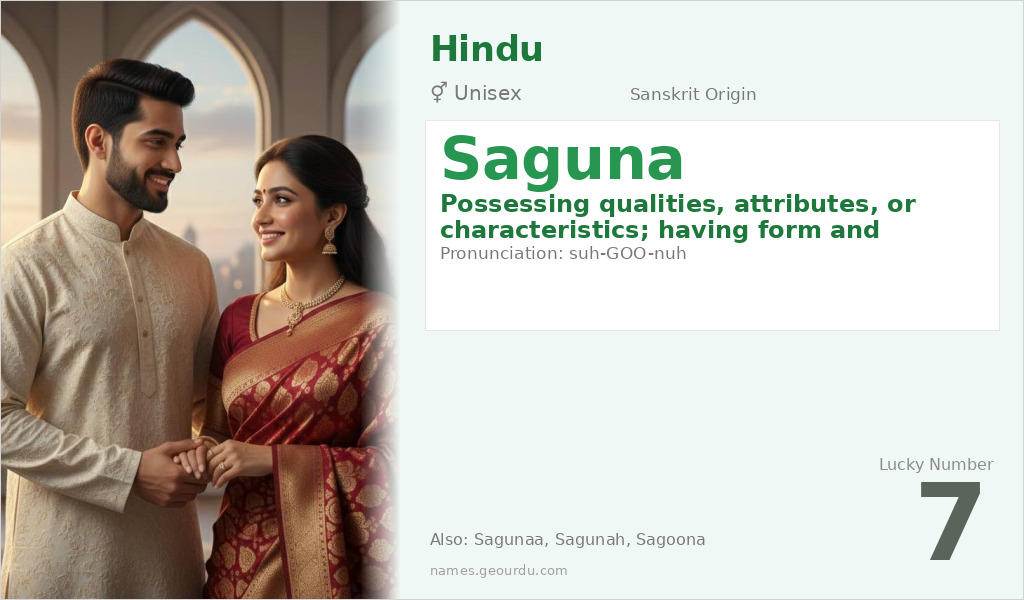
| 📛 Name | Saguna |
| 💎 Meaning | Possessing qualities, attributes, or characteristics; having form and qualities (as opposed to Nirguna which means without qualities) |
| 👤 Gender | Unisex |
| 🕌 Religion | Hindu |
| 🌍 Origin | Sanskrit |
| 🗣 Pronunciation | suh-GOO-nuh |
| ✍️ Urdu | سگن |
| ✍️ Arabic | ساغونا |
| 🔢 Numerology | 7 |
| ✨ Spellings | Sagunaa, Sagunah, Sagoona |
Origin & Cultural Significance
Saguna has its origins in ancient India, specifically within the Sanskrit linguistic and philosophical tradition. The concept of Saguna versus Nirguna is central to Hindu theology, particularly in schools like Advaita Vedanta where it describes different aspects of Brahman. While commonly used in philosophical contexts, Saguna has been adopted as a personal name primarily within Hindu communities in India, Nepal, and the diaspora. The name reflects the deep integration of philosophical concepts into personal identity within Hindu culture. Unlike many names that originate from deities or natural elements, Saguna comes directly from metaphysical terminology, making it particularly meaningful for families with philosophical or spiritual inclinations.
Personality Traits
Those named Saguna often carry the philosophical weight of their name in their approach to life. They tend to be individuals who manifest their inner qualities outwardly, making them perceptible and substantial in their interactions. The name suggests balance between having defined characteristics while maintaining depth beyond surface appearances. In social contexts, people named Saguna are often seen as grounded, reliable, and possessing discernible virtues that others can appreciate and relate to.
Similar Names
If you like Saguna, consider: Guna, Gunavati, Gunjan, Saguna-Nirguna, Gunendra
Famous People Named Saguna
- Saguna Shah — Nepali actress known for her work in Nepali cinema and television
- Saguna — Character in Hindu mythology and literature representing the concept of divine with attributes
Frequently Asked Questions About Saguna
What does Saguna mean?
Saguna means 'possessing qualities' or 'with attributes' in Sanskrit. It specifically refers to the philosophical concept of the divine with discernible characteristics, as opposed to Nirguna (without attributes).
Is Saguna a boy or girl name?
Saguna is traditionally a unisex name in Hindu culture, though it may be used more frequently for girls in some regions. Its philosophical origin makes it appropriate for any gender.
What is the origin of Saguna?
Saguna originates from Sanskrit, the ancient language of India. It comes from Hindu philosophical terminology describing aspects of ultimate reality (Brahman) with attributes, and has been adopted as a personal name within Hindu communities.