
Table of Contents
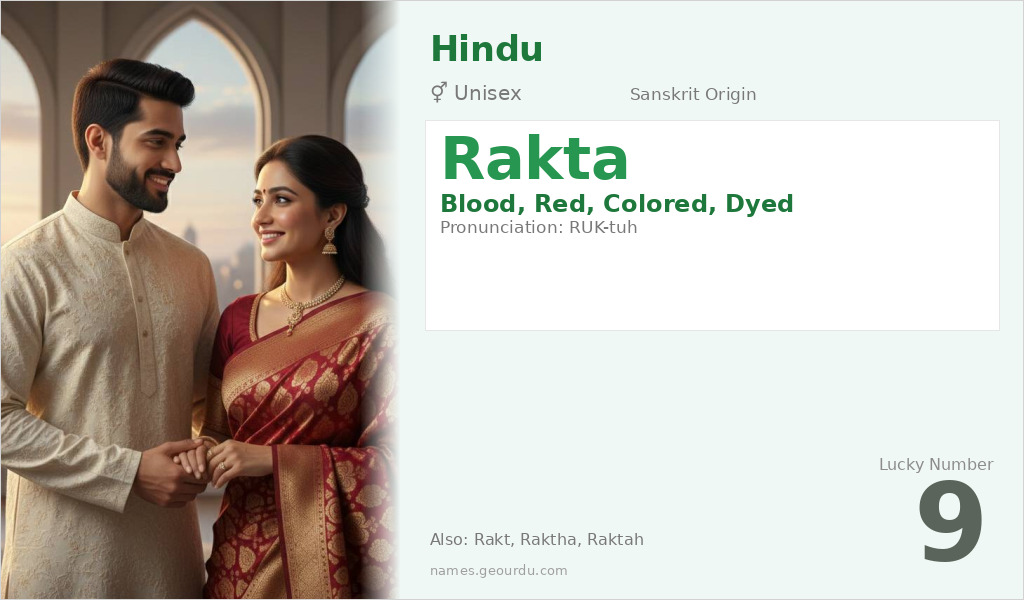
Rakta is a profound Sanskrit name that carries the essence of life itself. Meaning ‘blood’ or ‘red’, this name connects to fundamental concepts of vitality, passion, and existence. While primarily used in Hindu contexts due to its Sanskrit origins, Rakta offers rich symbolic meaning that transcends simple translation. Discover the linguistic roots and cultural significance of this powerful name.
Meaning of Rakta
Rakta originates from the ancient Sanskrit language, where it literally means ‘blood’, derived from the root ‘raj’ meaning ‘to color’ or ‘to dye’. In Sanskrit grammar, the ‘-ta’ suffix creates a past participle, giving the sense of ‘that which is colored’ or ‘dyed’. This etymology explains why Rakta also means ‘red’ or ‘colored’ – blood being the quintessential red substance. The word appears extensively in classical Indian texts, particularly in Ayurvedic medicine where ‘rakta’ represents one of the three fundamental bodily humors (alongside vata and pitta). In poetic and literary contexts, Rakta describes the color red in nature, art, and emotion, making it a richly layered term beyond mere biological reference.
| 📛 Name | Rakta |
| 💎 Meaning | Blood, Red, Colored, Dyed |
| 👤 Gender | Unisex |
| 🕌 Religion | Hindu |
| 🌍 Origin | Sanskrit |
| 🗣 Pronunciation | RUK-tuh |
| ✍️ Urdu | رکتا |
| ✍️ Arabic | ركتا |
| 🔢 Numerology | 9 |
| ✨ Spellings | Rakt, Raktha, Raktah |
Origin & Cultural Significance
Rakta has its origins in ancient Sanskrit, the classical language of India that dates back over 3,500 years. As a Sanskrit word, it appears in foundational Hindu texts including the Vedas, Ayurvedic treatises like the Charaka Samhita, and classical poetry and drama. The name reflects the cultural significance of blood in Hindu philosophy – representing life force (prana), sacrifice, and the cyclical nature of existence. While primarily associated with Hindu tradition due to its Sanskrit roots, the name could theoretically be used by anyone appreciating its linguistic and symbolic value. In modern usage, it remains relatively uncommon as a personal name but retains strong cultural and linguistic recognition.
Personality Traits
The name Rakta suggests a personality marked by intensity, passion, and vitality. Like the blood it represents, individuals with this name might be seen as life-giving, emotionally deep, and fundamentally connected to existence. They may possess strong convictions, artistic sensibilities, and a capacity for both great compassion and fierce determination. The red symbolism associates them with energy, action, and the raw essence of human experience.
Similar Names
If you like Rakta, consider: Raktim (Sanskrit: Reddish), Rohit (Sanskrit: Red), Lohit (Sanskrit: Red, Copper-colored), Aruna (Sanskrit: Reddish-brown, Dawn), Raktavarna (Sanskrit: Blood-colored)
Famous People Named Rakta
- No widely known contemporary figures with this exact name found in public records
- The term appears in classical Indian literature and Ayurvedic texts as a medical and poetic term
Frequently Asked Questions About Rakta
What does Rakta mean?
Rakta means 'blood' or 'red' in Sanskrit, originating from the root 'raj' meaning 'to color' or 'to dye'.
Is Rakta a boy or girl name?
Rakta is a unisex name, though it appears more commonly in reference sources as a word rather than a personal name. In Sanskrit, the word itself is grammatically neuter.
What is the origin of Rakta?
Rakta originates from Sanskrit, the ancient classical language of India, with documented usage in Hindu texts, Ayurvedic medicine, and classical literature dating back millennia.