Table of Contents
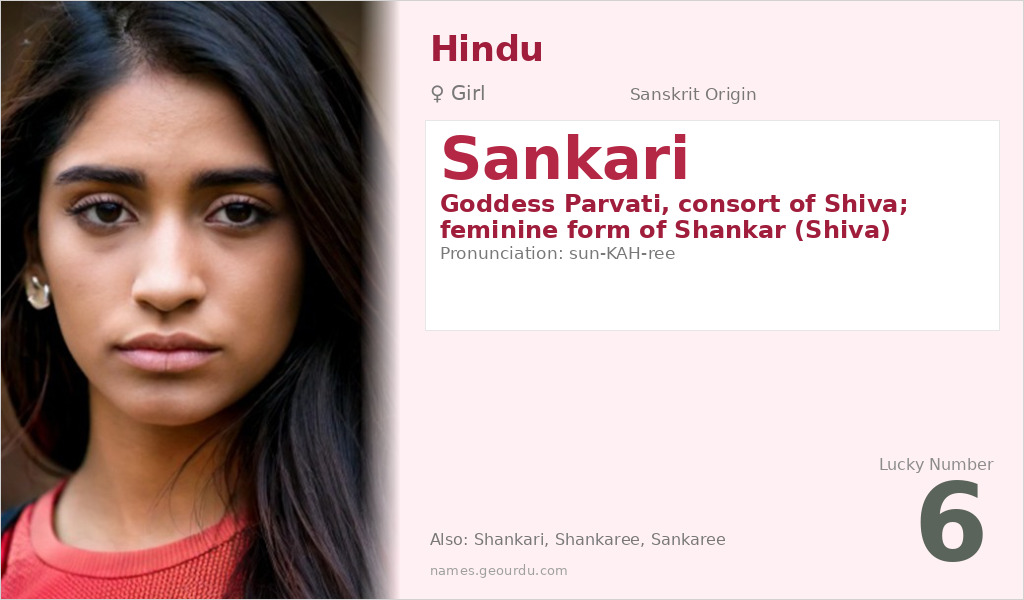
Sankari is a beautiful and spiritually significant name with deep roots in Hindu tradition. Derived from Sanskrit, this name carries the powerful meaning of ‘Goddess Parvati’, the divine consort of Lord Shiva. As a feminine form of Shankara (another name for Shiva), Sankari represents divine feminine energy, strength, and auspiciousness. This name has been cherished for centuries in Indian culture for its religious significance and melodic sound.
Meaning of Sankari
Sankari originates from the Sanskrit word ‘Shankara’ (शंकर), which is composed of ‘sham’ meaning ‘auspicious’ or ‘beneficent’ and ‘kara’ meaning ‘maker’ or ‘doer’. Thus, Shankara translates to ‘the auspicious one’ or ‘bringer of happiness’, referring to Lord Shiva. When the feminine suffix ‘-i’ is added, it becomes Sankari (शंकरी), meaning ‘consort of Shankara’ or ‘belonging to Shiva’. In Hindu mythology, this specifically denotes Goddess Parvati, who embodies feminine power, devotion, and marital bliss. The name appears in various Sanskrit scriptures and devotional hymns praising the divine couple. Its linguistic construction follows classic Sanskrit patterns for creating feminine forms from masculine nouns.
| 📛 Name | Sankari |
| 💎 Meaning | Goddess Parvati, consort of Shiva; feminine form of Shankar (Shiva) |
| 👤 Gender | Girl |
| 🕌 Religion | Hindu |
| 🌍 Origin | Sanskrit |
| 🗣 Pronunciation | sun-KAH-ree |
| ✍️ Urdu | سنکری |
| ✍️ Arabic | سانكاري |
| 🔢 Numerology | 6 |
| ✨ Spellings | Shankari, Shankaree, Sankaree |
Origin & Cultural Significance
Sankari has its origins in ancient Sanskrit, the classical language of India and Hinduism. The name emerged from Hindu religious texts and traditions where epithets for deities were commonly used as personal names. As a name for Goddess Parvati, Sankari reflects the practice of naming children after divine figures to invoke their blessings and qualities. This naming tradition is particularly prevalent in Hindu communities across India, Nepal, and the diaspora. The name gained popularity through religious literature, temple traditions, and cultural practices honoring the divine feminine. While primarily used in Hindu contexts, the name’s Sanskrit origin gives it linguistic connections to other Indo-European languages.
Personality Traits
Those named Sankari are often perceived as having a calm yet powerful presence, much like the goddess they’re named after. They typically exhibit strong maternal instincts, spiritual depth, and resilience in facing challenges. Their connection to the divine feminine often manifests as creativity, intuition, and a nurturing nature toward others. Many Sankaris are drawn to artistic pursuits, spiritual practices, or caregiving roles that allow them to express their compassionate nature.
Similar Names
If you like Sankari, consider: Parvati, Uma, Gauri, Shivani, Durga
Famous People Named Sankari
- Sankari Krishnan — Indian classical dancer and choreographer
- Sankari Prasad Basu — Indian author and researcher on Sri Ramakrishna
Frequently Asked Questions About Sankari
What does Sankari mean?
Sankari means 'Goddess Parvati, consort of Shiva' in Sanskrit. It is the feminine form of Shankara, another name for Lord Shiva.
Is Sankari a boy or girl name?
Sankari is exclusively a girl's name in Hindu tradition, as it refers to the feminine divine energy and specifically denotes Goddess Parvati.
What is the origin of Sankari?
Sankari originates from Sanskrit, the classical language of ancient India, and comes from Hindu religious tradition where it is an epithet for Goddess Parvati.