
Table of Contents
Thirumangai is a profound Tamil name with deep roots in South Indian spirituality and literature. Meaning ‘great elephant’ or ‘noble elephant’, this name carries centuries of cultural heritage and religious significance. Most famously associated with Thirumangai Alvar, one of the twelve revered poet-saints of Sri Vaishnavism, the name symbolizes strength, wisdom, and devotion. Today, it continues to be used in Tamil communities as a meaningful choice that connects children to their rich cultural past.
Meaning of Thirumangai
Thirumangai derives from classical Tamil, combining ‘Thiru’ (திரு), a prefix denoting sacredness, holiness, greatness, or nobility, with ‘Mangai’ (மங்கை), meaning elephant. In Tamil symbolism, elephants represent not just physical strength but also wisdom, memory, royalty, and spiritual significance—they are associated with the Hindu god Ganesha and appear frequently in temple architecture and processions. The name thus creates a compound meaning of ‘great elephant’ or ‘noble elephant’, suggesting someone with dignified strength and wisdom. This etymology is well-documented in Tamil lexicons and literary sources, particularly in reference to the Alvar saint who bore this name. The name’s meaning reflects the high cultural value placed on elephants in Tamil society, where they were historically associated with kingship, warfare, and religious ceremonies.
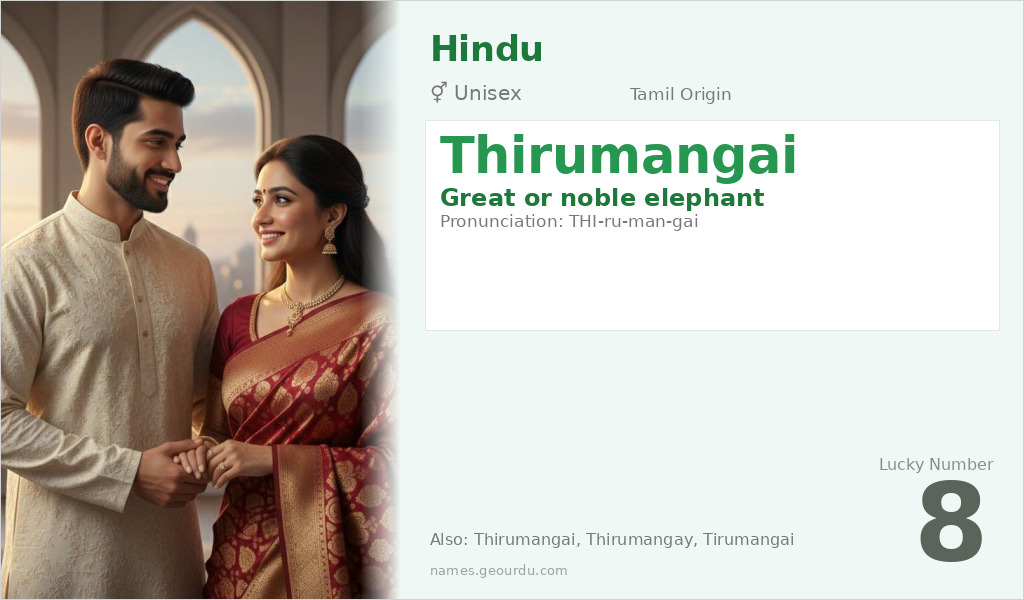
| 📛 Name | Thirumangai |
| 💎 Meaning | Great or noble elephant |
| 👤 Gender | Unisex |
| 🕌 Religion | Hindu |
| 🌍 Origin | Tamil |
| 🗣 Pronunciation | THI-ru-man-gai |
| ✍️ Urdu | تھرومنگائی |
| ✍️ Arabic | ثيرومانغاي |
| 🔢 Numerology | 8 |
| ✨ Spellings | Thirumangai, Thirumangay, Tirumangai |
Origin & Cultural Significance
Thirumangai originates from Tamil Nadu, South India, with its earliest recorded usage in the 8th-9th century CE through Thirumangai Alvar, one of the twelve Alvar saints of Sri Vaishnavism. The Alvars were Tamil poet-saints whose devotional hymns to Vishnu form an important part of the Tamil Bhakti movement. Thirumangai Alvar, originally named Neelan, was a military commander who underwent a spiritual transformation and became a wandering saint, composing over 1,300 hymns. The name appears in Sangam literature (300 BCE-300 CE) as well, referring to historical chieftains. While strongly associated with Hindu Sri Vaishnavism, the name’s cultural roots extend to broader Tamil heritage, where elephant symbolism permeates art, literature, and royal iconography. Today, it remains primarily used in Tamil-speaking communities in India, Sri Lanka, and the diaspora.
Personality Traits
Those named Thirumangai are often associated with qualities of strength, stability, and wisdom—traits symbolized by the elephant in Tamil culture. They may exhibit natural leadership abilities, patience in adversity, and a strong connection to tradition and spirituality. The name suggests someone who is both powerful and gentle, capable of bearing great responsibilities while maintaining compassion. These individuals often value family heritage and cultural roots, carrying forward traditions with dignity and respect.
Similar Names
If you like Thirumangai, consider: Thirumal, Thiruvalluvar, Mangaiyarkarasi, Thirumagal, Thirumurugan
Famous People Named Thirumangai
- Thirumangai Alvar — 8th-9th century Tamil poet-saint and one of the twelve Alvars in Sri Vaishnavism, known for his devotional hymns to Vishnu
- Thirumangai Mannan — Historical Tamil chieftain mentioned in Sangam literature
Frequently Asked Questions About Thirumangai
What does Thirumangai mean?
Thirumangai means 'great elephant' or 'noble elephant' in Tamil, combining 'Thiru' (sacred/great) and 'Mangai' (elephant).
Is Thirumangai a boy or girl name?
Thirumangai is historically masculine (most famously borne by the male saint Thirumangai Alvar) but can be considered unisex in modern usage, particularly in Tamil communities.
What is the origin of Thirumangai?
Thirumangai originates from Tamil language and culture in South India, with significant historical and religious associations to Sri Vaishnavism and the Alvar saint tradition.