
Table of Contents
Tina is a charming and widely recognized name that has graced generations of girls around the world. Often used as a standalone name, it originally served as a affectionate shortening of longer classical names. This name carries a legacy of strength and faith, depending on its root, and has been popularized by iconic figures in music and entertainment. Its simplicity and international appeal make it a timeless choice for parents seeking a familiar yet meaningful name.
Meaning of Tina
The name Tina does not have a standalone meaning in any language but derives its significance from the longer names it abbreviates. As a diminutive, it most commonly stems from Christina, which comes from the Latin Christianus, meaning ‘a Christian’ or ‘follower of Christ,’ with roots in the Greek Christos. Alternatively, it can shorten Martina, from the Latin Martius, meaning ‘warlike’ or ‘dedicated to Mars,’ the Roman god of war, or Valentina, from the Latin valens, meaning ‘strong, healthy, vigorous.’ This etymological linkage means Tina inherits meanings like ‘Christian woman,’ ‘warlike,’ or ‘strong,’ depending on its source. The name’s usage as an independent given name emerged in the 20th century, particularly in English-speaking countries, though it remains closely tied to its origins.
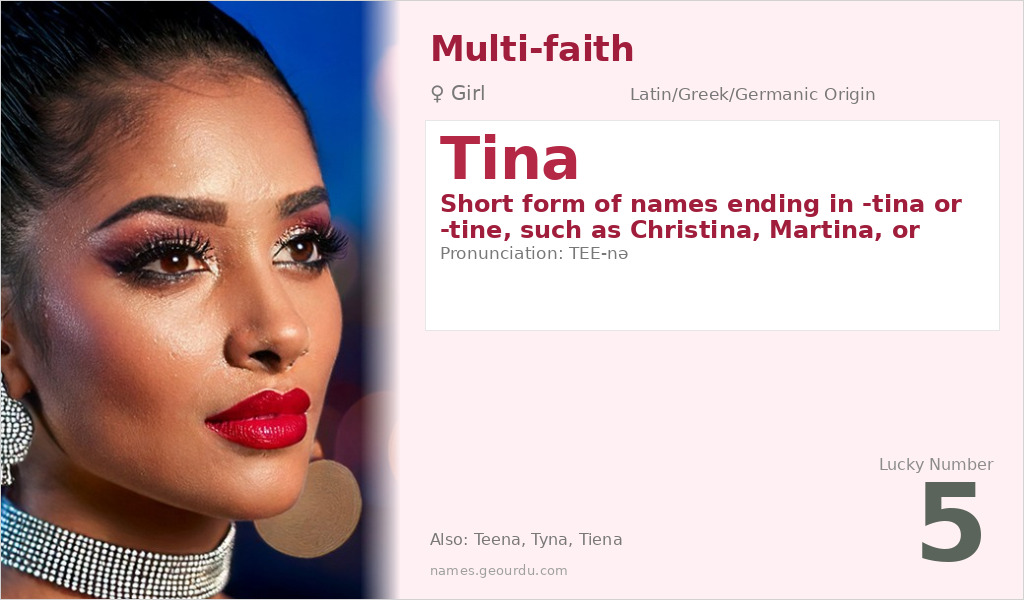
| 📛 Name | Tina |
| 💎 Meaning | Short form of names ending in -tina or -tine, such as Christina, Martina, or Valentina, meaning 'follower of Christ', 'warlike', or 'strong/healthy' respectively |
| 👤 Gender | Girl |
| 🕌 Religion | Multi-faith |
| 🌍 Origin | Latin/Greek/Germanic |
| 🗣 Pronunciation | TEE-nə |
| ✍️ Urdu | ٹینا |
| ✍️ Arabic | تينا |
| 🔢 Numerology | 5 |
| ✨ Spellings | Teena, Tyna, Tiena |
Origin & Cultural Significance
Tina originated in Europe as a nickname for names ending in ‘-tina’ or ‘-tine,’ such as Christina, Martina, and Valentina, which have Latin and Greek roots. It gained popularity as a formal given name in the mid-20th century, especially in the United States and United Kingdom, influenced by cultural icons and its easy pronunciation. The name is used across various cultures and religions, including Christianity due to its connection to Christina, but it is not specific to Hinduism or any single faith. In modern times, Tina is recognized globally, with variations in spelling and usage, but it does not have traditional roots in Arabic, Persian, Indian, or other non-European languages, contrary to some misconceptions.
Personality Traits
People named Tina are often seen as vibrant and outgoing, with a natural flair for communication and social interaction. They tend to be adaptable and resourceful, embracing new experiences with enthusiasm, which aligns with the numerological energy of number 5 associated with freedom and adventure. Their friendly demeanor and confidence often make them leaders in social circles, admired for their ability to inspire and connect with others.
Similar Names
If you like Tina, consider: Christina, Martina, Valentina, Sabrina, Katrina
Famous People Named Tina
- Tina Turner — American-born Swiss singer and actress known as the 'Queen of Rock 'n' Roll'
- Tina Fey — American actress, comedian, writer, and producer, known for Saturday Night Live and 30 Rock
Frequently Asked Questions About Tina
What does Tina mean?
Tina is a short form of names like Christina, Martina, or Valentina, meaning 'follower of Christ,' 'warlike,' or 'strong/healthy' respectively, depending on its origin. It has no standalone meaning.
Is Tina a boy or girl name?
Tina is almost exclusively a girl's name, used as a feminine diminutive or given name in various cultures, with rare unisex usage in some contexts.
What is the origin of Tina?
Tina originates from European languages, primarily Latin and Greek, as a nickname for longer names ending in '-tina.' It is not derived from Hindu, Arabic, or other non-European sources.





