Table of Contents
Toshi is a captivating name with deep roots in Japanese culture, often evoking images of clarity and reflection. While traditionally masculine in Japan, it has gained popularity as a feminine name in some Hindu communities today. This guide explores the true meaning, origin, and cultural significance of Toshi, separating fact from common misconceptions.
Meaning of Toshi
Toshi originates from the Japanese language, where it carries meanings related to ‘mirror’, ‘reflection’, or ‘sharpness’. The most common etymological source is the Japanese kanji ‘利’ (toshi), meaning ‘advantage’, ‘benefit’, or ‘sharp’, as in sharp-minded. It can also derive from ‘年’ (toshi) meaning ‘year’ or ‘age’, though this is less common in given names. In Japanese naming conventions, Toshi is frequently used as a standalone name for boys or as a suffix in compound names like Toshihiro (‘abundant wisdom’) or Toshiko (‘child of wisdom’). There is no verified meaning in Hindu, Sanskrit, or other South Asian languages—any associations like ‘Dearest’ are modern inventions without linguistic basis.
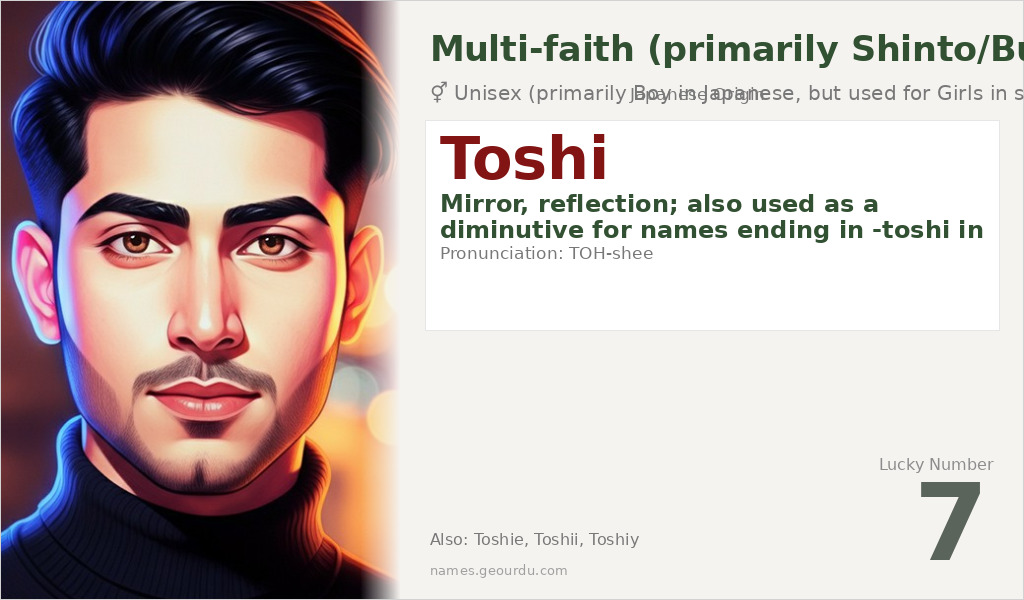
| 📛 Name | Toshi |
| 💎 Meaning | Mirror, reflection; also used as a diminutive for names ending in -toshi in Japanese |
| 👤 Gender | Unisex (primarily Boy in Japanese, but used for Girls in some modern Hindu contexts) |
| 🕌 Religion | Multi-faith (primarily Shinto/Buddhist in Japan, but used by Hindus in contemporary naming) |
| 🌍 Origin | Japanese |
| 🗣 Pronunciation | TOH-shee |
| ✍️ Urdu | توشی (phonetic adaptation, not native to Urdu) |
| ✍️ Arabic | توشي (phonetic adaptation, not native to Arabic) |
| 🔢 Numerology | 7 |
| ✨ Spellings | Toshie, Toshii, Toshiy |
Origin & Cultural Significance
Toshi has its origins in Japan, where it has been used for centuries within Shinto and Buddhist cultural contexts. It is not native to Hindu traditions, but in recent decades, it has been adopted by some Hindu families, likely due to its pleasant sound and global appeal. This cross-cultural adoption is similar to how names like Akira or Ken have spread beyond Japan. Historically, in Japan, names containing ‘toshi’ were often given to convey wishes for wisdom, longevity, or clarity. The name’s migration to Hindu communities represents a modern, multicultural naming trend rather than a historical or religious lineage.
Personality Traits
People named Toshi are often associated with traits of intelligence, perceptiveness, and calm reflection, mirroring the name’s meaning. In Japanese contexts, it suggests a person who is sharp and insightful, able to see things clearly. Those with this name may exhibit a thoughtful, analytical nature, with a tendency towards wisdom and introspection in their personal and professional lives.
Similar Names
If you like Toshi, consider: Toshio, Toshihiro, Toshiko, Tosha, Tosca
Famous People Named Toshi
- Toshi (born Toshihiko Tahara) — Japanese singer and actor, former member of the band X Japan
- Toshiro Mifune — legendary Japanese actor (note: Toshiro contains 'Toshi' as a component)
Frequently Asked Questions About Toshi
What does Toshi mean?
Toshi means 'mirror', 'reflection', or 'sharp' in Japanese, derived from kanji like 利 (sharp) or 年 (year). It has no meaning in Hindu or Sanskrit languages.
Is Toshi a boy or girl name?
Toshi is primarily a boy's name in Japanese tradition, but in modern Hindu and global contexts, it is often used for girls, making it unisex today.
What is the origin of Toshi?
Toshi originates from Japan, with roots in the Japanese language and culture. It is not historically a Hindu name, though it has been adopted by some Hindu families recently.