Table of Contents
Varunika is a beautiful and meaningful name deeply rooted in ancient Hindu tradition. Derived from Sanskrit, it connects to Varuna, the Vedic deity of waters, rain, and cosmic order. This name carries a sense of purity, nourishment, and spiritual depth, making it a cherished choice for girls in Hindu families. Explore the rich etymology, cultural significance, and modern usage of Varunika in this comprehensive guide.
Meaning of Varunika
Varunika originates from Sanskrit, formed by combining ‘Varuna’ (वरुण) with the feminine suffix ‘-ika’ (इका). Varuna is one of the most important gods in the Rigveda, associated with the celestial ocean, rainfall, and the maintenance of cosmic and moral law (ṛta). The suffix ‘-ika’ denotes belonging or relation, so Varunika literally means ‘belonging to Varuna’ or ‘daughter of Varuna’. This name emphasizes a connection to divine qualities like purity, life-giving waters, and universal order. Unlike the original article’s claim of ‘Goddess Of Rain’, Varunika is not a goddess but a theophoric name honoring Varuna. In Hindu mythology, Varuna’s consort is Varuni, the goddess of wine, but Varunika is a distinct feminine derivative.
| 📛 Name | Varunika |
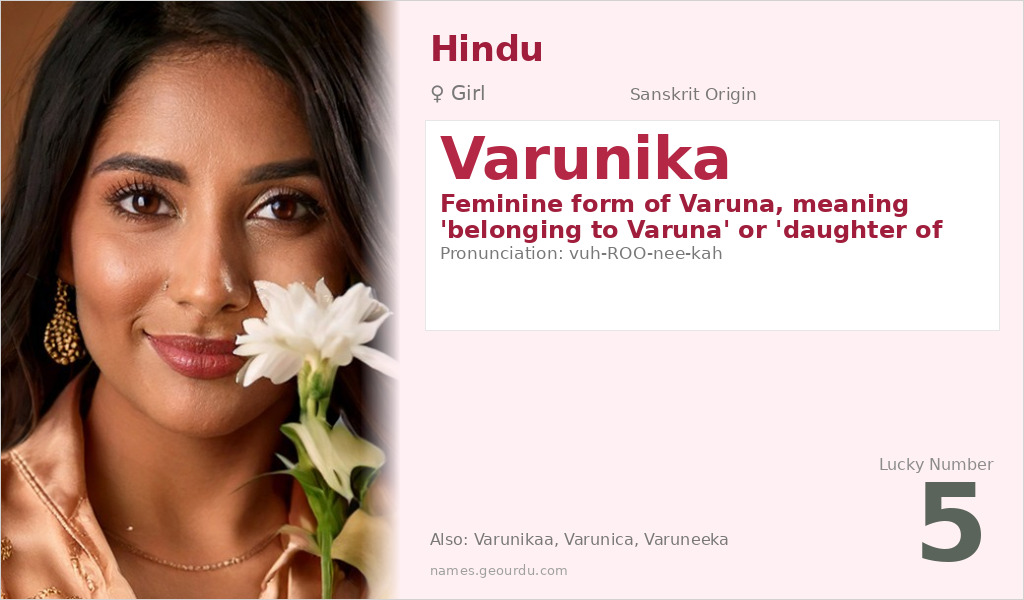
| 💎 Meaning | Feminine form of Varuna, meaning 'belonging to Varuna' or 'daughter of Varuna' — Varuna is the Vedic god of waters, oceans, rain, and cosmic order |
| 👤 Gender | Girl |
| 🕌 Religion | Hindu |
| 🌍 Origin | Sanskrit |
| 🗣 Pronunciation | vuh-ROO-nee-kah |
| ✍️ Urdu | ورنیکا |
| ✍️ Arabic | فارونيكا |
| 🔢 Numerology | 5 |
| ✨ Spellings | Varunikaa, Varunica, Varuneeka |
Origin & Cultural Significance
Varunika has its origins in ancient Sanskrit literature and Vedic tradition, dating back over 3,000 years. It is primarily used in Hindu communities across India, Nepal, and the diaspora, reflecting the enduring influence of Vedic deities in modern naming practices. The name is part of a broader category of Sanskrit names ending in ‘-ika’, such as Anandika or Devika, which feminize concepts or deities. Culturally, Varunika is chosen for its auspicious connotations related to water—symbolizing life, cleansing, and fertility—and its association with Varuna’s role as a guardian of cosmic order. While not extremely common, it appears in contemporary contexts among artists, academics, and professionals, maintaining its traditional roots.
Personality Traits
Those named Varunika are often perceived as empathetic, intuitive, and spiritually aware, mirroring the nurturing and orderly nature of Varuna. They may possess a creative flair and a strong sense of justice, valuing harmony in personal and professional relationships. Their connection to water symbolism can translate into adaptability and emotional depth, making them compassionate and reflective individuals who inspire trust and calm in others.
Similar Names
If you like Varunika, consider: Varuna, Varuni, Varsha, Megha, Jalaja
Famous People Named Varunika
- Varunika Saraf — Indian contemporary artist known for miniature paintings and installations
- Varunika Ruwanpura — Sri Lankan academic and researcher in Buddhist studies
Frequently Asked Questions About Varunika
What does Varunika mean?
Varunika means 'belonging to Varuna' or 'daughter of Varuna', derived from Sanskrit, where Varuna is the Vedic god of waters, rain, and cosmic order.
Is Varunika a boy or girl name?
Varunika is exclusively a girl's name, as it uses the feminine Sanskrit suffix '-ika' and is traditionally given to females in Hindu culture.
What is the origin of Varunika?
Varunika originates from Sanskrit, an ancient Indo-Aryan language, and is deeply rooted in Hindu Vedic tradition, associated with the deity Varuna.