
Table of Contents
Vaasaki is a distinctive name that appears in some Hindu naming traditions, though its exact origins and meaning remain somewhat elusive. While often associated with Sanskrit roots, the specific spelling ‘Vaasaki’ doesn’t appear in classical texts or standard dictionaries. This name carries an air of mystery and tradition, potentially connected to mythological figures from Hindu scriptures. Understanding its possible connections requires exploring linguistic variations and cultural contexts.
Meaning of Vaasaki
The name Vaasaki appears to be a variant spelling of the Sanskrit name ‘Vāsuki’, which refers to the king of serpents (nāgas) in Hindu mythology. In Sanskrit, ‘Vāsuki’ derives from the root ‘vas’ meaning ‘to dwell’ or ‘to reside’, suggesting one who possesses a dwelling or abode. The serpent king Vāsuki plays a significant role in Hindu scriptures, particularly in the story of Samudra Manthan (churning of the ocean) where he serves as the rope wrapped around Mount Mandara. While ‘Vaasaki’ may be a regional pronunciation or spelling variation, it doesn’t have an independently verified meaning in Sanskrit or other Indian languages. The connection to serpent mythology suggests associations with wisdom, protection, and cosmic balance in Hindu tradition.
| 📛 Name | Vaasaki |
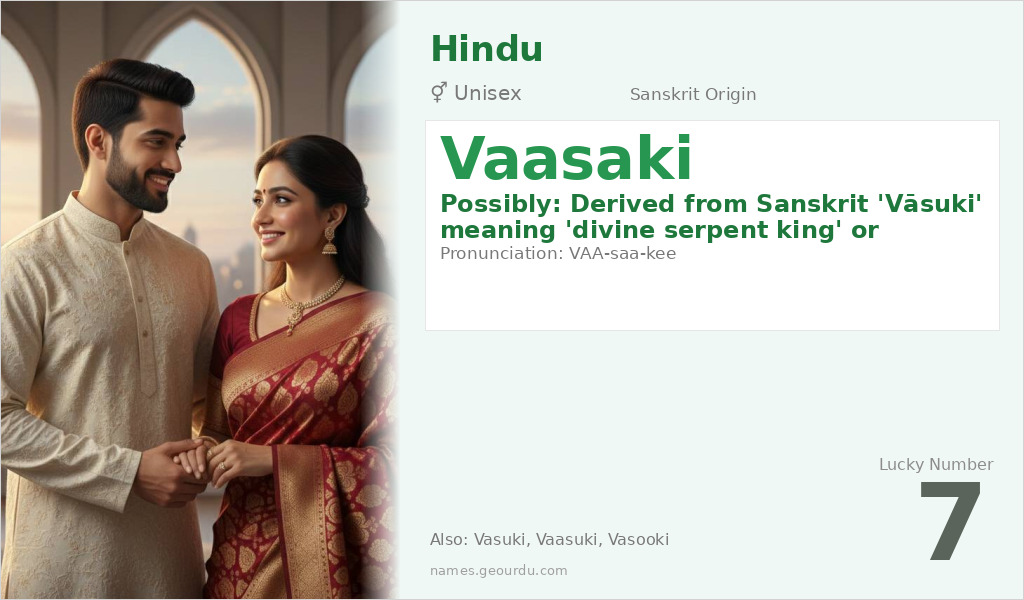
| 💎 Meaning | Possibly: Derived from Sanskrit 'Vāsuki' meaning 'divine serpent king' or 'celestial serpent' |
| 👤 Gender | Unisex |
| 🕌 Religion | Hindu |
| 🌍 Origin | Sanskrit |
| 🗣 Pronunciation | VAA-saa-kee |
| ✍️ Urdu | واساکی |
| ✍️ Arabic | فاساكي |
| 🔢 Numerology | 7 |
| ✨ Spellings | Vasuki, Vaasuki, Vasooki, Vaasooki |
Origin & Cultural Significance
Vaasaki likely originates from Sanskrit through the name Vāsuki, which has deep roots in Hindu mythology and scriptures. The serpent king Vāsuki appears in ancient texts including the Mahabharata, Puranas, and various Hindu mythological narratives. This name is particularly significant in Shaivism and Vaishnavism traditions where serpent deities hold important symbolic meanings. While the exact spelling ‘Vaasaki’ isn’t documented in classical sources, it may represent a regional or modern adaptation of the traditional name. The name appears primarily in Hindu communities, though its usage remains relatively uncommon compared to the standard ‘Vasuki’ spelling.
Personality Traits
Those named Vaasaki are often perceived as having deep, contemplative natures with strong intuitive abilities. They may exhibit protective qualities and a natural wisdom that others find comforting. Their connection to serpent mythology symbolism suggests individuals who can navigate complex situations with grace and strategic thinking. These personalities often value knowledge, tradition, and spiritual growth throughout their lives.
Similar Names
If you like Vaasaki, consider: Vasuki, Vasudev, Vasanta, Vasudha, Vasavi
Famous People Named Vaasaki
- No verified famous individuals with the exact spelling 'Vaasaki' found in historical or contemporary records
Frequently Asked Questions About Vaasaki
What does Vaasaki mean?
Vaasaki appears to be a variant of the Sanskrit name Vāsuki, which means 'divine serpent king' or 'celestial serpent'. The exact spelling 'Vaasaki' doesn't have a verified independent meaning in any language.
Is Vaasaki a boy or girl name?
Vaasaki is used as a unisex name in Hindu traditions, though it's more commonly associated with masculine usage when connected to the serpent king Vāsuki. Some families may use it for girls as well.
What is the origin of Vaasaki?
Vaasaki originates from Sanskrit through the mythological name Vāsuki, referring to a serpent king in Hindu scriptures. The specific spelling 'Vaasaki' may be a regional or modern variation of this traditional name.