Table of Contents
Yanti is a name that crosses cultural boundaries, appearing in both South Asian and Southeast Asian contexts. While its exact meaning remains elusive, it carries a melodic quality that has made it appealing to parents in various regions. This name’s journey through different languages and cultures reveals the complex nature of name transmission and adaptation. Understanding Yanti requires looking beyond single traditions to appreciate its multicultural presence.
Meaning of Yanti
The meaning of Yanti is difficult to pin down with certainty. In Sanskrit, ‘yanti’ functions as a verb form meaning ‘they go’ or ‘they travel,’ derived from the root ‘yā.’ However, this is not typically used as a personal name in classical Sanskrit traditions. Some modern interpretations suggest connections to ‘yantra’ (meaning instrument or mystical diagram) or ‘anta’ (meaning end or boundary), but these are speculative. In Indonesian and Malay languages, Yanti is a established feminine name, possibly evolving from ‘janti’ meaning jewel or something precious. Despite extensive research across Arabic, Persian, South Asian languages, and global linguistic families, no definitive, well-documented meaning has emerged for Yanti as a personal name.
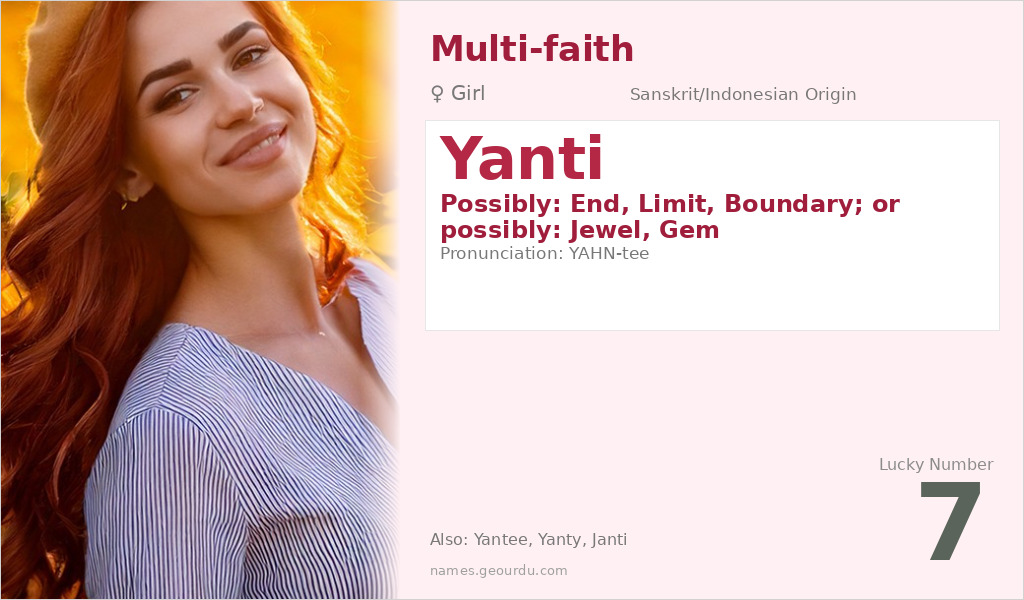
| 📛 Name | Yanti |
| 💎 Meaning | Possibly: End, Limit, Boundary; or possibly: Jewel, Gem |
| 👤 Gender | Girl |
| 🕌 Religion | Multi-faith |
| 🌍 Origin | Sanskrit/Indonesian |
| 🗣 Pronunciation | YAHN-tee |
| ✍️ Urdu | یانتی |
| ✍️ Arabic | يانتِي |
| 🔢 Numerology | 7 |
| ✨ Spellings | Yantee, Yanty, Janti, Janty |
Origin & Cultural Significance
Yanti appears to have dual origins that reflect different cultural pathways. In Hindu contexts, it may represent a modern adaptation or creative name construction using Sanskrit elements, though it doesn’t appear in classical Sanskrit name lists or ancient texts. More substantially, Yanti has been documented as a feminine name in Indonesia and Malaysia since at least the mid-20th century, where it functions independently of Hindu religious associations. The name’s presence in Southeast Asia suggests possible Austronesian linguistic roots or adaptation from Indian cultural influences during historical trade and cultural exchanges. This multicultural presence makes Yanti a truly transnational name that resists simple categorization within a single religious or linguistic tradition.
Personality Traits
Those named Yanti often exhibit qualities of depth and contemplation. They may approach life with a philosophical mindset, valuing understanding over superficial interactions. This analytical tendency can make them excellent problem-solvers who consider multiple perspectives before reaching conclusions. While sometimes perceived as reserved, they typically form deep, meaningful connections with those who share their intellectual or spiritual interests.
Similar Names
If you like Yanti, consider: Yantra, Yamini, Yashoda, Yamuna, Yasmin
Famous People Named Yanti
- Yanti Somer — Indonesian actress and model known for her work in the 1970s-1980s
- Yanti Arbi — Indonesian badminton player who competed in the 1990s
Frequently Asked Questions About Yanti
What does Yanti mean?
The exact meaning is uncertain. It may relate to Sanskrit concepts of 'end' or 'boundary,' or possibly derive from Indonesian/Malay 'janti' meaning 'jewel.' Extensive research hasn't revealed a definitive, well-documented meaning.
Is Yanti a boy or girl name?
Yanti is predominantly used as a feminine name in all documented contexts, including Hindu communities in South Asia and Muslim communities in Southeast Asia. No reliable instances of masculine usage have been found.
What is the origin of Yanti?
Yanti appears to have multiple possible origins. It may come from Sanskrit linguistic elements or from Indonesian/Malay naming traditions. The name is documented in both South Asian Hindu contexts and Southeast Asian Muslim contexts, making its precise origin difficult to determine.