
Table of Contents
Balashankar is a profound Sanskrit name that beautifully combines devotion and youthful energy. As a traditional Hindu boy’s name, it honors Lord Shiva while emphasizing his eternal youthfulness and vitality. This name carries centuries of cultural and spiritual significance, making it a meaningful choice for parents seeking a name with deep roots in Hindu tradition. Let’s explore the rich layers of meaning and history behind Balashankar.
Meaning of Balashankar
Balashankar is a compound Sanskrit name with clear etymological roots. The first component ‘Bala’ (बाल) derives from the Sanskrit root meaning ‘young, child, or youthful,’ representing vigor and new beginnings. The second component ‘Shankar’ (शंकर) is one of Shiva’s primary names, meaning ‘the auspicious one’ or ‘giver of happiness.’ Together, they create ‘young Shankar’ or ‘youthful Shiva,’ referencing Shiva’s eternal youth and vitality despite his role as the supreme ascetic. This name appears in Hindu texts and traditions as a devotional name, emphasizing Shiva’s dynamic, life-giving aspects alongside his meditative qualities. The compound structure follows classical Sanskrit naming conventions where attributes are combined with divine names.
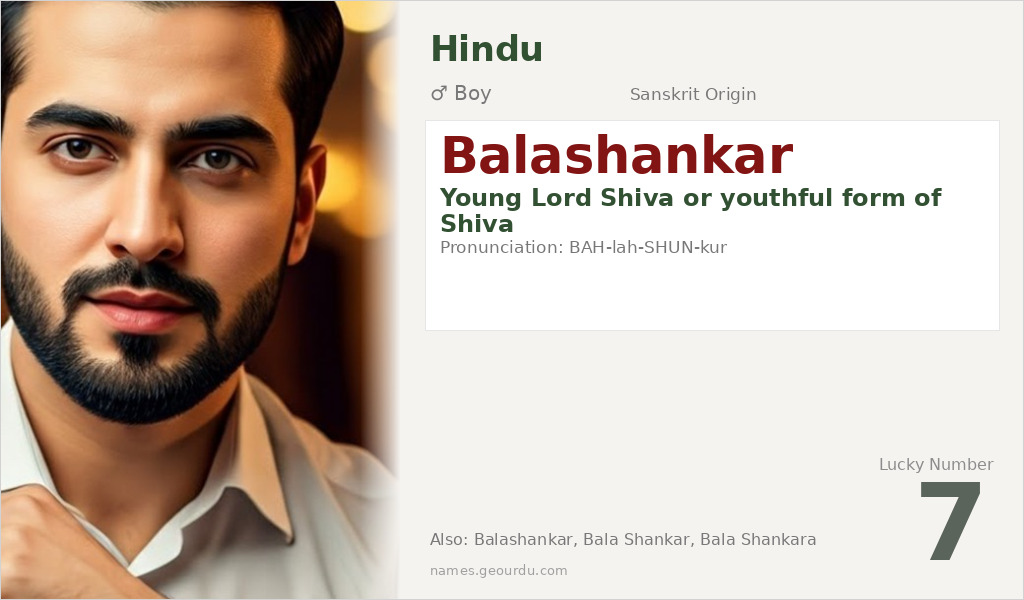
| 📛 Name | Balashankar |
| 💎 Meaning | Young Lord Shiva or youthful form of Shiva |
| 👤 Gender | Boy |
| 🕌 Religion | Hindu |
| 🌍 Origin | Sanskrit |
| 🗣 Pronunciation | BAH-lah-SHUN-kur |
| ✍️ Urdu | بالاشنکر |
| ✍️ Arabic | بالاشانكار |
| 🔢 Numerology | 7 |
| ✨ Spellings | Balashankar, Bala Shankar, Bala Shankara, Balashankara |
Origin & Cultural Significance
Balashankar originates from classical Sanskrit, the ancient liturgical language of Hinduism. It emerged within Hindu naming traditions where combining ‘Bala’ with divine names became popular to denote youthful aspects of deities. The name reflects the cultural practice of naming children after gods with descriptive prefixes, particularly common in Shaivism (worship of Shiva). Historically, such names were used by various Hindu communities across the Indian subcontinent, especially in regions with strong Shiva worship traditions. While primarily associated with Hindu religion, the name’s Sanskrit roots connect it to broader Indian cultural heritage. It remains in use today, particularly among families with Shaivite traditions or those seeking names with spiritual depth.
Personality Traits
Those named Balashankar are often seen as possessing a unique blend of spiritual depth and youthful energy. They may exhibit the contemplative nature associated with Shiva alongside creative vitality. This combination can make them both thoughtful and dynamic individuals who approach life with both wisdom and enthusiasm. Their personality often reflects balance—between tradition and innovation, seriousness and playfulness, much like Shiva’s own dual aspects.
Similar Names
If you like Balashankar, consider: Baleshwar, Balakrishna, Shivansh, Shivam, Balkrishna
Famous People Named Balashankar
- Balashankar Kantharia — Indian freedom fighter and social reformer from Gujarat
- Balashankar Jha — Indian classical vocalist in the Dhrupad tradition
Frequently Asked Questions About Balashankar
What does Balashankar mean?
Balashankar means 'Young Lord Shiva' or 'youthful form of Shiva.' It's a compound Sanskrit name where 'Bala' means 'young' and 'Shankar' is a name for Shiva meaning 'auspicious one.'
Is Balashankar a boy or girl name?
Balashankar is exclusively a boy's name in Hindu naming tradition, as it references the male deity Shiva and follows masculine Sanskrit grammatical structure.
What is the origin of Balashankar?
Balashankar originates from Sanskrit, the classical language of Hinduism. It combines 'Bala' (young) with 'Shankar' (Shiva) to create a devotional name honoring Shiva's youthful aspect.





