
Table of Contents
Bharath is a powerful and historically significant name with deep roots in Indian culture and Hindu tradition. Derived from ancient Sanskrit, this name carries the weight of mythology, history, and national identity. As both a personal name and a poetic reference to India itself, Bharath represents heritage, wisdom, and cultural continuity. Parents choosing this name often seek to connect their child with India’s rich spiritual and historical legacy.
Meaning of Bharath
The name Bharath originates from the Sanskrit word ‘Bharata’ (भरत), which has several interconnected meanings. Etymologically, it combines ‘bhar’ meaning ‘to bear, carry, or maintain’ with the agent suffix ‘-ata’, suggesting ‘one who bears or maintains’. In Hindu scriptures, Bharata was a legendary emperor and ancestor in the Mahabharata, whose kingdom gave India its ancient name ‘Bharat’. The name also relates to ‘bha’ (light, splendor) and ‘rata’ (devoted, engaged), creating the beautiful meaning ‘one devoted to light or knowledge’. This dual significance—both as a historical reference and a spiritual ideal—makes Bharath a name of profound depth and cultural resonance.
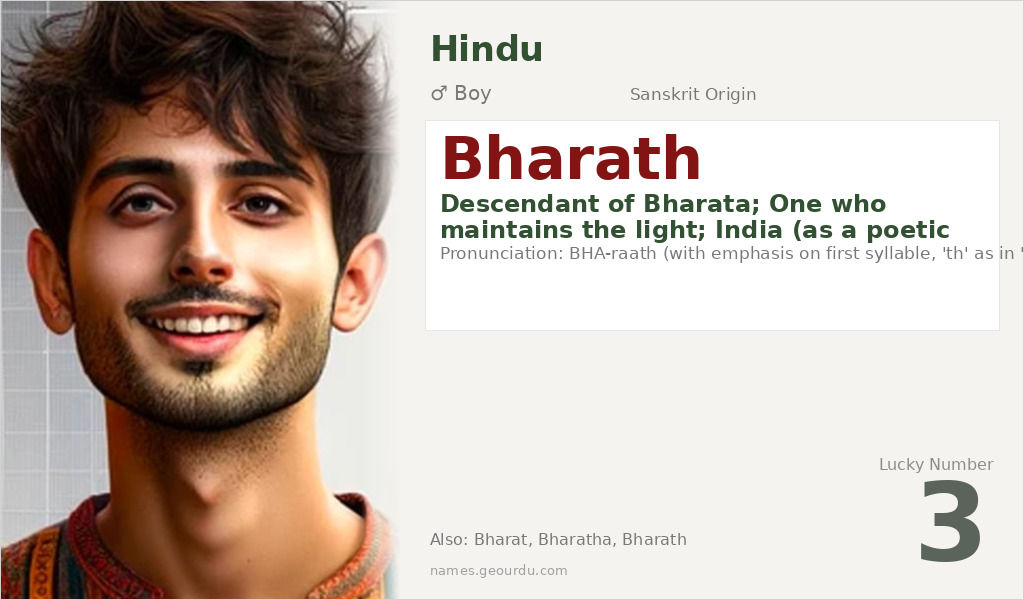
| 📛 Name | Bharath |
| 💎 Meaning | Descendant of Bharata; One who maintains the light; India (as a poetic name) |
| 👤 Gender | Boy |
| 🕌 Religion | Hindu |
| 🌍 Origin | Sanskrit |
| 🗣 Pronunciation | BHA-raath (with emphasis on first syllable, 'th' as in 'thought') |
| ✍️ Urdu | بھارت |
| ✍️ Arabic | بهارات |
| 🔢 Numerology | 3 |
| ✨ Spellings | Bharat, Bharatha, Bharath, Bharat |
Origin & Cultural Significance
Bharath has its origins in ancient Sanskrit literature and Hindu mythology, dating back thousands of years. The name first appears in the Mahabharata as King Bharata, an ancestor of both the Pandavas and Kauravas, whose descendants were called Bharatas. Over time, ‘Bharata’ became synonymous with the Indian subcontinent, referenced in the Indian constitution as ‘Bharat’. As a personal name, Bharath is predominantly used in Hindu communities across India, particularly in South India where it’s often spelled with the ‘h’ ending. The name represents a direct connection to India’s ancient civilization and continues to be popular among families valuing cultural heritage and historical continuity.
Personality Traits
Those named Bharath are often perceived as individuals with strong leadership qualities and deep cultural awareness. They typically exhibit intelligence, responsibility, and a natural inclination toward preserving traditions while embracing progress. The name’s association with light and knowledge suggests personality traits oriented toward wisdom-seeking, enlightenment, and intellectual pursuits. Bharaths are frequently seen as bridge-builders between past and present, carrying forward heritage while contributing to contemporary society.
Similar Names
If you like Bharath, consider: Bharat, Bharatha, Bharati, Bharadwaj, Bhavya
Famous People Named Bharath
- Bharath Srinivasan — Indian film actor known for Tamil cinema
- Bharath Gopi — National Award-winning Indian actor from Kerala
- Bharath — Indian playback singer in Tamil and Telugu films
Frequently Asked Questions About Bharath
What does Bharath mean?
Bharath means 'Descendant of Bharata' or 'One who maintains the light' in Sanskrit. It originates from the ancient name Bharata, a legendary emperor in Hindu mythology whose name became synonymous with India.
Is Bharath a boy or girl name?
Bharath is exclusively a boy's name in Hindu naming tradition. While 'Bharati' is the feminine equivalent, Bharath itself is masculine and has been used for boys for centuries in Indian culture.
What is the origin of Bharath?
Bharath originates from Sanskrit, the ancient language of India. It comes from 'Bharata', which appears in Hindu scriptures like the Mahabharata and has been used for thousands of years in Indian culture and history.





