
Table of Contents
Bhavanishankar is a profound Sanskrit name that carries deep spiritual significance in Hindu tradition. As a compound name combining two powerful divine elements, it represents Lord Shiva in his aspect as the consort of Goddess Parvati and ruler of all existence. This name has been cherished for centuries in Indian culture, particularly among Shiva devotees seeking to honor the supreme ascetic deity. Understanding its rich etymology reveals why it remains a meaningful choice for parents today.
Meaning of Bhavanishankar
Bhavanishankar is a Sanskrit compound name with precise theological meaning. The first component ‘Bhavani’ derives from the Sanskrit root ‘bhū’ meaning ‘to be’ or ‘to exist’, referring to Goddess Parvati (who is often called Bhavani) or more broadly to the universe and all existence. The second component ‘Shankar’ comes from ‘śam’ meaning ‘auspicious’ or ‘beneficent’, one of the primary epithets of Lord Shiva. When combined, Bhavanishankar literally means ‘Shiva who is the lord of Bhavani’ or ‘the auspicious one who rules over existence’. This name specifically references Shiva in his married aspect alongside Parvati, contrasting with his solitary ascetic forms. In Hindu scriptures, this compound name appears in devotional contexts emphasizing Shiva’s role as both transcendent ascetic and engaged householder.
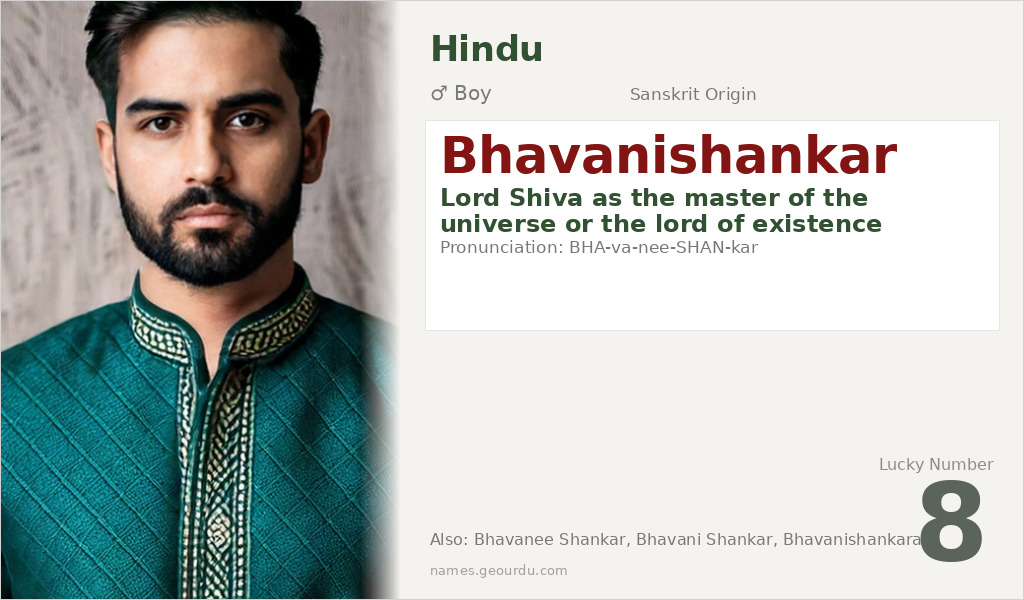
| 📛 Name | Bhavanishankar |
| 💎 Meaning | Lord Shiva as the master of the universe or the lord of existence |
| 👤 Gender | Boy |
| 🕌 Religion | Hindu |
| 🌍 Origin | Sanskrit |
| 🗣 Pronunciation | BHA-va-nee-SHAN-kar |
| ✍️ Urdu | بھونیشنکر |
| ✍️ Arabic | بهافانيسانكار |
| 🔢 Numerology | 8 |
| ✨ Spellings | Bhavanee Shankar, Bhavani Shankar, Bhavanishankara |
Origin & Cultural Significance
Bhavanishankar originates from classical Sanskrit, the ancient liturgical language of Hinduism. As a theophoric name (containing a deity’s name), it emerged within Hindu naming traditions that honor specific aspects of divinity. The name gained particular prominence in Shaivism (the worship of Shiva as supreme deity) and appears in various regional traditions across India, especially in Maharashtra, Karnataka, and Tamil Nadu where Shiva devotion has deep roots. Historically, the name has been used by both religious figures and lay devotees, reflecting the widespread veneration of Shiva-Shakti (the divine couple) in Hindu culture. While primarily an Indian name, its use has spread with the Hindu diaspora worldwide.
Personality Traits
Those named Bhavanishankar are often associated with qualities reflecting their divine namesake: spiritual depth, inner strength, and philosophical contemplation. They may exhibit a balanced nature—combining discipline with compassion, much like Shiva embodies both ascetic rigor and familial devotion. The name suggests someone who approaches life with seriousness of purpose yet maintains inner tranquility, potentially excelling in fields requiring deep focus or leadership with integrity.
Similar Names
If you like Bhavanishankar, consider: Shiva, Shankar, Bholenath, Mahadev, Bhairav
Famous People Named Bhavanishankar
- Bhavanishankar — 19th century Indian saint and devotee of Shiva from Maharashtra
- Bhavanishankar Nair — Indian classical musician and composer
Frequently Asked Questions About Bhavanishankar
What does Bhavanishankar mean?
Bhavanishankar means 'Lord Shiva as the master of the universe' or 'Shiva who is the lord of Bhavani (Parvati)'. It's a Sanskrit compound name combining 'Bhavani' (existence/universe/Parvati) and 'Shankar' (auspicious one, Shiva).
Is Bhavanishankar a boy or girl name?
Bhavanishankar is exclusively a boy's name in Hindu tradition, as it refers to the male deity Shiva. There are feminine equivalents like Bhavani or Shivani for girls.
What is the origin of Bhavanishankar?
Bhavanishankar originates from Sanskrit, the classical language of Hinduism. It's a theophoric name specifically from Shaivite (Shiva-worshipping) traditions within Hindu culture, with documented usage for centuries in Indian religious and cultural contexts.





