
Table of Contents
Balwant is a classic Indian name with deep roots in Sanskrit tradition, carrying connotations of strength and power. Used primarily for boys, this name has been popular across generations in Hindu and Sikh communities. Its meaningful etymology and strong phonetic presence make it a timeless choice for parents seeking a name with traditional significance. Let’s explore the rich linguistic and cultural background of this powerful name.
Meaning of Balwant
The name Balwant originates from Sanskrit, one of the world’s oldest languages and the liturgical language of Hinduism. It is a compound word formed from ‘bala’ (बल), which means strength, power, or might, and the suffix ‘-want’ (वंत), which indicates possession or having a quality. Thus, Balwant literally translates to ‘one who possesses strength’ or ‘the powerful one’. This construction follows a common pattern in Sanskrit names where desirable qualities are combined with possessive suffixes. The name appears in various historical texts and continues to be used in modern Indian languages including Hindi, Punjabi, and Gujarati with the same essential meaning.
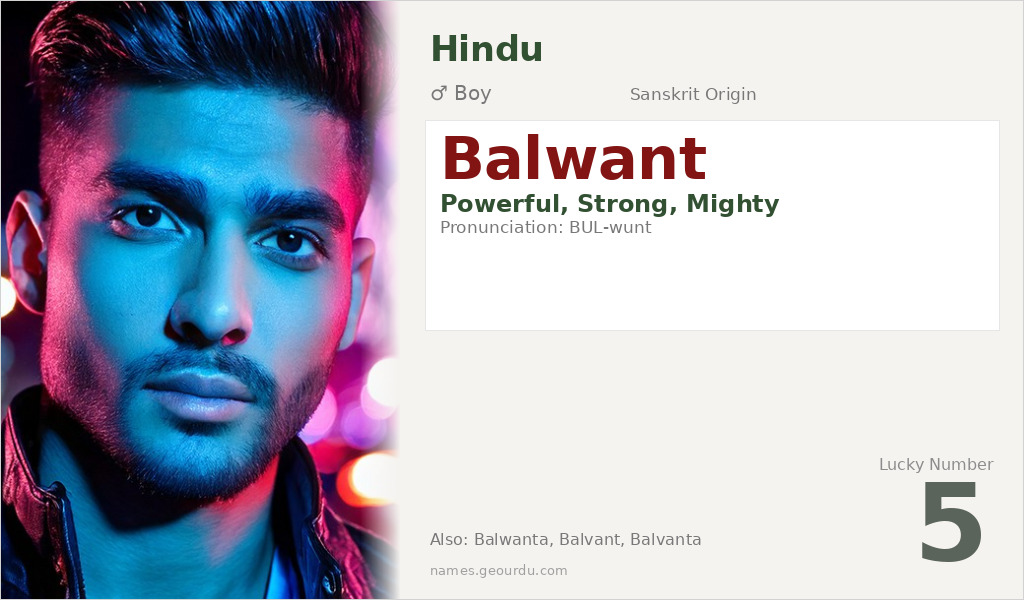
| 📛 Name | Balwant |
| 💎 Meaning | Powerful, Strong, Mighty |
| 👤 Gender | Boy |
| 🕌 Religion | Hindu |
| 🌍 Origin | Sanskrit |
| 🗣 Pronunciation | BUL-wunt |
| ✍️ Urdu | بلونت |
| ✍️ Arabic | بالوانت |
| 🔢 Numerology | 5 |
| ✨ Spellings | Balwanta, Balvant, Balvanta, Balwanth |
Origin & Cultural Significance
Balwant has its origins in ancient Sanskrit, which has influenced numerous modern Indian languages. While primarily associated with Hindu tradition, the name is also used in Sikh communities, reflecting the shared linguistic heritage of North Indian cultures. Historically, names containing ‘bala’ (strength) elements were popular among warrior classes and royalty in ancient India. The name spread through literary works, religious texts, and oral traditions across the Indian subcontinent. Today, it remains particularly common in Punjab, Haryana, Gujarat, and other regions with strong Sanskrit linguistic influence.
Personality Traits
The meaning of Balwant naturally suggests personality traits associated with strength and resilience. Those bearing this name are often expected to demonstrate fortitude, determination, and protective instincts. In cultural contexts, the name carries expectations of leadership capability and the ability to overcome obstacles. While individual personalities vary, the name’s etymology creates associations with physical, mental, or spiritual power that can influence how bearers are perceived in their communities.
Similar Names
If you like Balwant, consider: Baldev, Balbir, Balkrishna, Balaram, Baldwin
Famous People Named Balwant
- Balwant Singh Rajoana — Indian Sikh activist and former soldier
- Balwant Gargi — Punjabi playwright and novelist
- Balwant Rai Mehta — Indian politician and former Chief Minister of Gujarat
Frequently Asked Questions About Balwant
What does Balwant mean?
Balwant means 'powerful', 'strong', or 'mighty'. It comes from Sanskrit, combining 'bala' (strength) and '-want' (possessing), so it literally means 'one who possesses strength'.
Is Balwant a boy or girl name?
Balwant is exclusively a boy's name in Indian naming traditions. While some Sanskrit names can be unisex, Balwant has historically been used only for males across Hindu and Sikh communities.
What is the origin of Balwant?
Balwant originates from Sanskrit, the ancient classical language of India. It is a compound word that follows traditional Sanskrit naming patterns and has been used for centuries in various Indian languages and cultures.





