
Table of Contents
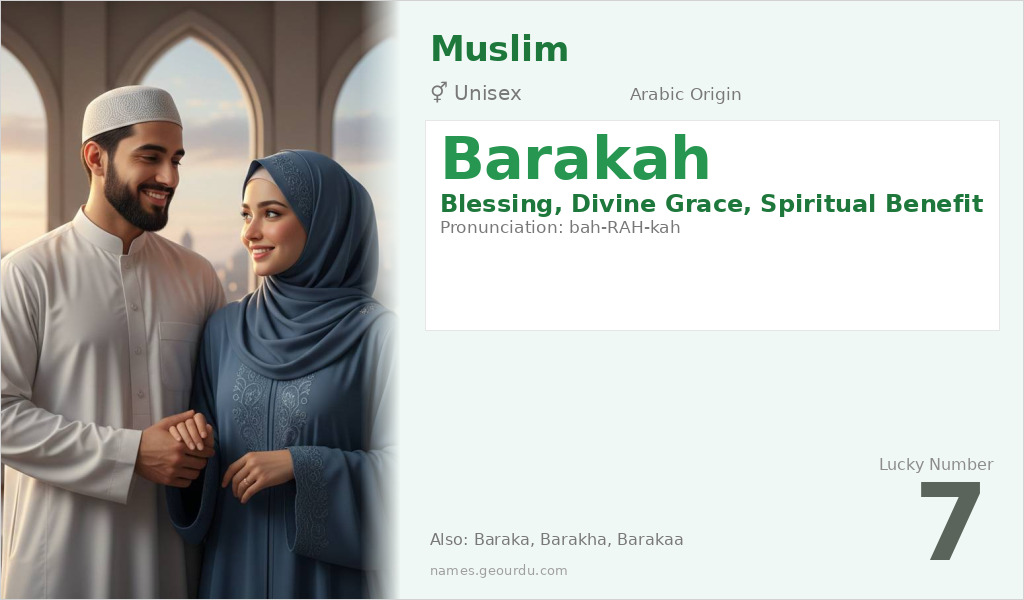
Barakah is a profoundly spiritual name with roots deep in Arabic language and Islamic tradition. Meaning ‘blessing’ or ‘divine grace,’ this name carries significant cultural and religious weight across Muslim communities worldwide. Unlike many names that are gender-specific, Barakah is beautifully versatile, used for both boys and girls. Its enduring popularity stems from its connection to core Islamic concepts of spiritual abundance and God’s favor.
Meaning of Barakah
The name Barakah originates from the Arabic root B-R-K (ب ر ك), which fundamentally means ‘to bless’ or ‘to kneel.’ This root gives rise to various related words including ‘mubarak’ (blessed) and ‘barak’ (to kneel in prayer). In Islamic context, barakah specifically refers to the divine blessing that causes increase, protection, and spiritual benefit in one’s life. The concept appears throughout the Quran, such as in Surah Al-A’raf (7:96), and in numerous Hadiths describing how believers can attain and preserve barakah. Linguistically, it’s distinct from mere material wealth, encompassing spiritual growth, health, relationships, and overall well-being bestowed by God.
| 📛 Name | Barakah |
| 💎 Meaning | Blessing, Divine Grace, Spiritual Benefit |
| 👤 Gender | Unisex |
| 🕌 Religion | Muslim |
| 🌍 Origin | Arabic |
| 🗣 Pronunciation | bah-RAH-kah |
| ✍️ Urdu | برکت |
| ✍️ Arabic | بركة |
| 🔢 Numerology | 7 |
| ✨ Spellings | Baraka, Barakha, Barakaa, Barakah |
Origin & Cultural Significance
Barakah has its origins in pre-Islamic Arabic language but gained profound significance with the advent of Islam. The term became central to Islamic spirituality, describing God’s continuous blessings that manifest in both visible and invisible ways. Historically, several notable companions of Prophet Muhammad bore this name, including Barakah al-Qibtiyya (also known as Umm Ayman), who played a significant role in early Islamic history. The name spread throughout the Muslim world via Arabic language and Islamic scholarship, maintaining its religious connotations across diverse cultures from North Africa to Southeast Asia. While primarily used in Muslim communities, the concept of barakah has influenced spiritual vocabulary in various languages through cultural exchange.
Personality Traits
Those named Barakah are often associated with qualities of spiritual depth, generosity, and stability. They tend to approach life with gratitude and seek to create positive impact in their relationships and communities. Their name suggests someone who values meaningful connections and acts as a source of comfort and benefit to others. While personality varies by individual, the name carries expectations of integrity, humility, and a focus on spiritual rather than purely material pursuits.
Similar Names
If you like Barakah, consider: Nimat (Arabic: blessing), Rahmat (Arabic: mercy), Fadl (Arabic: grace), Hadiyah (Arabic: gift), Mubarak (Arabic: blessed)
Famous People Named Barakah
- Barakah bint Tha'alaba — Early Muslim woman companion of Prophet Muhammad
- Barakah al-Qibtiyya — Also known as Umm Ayman, nursemaid and companion of Prophet Muhammad
Frequently Asked Questions About Barakah
What does Barakah mean?
Barakah means 'blessing,' 'divine grace,' or 'spiritual benefit' in Arabic. It comes from the root B-R-K which conveys concepts of blessing and prosperity.
Is Barakah a boy or girl name?
Barakah is a unisex name used for both boys and girls in Muslim communities, though it may be more common for girls in some regions. Its spiritual meaning makes it appropriate for either gender.
What is the origin of Barakah?
Barakah originates from Arabic language and Islamic tradition. It's a deeply religious name with roots in Quranic vocabulary and early Islamic history, particularly associated with companions of Prophet Muhammad.