
Table of Contents
Bashishta, a name steeped in ancient Vedic tradition, carries the profound meaning of ‘most excellent’ or ‘supreme’ in Sanskrit. This distinguished name belongs to one of Hinduism’s most revered sages, Vasishtha, who appears throughout sacred texts as a symbol of wisdom and spiritual authority. Choosing Bashishta for your child connects them to a lineage of philosophical depth and intellectual excellence that has guided Hindu thought for millennia. The name’s rich heritage makes it both timeless and deeply meaningful for families seeking a name with spiritual resonance.
Meaning of Bashishta
Bashishta (more commonly spelled Vasishtha in scholarly contexts) derives from the Sanskrit compound ‘vasiṣṭha’ (वसिष्ठ), which breaks down to ‘vasi’ meaning ‘dwelling, abode, residence’ and ‘iṣṭha’ meaning ‘most desired, excellent, best’. Together, they create the meaning ‘the most excellent dwelling’ or metaphorically ‘supreme being’. This etymology reflects the name’s association with spiritual perfection and highest attainment. In Hindu philosophy, Vasishtha represents the ideal sage whose consciousness serves as the perfect dwelling for divine wisdom. The name appears in the Rigveda (7.33) where Vasishtha is mentioned as a seer, and throughout the Mahabharata and Puranas as a central spiritual figure. Linguistic analysis confirms this meaning across classical Sanskrit literature and commentaries.
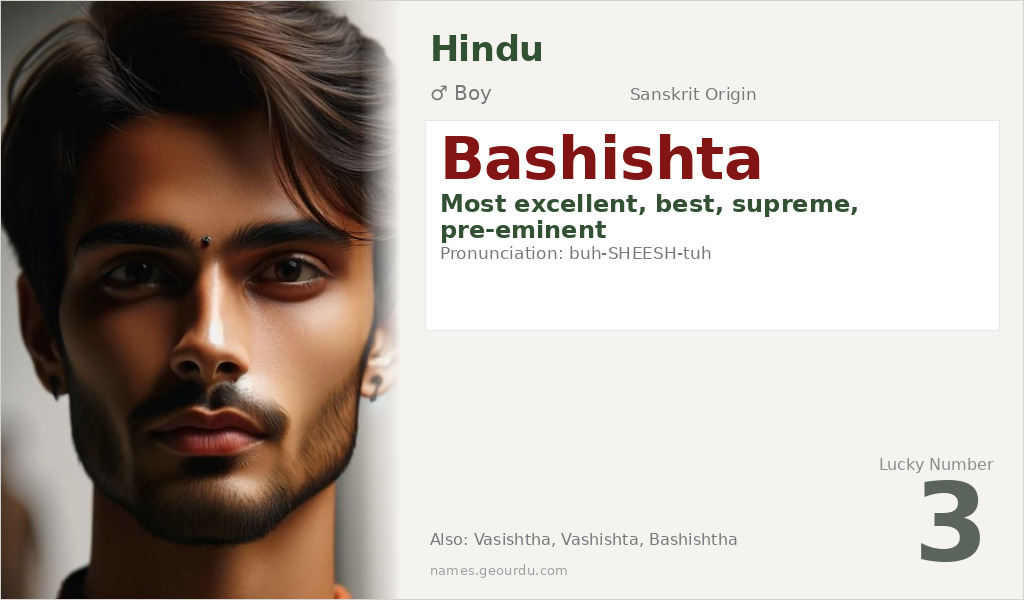
| 📛 Name | Bashishta |
| 💎 Meaning | Most excellent, best, supreme, pre-eminent |
| 👤 Gender | Boy |
| 🕌 Religion | Hindu |
| 🌍 Origin | Sanskrit |
| 🗣 Pronunciation | buh-SHEESH-tuh |
| ✍️ Urdu | بشیستھ |
| ✍️ Arabic | باشيشتا |
| 🔢 Numerology | 3 |
| ✨ Spellings | Vasishtha, Vashishta, Bashishtha, Vasishta |
Origin & Cultural Significance
Bashishta originates from ancient Sanskrit, the liturgical language of Hinduism, and specifically references Rishi Vasishtha, one of the Saptarishis (seven great sages) in Hindu tradition. Vasishtha appears in the Rigveda (dated 1500-1200 BCE) as the author of numerous hymns and as the family priest (purohita) of the Solar dynasty kings, including Lord Rama’s ancestors. The name gained prominence through texts like the Yoga Vasishtha, a philosophical dialogue between Rama and Vasishtha about consciousness and reality. Culturally, the name represents the ideal Brahmin sage—wise, composed, and spiritually accomplished. While primarily a Hindu name, its Sanskrit origin means it’s respected across Indian religions that engage with Vedic literature, though it remains most closely associated with Hindu tradition.
Personality Traits
Those named Bashishta often embody the qualities of their namesake sage: wisdom, calmness, and intellectual depth. They tend to be natural teachers or guides, with a thoughtful approach to life’s challenges. The name suggests someone who values knowledge, spirituality, and maintaining harmony in their relationships and surroundings. While individual personalities vary, the name’s meaning of ‘most excellent’ often inspires high standards and a pursuit of excellence in chosen endeavors.
Similar Names
If you like Bashishta, consider: Vishwamitra, Agastya, Parashara, Bhrigu, Atri
Famous People Named Bashishta
- Vasishtha — One of the Saptarishis (seven great sages) in Hindu tradition, author of numerous Vedic hymns and the Yoga Vasishtha scripture
- Vasishtha Ganapati Muni — 20th century Indian scholar and disciple of Ramana Maharshi who wrote extensively on Vedic philosophy
Frequently Asked Questions About Bashishta
What does Bashishta mean?
Bashishta means 'most excellent', 'best', 'supreme', or 'pre-eminent' in Sanskrit. It specifically refers to the quality of being the highest or most distinguished.
Is Bashishta a boy or girl name?
Bashishta is exclusively a boy's name in Hindu tradition, named after the male sage Vasishtha. There are no recorded instances of it being used for girls in historical or contemporary contexts.
What is the origin of Bashishta?
Bashishta originates from Sanskrit, the ancient language of Hindu scriptures. It specifically comes from the name Vasishtha, one of the seven great sages (Saptarishi) in Hindu tradition, first appearing in the Rigveda around 1500-1200 BCE.





