
Table of Contents
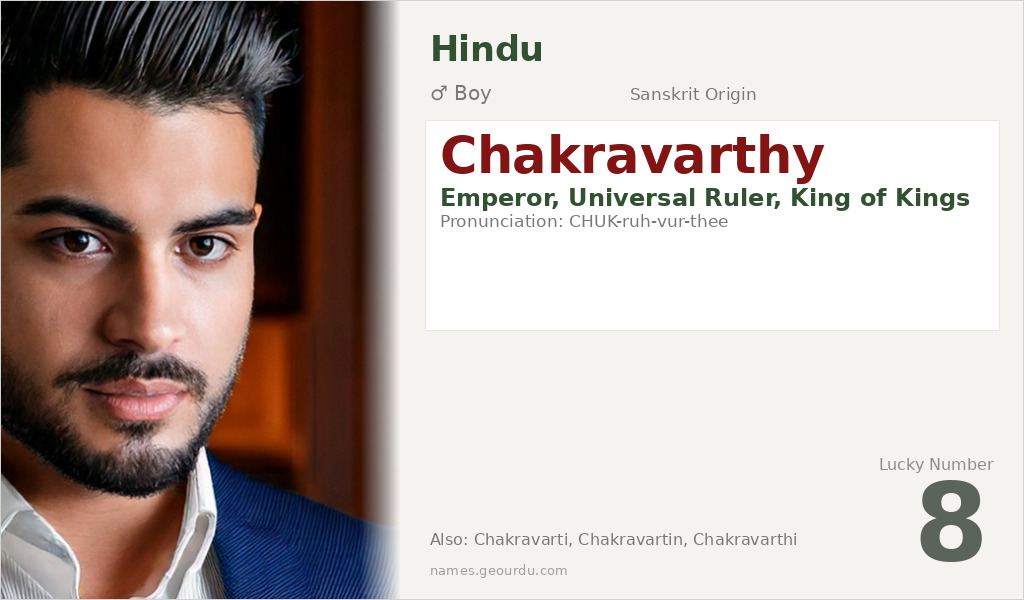
Chakravarthy is a powerful and regal name of Sanskrit origin, carrying centuries of cultural weight in Indian traditions. Meaning ‘Emperor’ or ‘Universal Ruler’, this name evokes images of sovereignty, leadership, and expansive authority. Often chosen for boys in Hindu families, it reflects aspirations for strength, wisdom, and noble character. Its deep roots in ancient texts make it both historically significant and timelessly relevant.
Meaning of Chakravarthy
Chakravarthy originates from the Sanskrit term ‘Chakravartin’, which is composed of two elements: ‘chakra’ meaning ‘wheel’, ‘discus’, or ‘circle’, and ‘vartin’ meaning ‘one who turns’ or ‘mover’. In Vedic and classical Indian literature, a Chakravartin was an ideal universal monarch whose rule was marked by righteousness (dharma) and whose influence extended across all lands. This concept appears prominently in Hindu epics like the Mahabharata, Buddhist sutras describing wheel-turning kings, and Jain scriptures outlining enlightened rulers. The name thus conveys not just political power but moral authority and cosmic order, symbolizing a leader who maintains balance and justice throughout their domain.
| 📛 Name | Chakravarthy |
| 💎 Meaning | Emperor, Universal Ruler, King of Kings |
| 👤 Gender | Boy |
| 🕌 Religion | Hindu |
| 🌍 Origin | Sanskrit |
| 🗣 Pronunciation | CHUK-ruh-vur-thee |
| ✍️ Urdu | چکرورتی |
| ✍️ Arabic | تشاكرافارتي |
| 🔢 Numerology | 8 |
| ✨ Spellings | Chakravarti, Chakravartin, Chakravarthi |
Origin & Cultural Significance
The name Chakravarthy has its origins in ancient Sanskrit, the classical language of India, and is deeply embedded in Hindu, Buddhist, and Jain traditions. Historically, the title ‘Chakravartin’ was used for legendary emperors in Indian mythology and history, such as Bharata and Ashoka, who were considered to rule justly over vast territories. In Hindu culture, it is particularly associated with the idea of a dharmic ruler, often linked to Vishnu’s Sudarshana Chakra (a divine discus) as a symbol of protection and order. Over time, it evolved into a given name in South Indian communities, especially among Tamil and Telugu speakers, reflecting cultural values of leadership and nobility.
Personality Traits
Those named Chakravarthy are often seen as born leaders with a natural aptitude for management and decision-making. They may exhibit confidence, strategic thinking, and a protective instinct toward others, mirroring the name’s imperial connotations. While they can be authoritative, they also tend to value fairness and responsibility, striving to create harmony in their surroundings. This name suggests a personality that is both commanding and conscientious, capable of guiding others with wisdom and integrity.
Similar Names
If you like Chakravarthy, consider: Rajendra, Samrat, Maharaja, Chandragupta, Ashoka
Famous People Named Chakravarthy
- Chakravarthy Rajagopalachari — Indian politician and activist, son of C. Rajagopalachari
- Chakravarthy — Indian film director known for Tamil movies like 'Muthu' and 'Kaththi'
Frequently Asked Questions About Chakravarthy
What does Chakravarthy mean?
Chakravarthy means 'Emperor', 'Universal Ruler', or 'King of Kings'. It comes from the Sanskrit word 'Chakravartin', which literally translates to 'wheel-turner', symbolizing a monarch whose dominion extends everywhere.
Is Chakravarthy a boy or girl name?
Chakravarthy is exclusively a boy's name in Hindu naming traditions, reflecting its meaning related to kingship and masculine leadership roles in historical contexts.
What is the origin of Chakravarthy?
Chakravarthy originates from Sanskrit, an ancient Indian language. It is deeply rooted in Hindu, Buddhist, and Jain cultures, where it denotes an ideal universal ruler or emperor.





