
Table of Contents
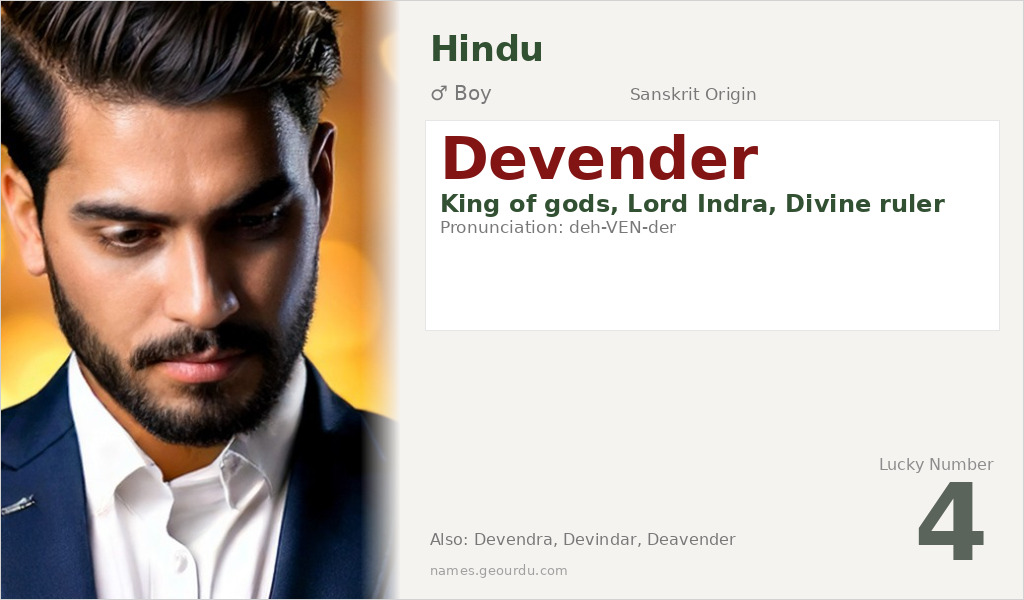
Devender is a powerful and traditional Hindu boy’s name that carries the weight of divine royalty. Rooted in ancient Sanskrit, it combines ‘Deva’ (god) and ‘Indra’ (king of gods) to signify celestial leadership. This name is popular among Hindu families seeking to bestow qualities of strength, protection, and authority upon their sons. Explore the rich etymology, cultural significance, and modern usage of Devender in this detailed analysis.
Meaning of Devender
Devender derives from Sanskrit, an ancient Indo-Aryan language central to Hindu scriptures. The first component, ‘Deva’ (देव), means ‘god’ or ‘divine being,’ appearing in numerous Hindu texts like the Vedas and Puranas. The second component, ‘Indra’ (इन्द्र), refers specifically to the king of the Devas (gods) in Hindu mythology, known for his control over weather and his role as a warrior deity. Together, Devender translates to ‘King of Gods’ or ‘Divine Ruler,’ embodying sovereignty and spiritual power. This compound structure is common in Sanskrit names, where elements are combined to create meaningful, auspicious appellations. The name is phonetically rendered as ‘deh-VEN-der’ in English, with stress on the second syllable.
| 📛 Name | Devender |
| 💎 Meaning | King of gods, Lord Indra, Divine ruler |
| 👤 Gender | Boy |
| 🕌 Religion | Hindu |
| 🌍 Origin | Sanskrit |
| 🗣 Pronunciation | deh-VEN-der |
| ✍️ Urdu | دیویندر |
| ✍️ Arabic | ديفيندر |
| 🔢 Numerology | 4 |
| ✨ Spellings | Devendra, Devindar, Deavender, Devendar |
Origin & Cultural Significance
Originating from Sanskrit, Devender has deep roots in Hindu culture and Vedic traditions. It is primarily used in India and among Hindu diaspora communities worldwide, reflecting the enduring influence of Sanskrit on Indian naming conventions. The name gained prominence through mythological references to Indra, who is celebrated in texts like the Rigveda as a central deity. In modern times, Devender remains a popular choice in regions such as Maharashtra, Gujarat, and North India, often chosen for its auspicious connotations and historical resonance. While it is distinctly Hindu in religious association, its linguistic origins connect it to broader Indo-European language families, though it does not have verified meanings in unrelated languages like Arabic or Persian.
Personality Traits
Named after the king of gods, Devender often evokes traits of leadership, confidence, and a protective nature. Those bearing this name may be perceived as authoritative and driven, with a natural inclination toward roles that require decision-making and responsibility. Inspired by Indra’s mythological persona, they might exhibit qualities of resilience and a desire to overcome challenges, much like the deity who battles demons in Hindu lore. This name can inspire a sense of duty and honor, shaping an individual’s path toward impactful endeavors.
Similar Names
If you like Devender, consider: Dev, Devansh, Indra, Mahendra, Rajendra
Famous People Named Devender
- Devendra Fadnavis — Indian politician and former Chief Minister of Maharashtra
- Devendra Banhart — Venezuelan-American singer-songwriter and visual artist
Frequently Asked Questions About Devender
What does Devender mean?
Devender means 'King of Gods' or 'Divine Ruler,' derived from the Sanskrit words 'Deva' (god) and 'Indra' (king of gods).
Is Devender a boy or girl name?
Devender is exclusively a boy's name in Hindu tradition, reflecting masculine divine qualities associated with the deity Indra.
What is the origin of Devender?
Devender originates from Sanskrit, an ancient Indian language, and is deeply rooted in Hindu mythology and culture.





