
Table of Contents
Dhrtaraja is a powerful and regal Sanskrit name that carries centuries of cultural heritage. Meaning ‘King Who Holds Firm’ or ‘Steadfast Ruler’, this name embodies qualities of stability, sovereignty, and principled leadership. Primarily used in Hindu communities, it reflects ancient Indian values of dharma and righteous governance. With its deep linguistic roots, Dhrtaraja remains a meaningful choice for parents seeking a name with historical depth and noble connotations.
Meaning of Dhrtaraja
Dhrtaraja is a compound Sanskrit name with precise etymological components. The first element, ‘dhṛta’ (धृत), derives from the Sanskrit root √dhṛ, meaning ‘to hold, bear, support, or maintain’. This conveys steadfastness, firmness, and endurance. The second element, ‘rāja’ (राज), comes from √rāj, meaning ‘to rule, shine, or be illustrious’, and directly translates to ‘king’ or ‘ruler’. Thus, Dhrtaraja literally means ‘one who holds kingship firmly’—a ruler who maintains sovereignty with stability and integrity. This name appears in classical Indian literature and epics, often describing monarchs known for their unwavering commitment to dharma (cosmic order) and just rule. Unlike simpler translations, it specifically combines rulership with the quality of steadfastness, making it distinct from names that merely mean ‘king’ or ‘upholder of law’.
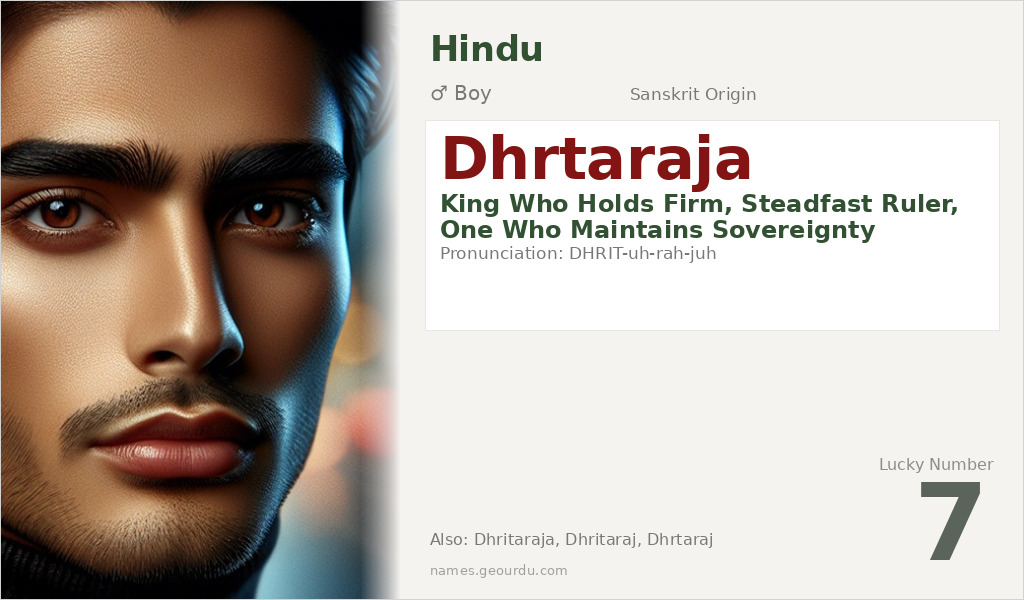
| 📛 Name | Dhrtaraja |
| 💎 Meaning | King Who Holds Firm, Steadfast Ruler, One Who Maintains Sovereignty |
| 👤 Gender | Boy |
| 🕌 Religion | Hindu |
| 🌍 Origin | Sanskrit |
| 🗣 Pronunciation | DHRIT-uh-rah-juh |
| ✍️ Urdu | دھرت راج |
| ✍️ Arabic | دهريتاراجا |
| 🔢 Numerology | 7 |
| ✨ Spellings | Dhritaraja, Dhritaraj, Dhrtaraj, Dhrutaraja |
Origin & Cultural Significance
Dhrtaraja originates from Sanskrit, the ancient liturgical language of Hinduism, Buddhism, and Jainism, with literary records dating back over 3,500 years. As a compound name, it reflects the sophisticated naming traditions of ancient India, where names often conveyed virtues, roles, or divine attributes. In Hindu culture, names like Dhrtaraja are deeply connected to concepts of dharma (righteousness) and rajadharma (the duty of a ruler), emphasizing moral leadership and stability. Historically, such names were bestowed upon individuals in royal or warrior classes, symbolizing their expected qualities of governance and protection. While primarily used in Hindu communities today, the name’s Sanskrit roots give it pan-Indian relevance, appearing in various regional adaptations and literary contexts across South Asia.
Personality Traits
Those named Dhrtaraja are often associated with traits of resilience, authority, and dependability. They may exhibit natural leadership abilities, combined with a strong sense of responsibility and commitment to their principles. In social and professional settings, they tend to be seen as pillars of stability—people who uphold traditions and provide steady guidance. Their name suggests a personality that values order, integrity, and lasting legacy, often inspiring trust and respect from others.
Similar Names
If you like Dhrtaraja, consider: Dharmaraja, Yudhishthira, Bharata, Rajendra, Dhirasena
Famous People Named Dhrtaraja
- Dhritarashtra — In the Mahabharata, Dhritarashtra was the blind king of Hastinapura, father of the Kauravas. The name Dhritarashtra shares the same 'dhṛta' root but means 'one who holds the kingdom'.
- Various historical and mythological figures — While not specifically named Dhrtaraja, many Indian kings and rulers in Puranic literature embody the qualities of a 'dhrtaraja' (steadfast ruler).
Frequently Asked Questions About Dhrtaraja
What does Dhrtaraja mean?
Dhrtaraja means 'King Who Holds Firm' or 'Steadfast Ruler'. It is a Sanskrit compound name from 'dhṛta' (steadfast, held) and 'rāja' (king, ruler).
Is Dhrtaraja a boy or girl name?
Dhrtaraja is exclusively a boy's name in Hindu naming traditions, reflecting masculine qualities of kingship and steadfast rule.
What is the origin of Dhrtaraja?
Dhrtaraja originates from Sanskrit, the ancient classical language of India, and is deeply rooted in Hindu culture and epics like the Mahabharata.





