
Table of Contents
Digambar is a profound Sanskrit name that carries centuries of spiritual tradition within its meaning. Literally translating to ‘sky-clad’ or ‘one who wears the sky as clothing’, this name embodies the highest ideals of asceticism and detachment in Hindu philosophy. Used primarily for boys, Digambar represents a connection to ancient Indian spiritual practices where renunciation of material possessions was considered the path to enlightenment. Today, it remains a meaningful choice for parents seeking a name with deep philosophical roots.
Meaning of Digambar
The name Digambar originates from the Sanskrit language, combining two elements: ‘dig’ (दिक्) meaning ‘directions’, ‘space’, or ‘sky’, and ‘ambara’ (अम्बर) meaning ‘garment’, ‘clothing’, or ‘covering’. When combined, these elements create the literal meaning ‘sky-clad’ or ‘wearing the sky as one’s only garment’. This term holds specific significance in both Hindu and Jain traditions, where it describes ascetics who have renounced all worldly possessions including clothing. The concept represents complete detachment from material concerns and identification with the infinite. In Jainism specifically, Digambara is one of the two main sects, whose monks practice complete nudity as part of their spiritual discipline.
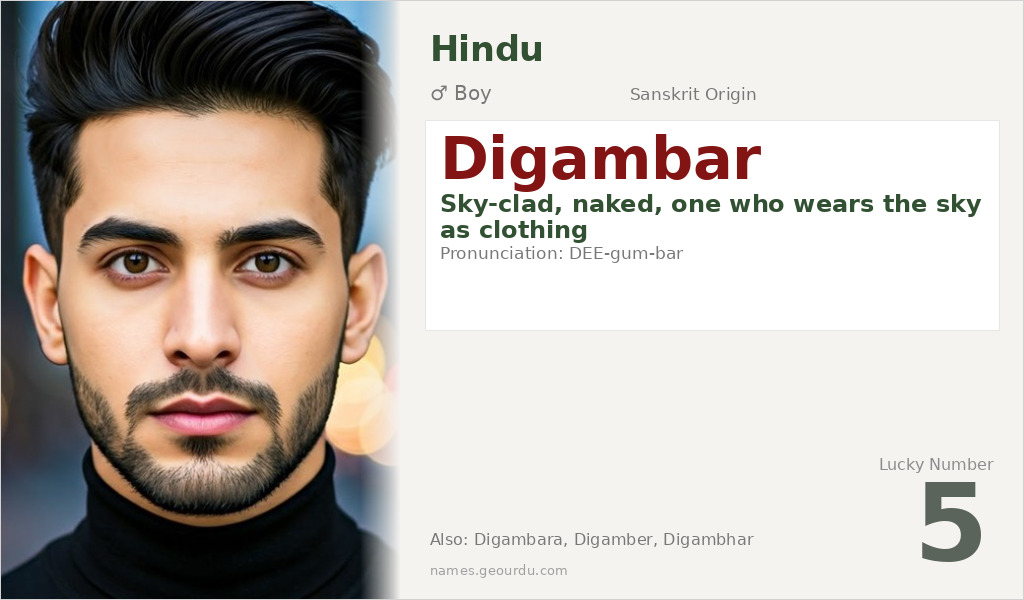
| 📛 Name | Digambar |
| 💎 Meaning | Sky-clad, naked, one who wears the sky as clothing |
| 👤 Gender | Boy |
| 🕌 Religion | Hindu |
| 🌍 Origin | Sanskrit |
| 🗣 Pronunciation | DEE-gum-bar |
| ✍️ Urdu | ڈیگمبر |
| ✍️ Arabic | ديغامبر |
| 🔢 Numerology | 5 |
| ✨ Spellings | Digambara, Digamber, Digambhar |
Origin & Cultural Significance
Digambar has its roots in ancient Indian spiritual traditions, primarily within Hinduism and Jainism. The term appears in classical Sanskrit texts describing ascetic practices dating back over two millennia. In Hindu tradition, certain sadhus (holy men) who follow the path of complete renunciation are called Digambar, symbolizing their freedom from all material attachments. The name gained particular prominence within the Digambara sect of Jainism, established around the 3rd century BCE, whose monks practice complete nudity to demonstrate their detachment from worldly possessions. While the name is used across India, it has special significance in Maharashtra and Goa regions, where several historical figures bearing this name contributed to religious and cultural movements.
Personality Traits
Those named Digambar are often associated with qualities of simplicity, spiritual depth, and philosophical thinking. The name’s meaning suggests a personality inclined toward minimalism and authenticity rather than material accumulation. They may exhibit strong principles, independence of thought, and a contemplative nature. While not necessarily ascetic in modern contexts, the name carries connotations of wisdom, detachment from trivial concerns, and focus on essential truths.
Similar Names
If you like Digambar, consider: Nirvana, Sanyasi, Tyagi, Vairagi, Muni
Famous People Named Digambar
- Digambar — 17th century Marathi saint poet from the Varkari tradition
- Digambar Kamat — Indian politician and former Chief Minister of Goa
Frequently Asked Questions About Digambar
What does Digambar mean?
Digambar means 'sky-clad' or 'one who wears the sky as clothing' in Sanskrit. It refers to ascetics who renounce all material possessions including clothing, symbolizing complete spiritual detachment.
Is Digambar a boy or girl name?
Digambar is traditionally a masculine name used for boys in Hindu and Jain communities. The name's association with male ascetic traditions makes it predominantly male, though names can evolve in usage over time.
What is the origin of Digambar?
Digambar originates from Sanskrit, the classical language of ancient India. It has specific significance in both Hindu and Jain spiritual traditions, particularly associated with the Digambara sect of Jainism whose monks practice complete nudity as part of their ascetic discipline.





