
Table of Contents
Deepavali is one of the most significant names in Hindu culture, representing both a major festival and a meaningful personal name. Derived from ancient Sanskrit, it literally translates to ‘row of lamps’ and symbolizes the triumph of light over darkness. While primarily known as the Festival of Lights celebrated by millions worldwide, Deepavali also serves as a beautiful, symbolic name with deep spiritual connotations. This comprehensive guide explores the etymology, cultural significance, and usage of this luminous name.
Meaning of Deepavali
Deepavali originates from the Sanskrit language, combining two distinct elements: ‘dīpa’ (दीप) meaning ‘lamp’ or ‘light’ and ‘āvali’ (आवलि) meaning ‘row’, ‘series’, or ‘line’. The complete compound ‘dīpāvali’ thus translates precisely to ‘row of lamps’. This name is deeply embedded in Hindu religious texts and traditions, most famously referring to the five-day festival that celebrates Lord Rama’s return to Ayodhya after defeating Ravana. Linguistically, it belongs to the Indo-Aryan language family and has cognates in many modern Indian languages. The name’s meaning extends beyond the literal to symbolize enlightenment, knowledge, prosperity, and the victory of good over evil.
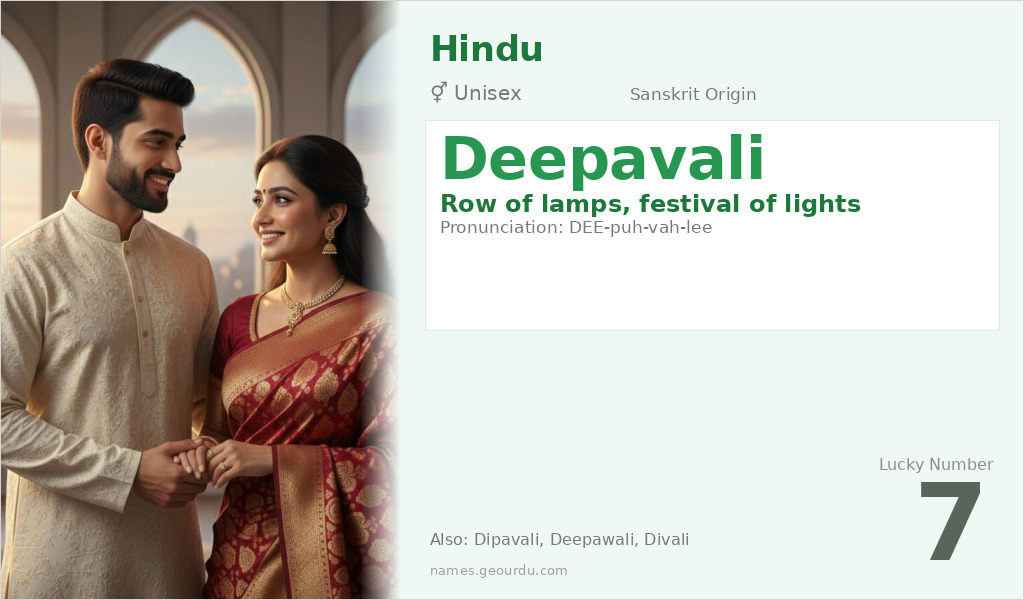
| 📛 Name | Deepavali |
| 💎 Meaning | Row of lamps, festival of lights |
| 👤 Gender | Unisex |
| 🕌 Religion | Hindu |
| 🌍 Origin | Sanskrit |
| 🗣 Pronunciation | DEE-puh-vah-lee |
| ✍️ Urdu | دیوالی |
| ✍️ Arabic | ديوالي |
| 🔢 Numerology | 7 |
| ✨ Spellings | Dipavali, Deepawali, Divali, Diwali |
Origin & Cultural Significance
Deepavali has its roots in ancient India, with references found in early Sanskrit texts like the Padma Purana and Skanda Purana. The festival it names is celebrated across the Indian subcontinent and by Hindu communities worldwide, with regional variations in traditions and stories. As a personal name, Deepavali is used relatively rarely but carries profound symbolic weight, often given to children born during the festival period or to represent spiritual aspirations. The name has spread through Hindu diaspora communities to Southeast Asia, the Caribbean, Africa, and Western nations. While primarily associated with Hinduism, the festival is also observed by Jains, Sikhs, and some Buddhists, though as a personal name it remains predominantly Hindu.
Personality Traits
The name Deepavali evokes qualities of illumination, celebration, and spiritual awakening. Those bearing this name are often perceived as bringers of light and joy to their communities. They may exhibit traits of optimism, cultural pride, and a deep connection to tradition while embracing positive transformation. The name suggests someone who values knowledge, dispels darkness through wisdom, and maintains hope even in challenging circumstances.
Similar Names
If you like Deepavali, consider: Deepak, Deep, Avali, Jyoti, Prakash
Famous People Named Deepavali
- Deepavali is primarily known as a festival rather than a personal name, though it may be used symbolically. There are no widely known public figures with Deepavali as their given name.
Frequently Asked Questions About Deepavali
What does Deepavali mean?
Deepavali means 'row of lamps' or 'series of lights' in Sanskrit. It refers to the Hindu Festival of Lights that symbolizes the victory of light over darkness and knowledge over ignorance.
Is Deepavali a boy or girl name?
Deepavali is a unisex name, though it is more commonly known as the name of a major Hindu festival rather than a frequently used personal name. When used as a given name, it can be used for any gender.
What is the origin of Deepavali?
Deepavali originates from Sanskrit, an ancient Indo-Aryan language of India. It is composed of 'dīpa' (lamp) and 'āvali' (row), and has been used for centuries to denote both the festival and as a symbolic personal name in Hindu culture.