
Table of Contents
Deepawali, more commonly known as Diwali, is one of the most significant festivals in Hindu culture, celebrated with immense joy across India and the global diaspora. While rarely used as a personal name, the term carries profound spiritual meaning that transcends its literal translation. This festival of lights represents the eternal human aspiration for illumination, both literal and metaphorical. Understanding Deepawali offers insight into core Hindu philosophical values and cultural practices.
Meaning of Deepawali
Deepawali originates from the Sanskrit language, combining two distinct elements: ‘deepa’ (दीप) meaning ‘lamp’ or ‘light’, and ‘avali’ (आवलि) meaning ‘row’, ‘series’, or ‘line’. The complete term therefore translates precisely to ‘row of lamps’, referring to the traditional practice of illuminating homes, temples, and public spaces with numerous oil lamps during the festival. In Sanskrit literature, the concept appears in various contexts celebrating illumination and auspiciousness. The festival’s name embodies the symbolic victory of light (knowledge, goodness) over darkness (ignorance, evil), a theme central to Hindu philosophy. While the name is primarily associated with the festival, its components are occasionally used in compound personal names across Indian languages.
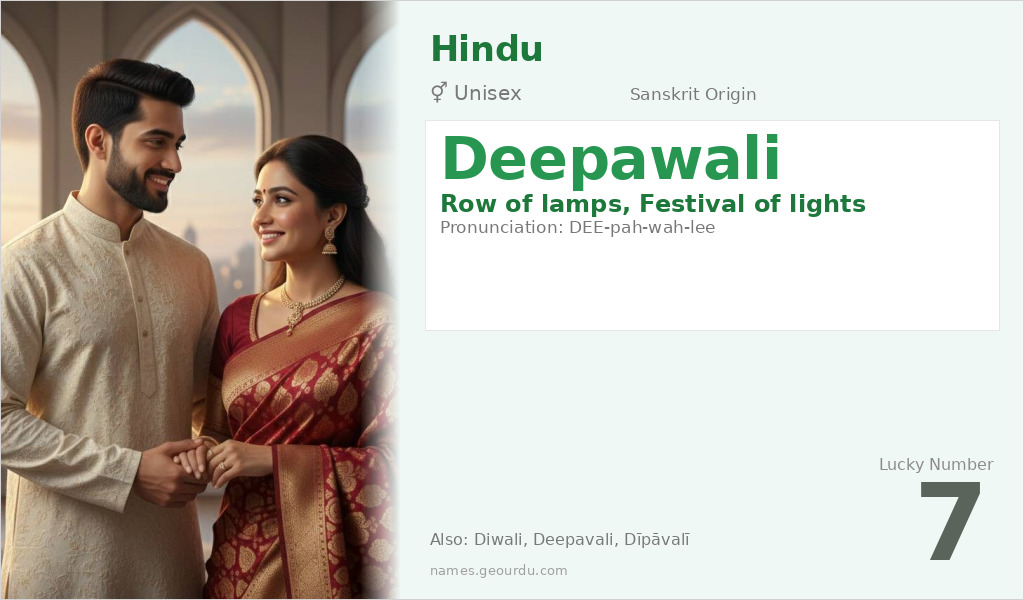
| 📛 Name | Deepawali |
| 💎 Meaning | Row of lamps, Festival of lights |
| 👤 Gender | Unisex |
| 🕌 Religion | Hindu |
| 🌍 Origin | Sanskrit |
| 🗣 Pronunciation | DEE-pah-wah-lee |
| ✍️ Urdu | دیوالی |
| ✍️ Arabic | ديوالي |
| 🔢 Numerology | 7 |
| ✨ Spellings | Diwali, Deepavali, Dīpāvalī, दीपावली |
Origin & Cultural Significance
Deepawali has its roots in ancient Sanskrit traditions and Hindu religious practices dating back thousands of years. The festival is mentioned in early Sanskrit texts and has evolved through various regional traditions across the Indian subcontinent. While primarily associated with Hinduism, the festival is also celebrated by Jains, Sikhs, and some Buddhist communities, each with their own historical narratives. The name reflects the pan-Indian cultural practice of lighting lamps during the autumn festival, symbolizing the return of Lord Rama to Ayodhya according to the Ramayana. Today, Deepawali/Diwali is recognized as a national holiday in India and celebrated by Hindu communities worldwide, maintaining its core symbolism while adapting to contemporary contexts.
Personality Traits
While Deepawali is primarily a festival name rather than a common personal name, those who might bear this name or be associated with it are often seen as embodiments of its symbolic values. They typically exhibit qualities of enlightenment, bringing clarity and hope to situations. Such individuals often value tradition, family, and community celebrations, serving as connectors between generations. Their personality might reflect the festival’s themes of renewal, prosperity, and the persistent human capacity to find light even in darkness.
Similar Names
If you like Deepawali, consider: Deepak, Deep, Prakash, Jyoti, Ujjwal
Famous People Named Deepawali
- Deepawali is not typically used as a personal name but is the name of India's most significant festival celebrated by millions including prominent figures like Mahatma Gandhi, who emphasized its message of light and truth.
- The festival is celebrated by Hindu communities worldwide, including notable diaspora figures in politics, arts, and business who observe Deepawali traditions.
Frequently Asked Questions About Deepawali
What does Deepawali mean?
Deepawali means 'row of lamps' in Sanskrit, referring to the Hindu Festival of Lights celebrated annually. The name combines 'deepa' (lamp) and 'avali' (row).
Is Deepawali a boy or girl name?
Deepawali is primarily the name of a major Hindu festival and is rarely used as a personal name. When occasionally used for people, it is considered unisex, though the festival itself has no gender association.
What is the origin of Deepawali?
Deepawali originates from Sanskrit, the ancient language of India, and refers to the Festival of Lights celebrated in Hindu tradition. The festival has historical and religious significance across the Indian subcontinent.