
Table of Contents
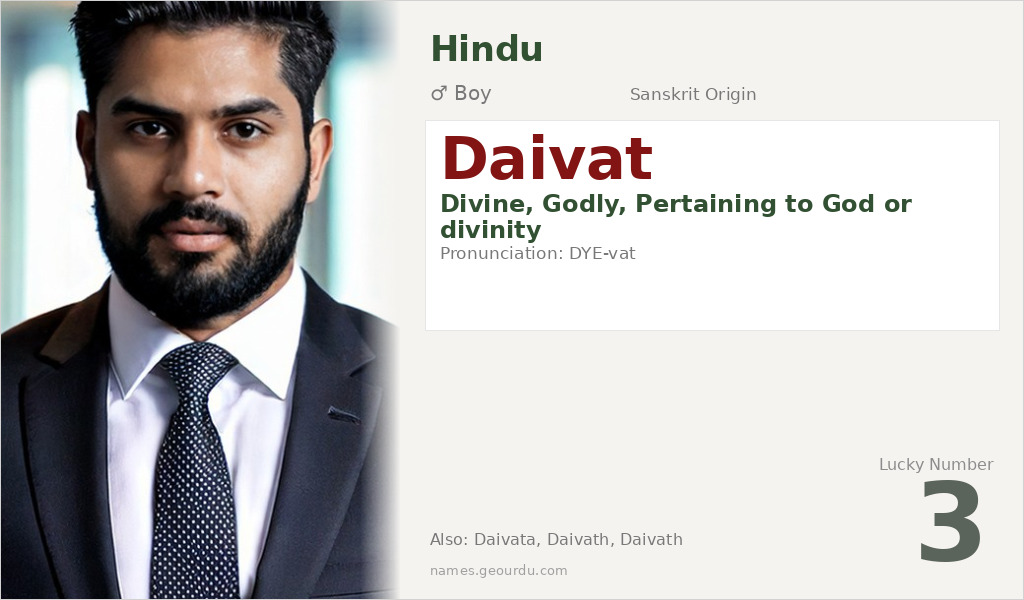
Daivat is a profound and spiritually rich name of Sanskrit origin, meaning ‘Divine’ or ‘Godly.’ Commonly given to boys in Hindu families, it embodies a connection to the celestial and sacred, reflecting deep religious roots. This name is cherished for its philosophical depth and cultural heritage, making it a meaningful choice for parents seeking a name with divine resonance. Explore the etymology, significance, and personality traits associated with Daivat in this comprehensive guide.
Meaning of Daivat
Daivat originates from the Sanskrit word ‘दैवत’ (daivata), which translates to ‘divine,’ ‘godly,’ or ‘pertaining to God or gods.’ The root ‘देव’ (deva) means ‘god’ or ‘deity,’ a central concept in Hinduism and other Indian religions, while the suffix ‘-त’ (-ta) forms adjectives or nouns indicating relation or possession. In Vedic texts, ‘daivata’ is used to refer to divine beings, celestial powers, or aspects of the divine, such as in rituals and hymns. This name is not found in Arabic, Persian, Pashto, or other regional languages with verified meanings, confirming its exclusive Sanskrit derivation. The meaning is well-documented in Sanskrit dictionaries and Hindu scriptures, emphasizing its spiritual and religious connotations.
| 📛 Name | Daivat |
| 💎 Meaning | Divine, Godly, Pertaining to God or divinity |
| 👤 Gender | Boy |
| 🕌 Religion | Hindu |
| 🌍 Origin | Sanskrit |
| 🗣 Pronunciation | DYE-vat |
| ✍️ Urdu | دیوت |
| ✍️ Arabic | دايفات |
| 🔢 Numerology | 3 |
| ✨ Spellings | Daivata, Daivath, Daivath, Daivat |
Origin & Cultural Significance
Daivat has its origins in ancient Sanskrit, the classical language of India, and is deeply rooted in Hindu culture and religion. It is primarily used in Hindu communities across India, Nepal, and the diaspora, reflecting the influence of Sanskrit on Indian naming traditions. The name appears in Hindu philosophical and religious contexts, such as in the Vedas and Puranas, where it denotes divine entities or sacred principles. Over time, it has been adopted as a personal name, symbolizing a child’s connection to the divine or auspicious blessings. While similar-sounding names exist in other languages, Daivat is specifically tied to Sanskrit and Hindu practices, without significant usage in Islamic, Christian, or other religious traditions.
Personality Traits
People named Daivat are often seen as spiritually inclined, with a natural affinity for introspection and ethical living. Their name inspires qualities of compassion, wisdom, and a sense of higher purpose, leading them to roles in leadership, education, or community service. They may exhibit creativity and intuition, drawing from the divine essence of their name to navigate life’s challenges with grace and resilience.
Similar Names
If you like Daivat, consider: Dev, Deva, Devansh, Divyansh, Divyesh
Famous People Named Daivat
- Daivat Patel — Indian-American entrepreneur in technology sector
- Daivat Singh — fictional character in modern Indian literature representing divine qualities
Frequently Asked Questions About Daivat
What does Daivat mean?
Daivat means 'Divine' or 'Godly,' derived from the Sanskrit word 'दैवत' (daivata), which refers to something pertaining to God or gods.
Is Daivat a boy or girl name?
Daivat is traditionally a boy name in Hindu culture, though it is rarely used for girls due to its masculine grammatical structure in Sanskrit.
What is the origin of Daivat?
Daivat originates from Sanskrit, an ancient Indian language, and is primarily associated with Hindu religion and culture, with no verified roots in other languages like Arabic or Persian.





