
Table of Contents
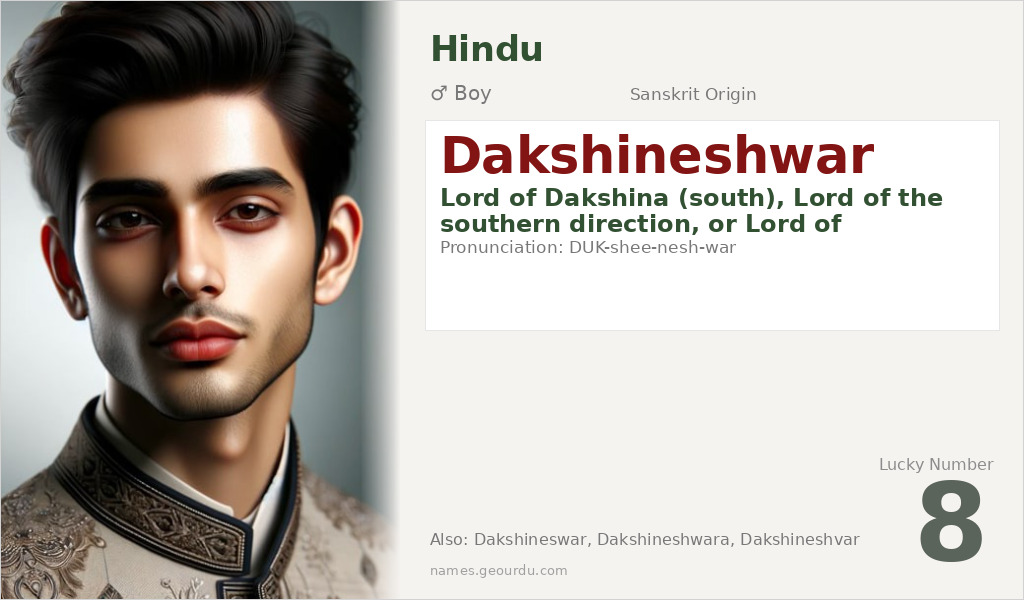
Dakshineshwar is a profound Sanskrit name rich with spiritual and directional symbolism in Hindu tradition. Primarily given to boys, this name embodies divine lordship over the southern direction and sacred offerings. It carries deep religious significance, often associated with Lord Shiva and ancient Vedic concepts. Explore the etymology, cultural context, and personality traits associated with this meaningful name.
Meaning of Dakshineshwar
Dakshineshwar is a compound Sanskrit name combining ‘Dakshina’ and ‘Ishwar’. ‘Dakshina’ (दक्षिणा) holds multiple meanings in Vedic texts: it refers to the southern cardinal direction, symbolizing the realm of ancestors and Yama; it also means ‘right hand’, representing skill and auspiciousness; and in ritual context, it denotes ‘offering’ or ‘gift’ given with respect. ‘Ishwar’ (ईश्वर) means ‘lord’, ‘master’, or ‘supreme being’, commonly used for deities like Shiva. Thus, Dakshineshwar translates to ‘Lord of the South’, ‘Lord of Offerings’, or ‘Master of the Right Hand’. This name is particularly associated with Shiva as the ruler of the southern direction in Hindu cosmology.
| 📛 Name | Dakshineshwar |
| 💎 Meaning | Lord of Dakshina (south), Lord of the southern direction, or Lord of offerings/gifts |
| 👤 Gender | Boy |
| 🕌 Religion | Hindu |
| 🌍 Origin | Sanskrit |
| 🗣 Pronunciation | DUK-shee-nesh-war |
| ✍️ Urdu | دکشنیشور |
| ✍️ Arabic | داكشينيشوار |
| 🔢 Numerology | 8 |
| ✨ Spellings | Dakshineswar, Dakshineshwara, Dakshineshvar |
Origin & Cultural Significance
Originating from classical Sanskrit, Dakshineshwar has roots in ancient Hindu scriptures and directional worship traditions. In Hinduism, the four cardinal directions are governed by deities: east by Indra, south by Yama, west by Varuna, and north by Kubera. Dakshineshwar as an epithet of Shiva emphasizes his sovereignty over the southern direction, linked to transformation and ancestral reverence. The name gained prominence through places like the Dakshineswar Kali Temple in West Bengal, India, dedicated in 1855. It remains used in Hindu communities, especially in India and Nepal, reflecting enduring spiritual and cultural heritage.
Personality Traits
Those named Dakshineshwar are often perceived as grounded, spiritually inclined, and protective individuals. They may demonstrate a strong sense of duty, guidance, and connection to cultural roots, with an innate ability to navigate challenges with resilience. Their personality might blend traditional values with a calm, authoritative presence, making them natural leaders in familial or community settings.
Similar Names
If you like Dakshineshwar, consider: Daksh, Dakshin, Ishwar, Dakshina, Dakshayani, Dakshata, Dakshayan, Dakshinamurthy, Dakshinayan, Dakshinesh
Famous People Named Dakshineshwar
- Dakshineswar Kali Temple — Famous Hindu temple in Kolkata, India, dedicated to Goddess Kali, named after the location Dakshineswar
- Sri Ramakrishna Paramahamsa — 19th-century Indian mystic who lived and taught at the Dakshineswar Kali Temple
Frequently Asked Questions About Dakshineshwar
What does Dakshineshwar mean?
Dakshineshwar means 'Lord of the South' or 'Lord of Offerings' in Sanskrit, derived from 'Dakshina' (south/offering) and 'Ishwar' (lord).
Is Dakshineshwar a boy or girl name?
Dakshineshwar is traditionally a boy name in Hindu culture, though it is rarely used for girls due to its masculine ending and deity association.
What is the origin of Dakshineshwar?
Dakshineshwar originates from Sanskrit, an ancient Indo-Aryan language of India, with deep roots in Hindu religious and directional traditions.





