
Table of Contents
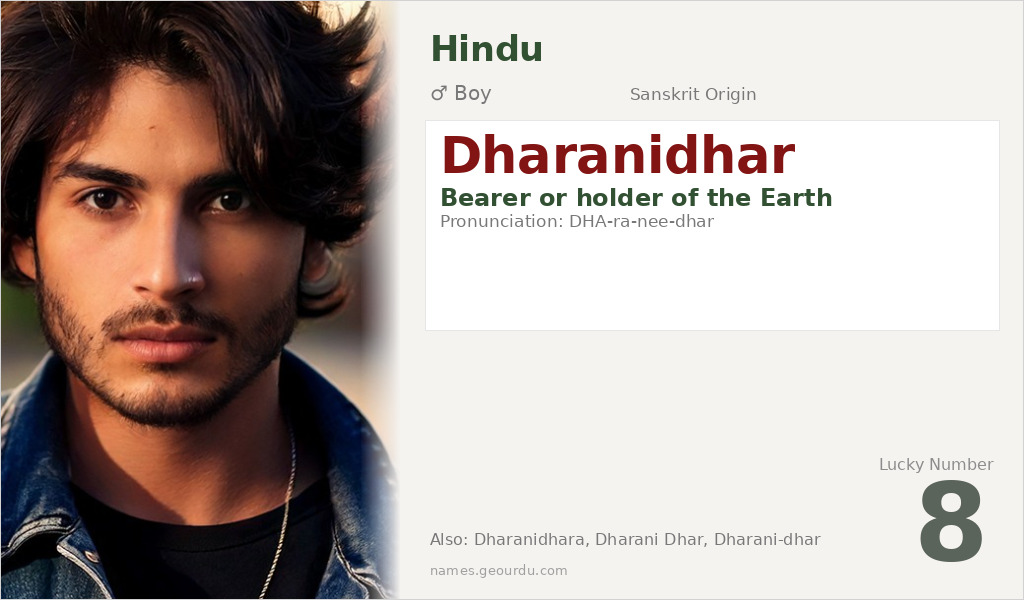
Dharanidhar is a profound and ancient Sanskrit name that carries deep mythological and cultural significance in Hindu tradition. Meaning ‘Bearer of the Earth’, this name evokes images of strength, stability, and divine support. Historically used as an epithet for Lord Vishnu and the serpent Sheshnag, Dharanidhar represents the cosmic force that sustains the world. Today, it remains a meaningful choice for parents seeking a name with spiritual depth and historical resonance.
Meaning of Dharanidhar
Dharanidhar is a classical Sanskrit compound name with a clear etymological foundation. It combines ‘Dharani’ (धरणी), derived from the Sanskrit root ‘dhṛ’ meaning ‘to hold’ or ‘to sustain’, which specifically refers to the Earth as the sustainer of life. The second component ‘Dhar’ (धर) comes from the same root and means ‘bearer’, ‘holder’, or ‘supporter’. Thus, the complete name translates precisely to ‘Bearer of the Earth’ or ‘One who holds the Earth’. This meaning is consistently documented in Sanskrit dictionaries, religious texts like the Puranas, and historical usage. The name’s linguistic structure follows standard Sanskrit compounding rules, making its meaning unambiguous and well-established in Indological scholarship.
| 📛 Name | Dharanidhar |
| 💎 Meaning | Bearer or holder of the Earth |
| 👤 Gender | Boy |
| 🕌 Religion | Hindu |
| 🌍 Origin | Sanskrit |
| 🗣 Pronunciation | DHA-ra-nee-dhar |
| ✍️ Urdu | دھرانی دھر |
| ✍️ Arabic | دهارانيدهار |
| 🔢 Numerology | 8 |
| ✨ Spellings | Dharanidhara, Dharani Dhar, Dharani-dhar |
Origin & Cultural Significance
Dharanidhar originates from Sanskrit, the ancient liturgical language of Hinduism, and has been used for centuries within Hindu communities across India and the diaspora. Its primary cultural context is Hindu mythology, where it appears as an epithet for deities and divine beings who support the cosmos. Most notably, it describes Lord Vishnu in his role as the preserver of the universe and the serpent Sheshnag (Ananta) upon whom Vishnu rests. The name reflects the Hindu cosmological concept of divine beings sustaining the Earth, making it particularly significant in Vaishnavism. While primarily a Hindu name, its Sanskrit origin means it may appear in related cultural contexts like Jainism or Buddhism, though with less frequency.
Personality Traits
Those named Dharanidhar are often perceived as having a grounded, reliable, and protective nature, mirroring the name’s meaning of supporting the Earth. They may exhibit strong leadership qualities, a sense of duty, and resilience in the face of adversity. Their personality tends to be calm and steady, providing stability to those around them, much like the Earth itself. These traits make them natural caretakers and dependable individuals in both personal and professional spheres.
Similar Names
If you like Dharanidhar, consider: Dharani, Dhara, Dharitri, Vishnu, Ananta, Prithvi, Bhoomi, Vasuki, Kubera, Indra
Famous People Named Dharanidhar
- Dharanidhar — Indian classical vocalist from the Gwalior gharana tradition
- Dharanidhar Sahu — Odia writer and poet known for his contributions to modern Odia literature
Frequently Asked Questions About Dharanidhar
What does Dharanidhar mean?
Dharanidhar means 'Bearer of the Earth' or 'One who holds the Earth'. It is a Sanskrit compound name from 'Dharani' (Earth) and 'Dhar' (bearer/holder).
Is Dharanidhar a boy or girl name?
Dharanidhar is traditionally a boy's name in Hindu culture, reflecting masculine divine figures like Vishnu and Sheshnag who bear the Earth.
What is the origin of Dharanidhar?
Dharanidhar originates from Sanskrit, the ancient language of Hinduism, with deep roots in Hindu mythology and religious texts.





