
Table of Contents
Eswarapu is an intriguing name that appears primarily in Telugu-speaking regions of India, though its usage as a given name remains uncommon. While often mistaken for a traditional first name, research suggests it functions more commonly as a surname or place name. The name combines the divine reference ‘Eswara’ (Lord Shiva) with the Telugu suffix ‘-pu,’ creating a name that suggests connection to the divine or sacred places.
Meaning of Eswarapu
The name Eswarapu appears to be a compound of two elements from Telugu, a Dravidian language spoken primarily in the Indian states of Andhra Pradesh and Telangana. The first component, ‘Eswara,’ derives from Sanskrit ‘Īśvara’ meaning ‘Lord,’ ‘God,’ or specifically referring to Lord Shiva in Hindu tradition. This element is well-documented in both Sanskrit and Dravidian languages. The suffix ‘-pu’ is a common Telugu morphological element found in place names and surnames, typically indicating ‘place of,’ ‘belonging to,’ or association. Thus, the complete name might be interpreted as ‘place of Lord Shiva’ or ‘belonging to Eswara.’ However, it’s crucial to note that this analysis is based on linguistic components rather than verified usage as a given name in naming traditions.
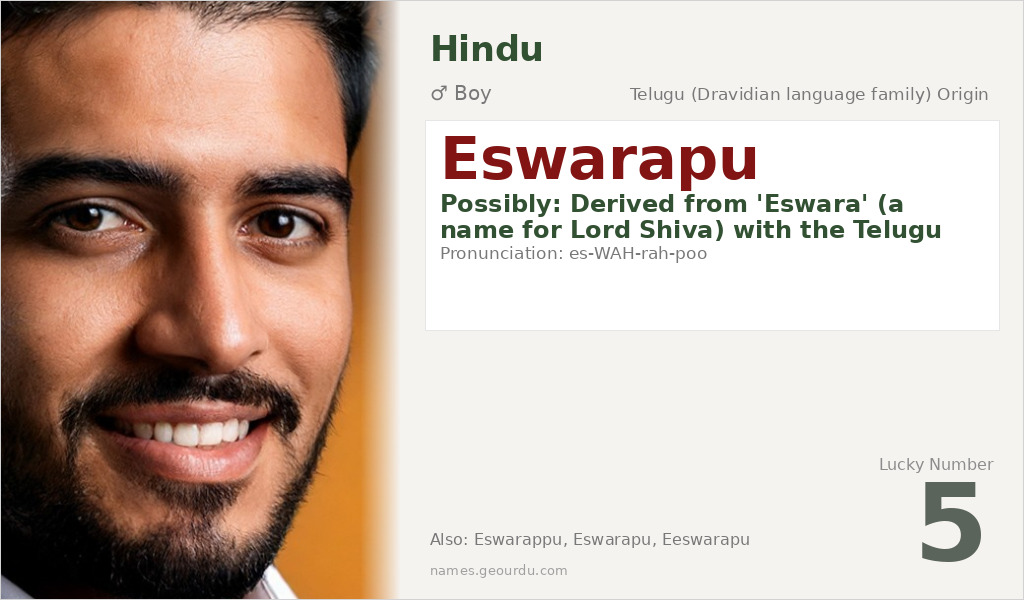
| 📛 Name | Eswarapu |
| 💎 Meaning | Possibly: Derived from 'Eswara' (a name for Lord Shiva) with the Telugu suffix '-pu' indicating 'place of' or 'belonging to' |
| 👤 Gender | Boy |
| 🕌 Religion | Hindu |
| 🌍 Origin | Telugu (Dravidian language family) |
| 🗣 Pronunciation | es-WAH-rah-poo |
| ✍️ Urdu | ایسواراپو |
| ✍️ Arabic | إيسوارابو |
| 🔢 Numerology | 5 |
| ✨ Spellings | Eswarappu, Eswarapu, Eeswarapu |
Origin & Cultural Significance
Eswarapu originates from the Telugu language, which belongs to the Dravidian language family predominantly spoken in South India. Unlike many traditional Hindu given names that have centuries of documented usage, Eswarapu appears to have emerged more recently, possibly as a surname derived from place names or family associations. In Telugu culture, many surnames end with ‘-pu,’ ‘-pati,’ or other suffixes indicating geographical or ancestral connections. The name reflects the strong Shiva worship tradition in South India, where names referencing Shiva (Eswara, Ishwara, Eshwar) are common. However, as a given name rather than surname, its cultural usage appears limited and modern rather than traditional.
Personality Traits
Since Eswarapu is not a traditional given name with established cultural associations, specific personality traits cannot be reliably attributed. In broader Hindu naming traditions, names containing divine references like ‘Eswara’ are often chosen with the hope that the child will embody divine qualities—spiritual depth, strength, protection, and leadership. Parents might select such names to invoke blessings or express devotion. However, any specific personality characteristics would be individual rather than culturally prescribed for this particular name form.
Similar Names
If you like Eswarapu, consider: Eswar, Eshwar, Ishwar, Ishwara, Eswaran
Famous People Named Eswarapu
- No verified famous individuals with 'Eswarapu' as a given name found in research. It appears primarily as a surname among Telugu-speaking communities.
Frequently Asked Questions About Eswarapu
What does Eswarapu mean?
Eswarapu appears to be a Telugu name combining 'Eswara' (meaning 'Lord' or specifically 'Lord Shiva') with the suffix '-pu' (indicating 'place of' or 'belonging to'). Thus, it might mean 'place of Lord Shiva' or 'belonging to Eswara.' However, this is primarily a surname or place name rather than a traditional given name.
Is Eswarapu a boy or girl name?
Eswarapu is used for boys when used as a given name, though this usage appears rare. The masculine association comes from the component 'Eswara,' which refers to the male deity Lord Shiva in Hindu tradition.
What is the origin of Eswarapu?
Eswarapu originates from the Telugu language, a Dravidian language spoken in South India. It appears to be a modern formation, possibly derived from place names or as a surname, combining the divine reference 'Eswara' with the locative suffix '-pu.'





