
Table of Contents
Dharmanga is an intriguing and rare name that appears in some Hindu naming contexts, though its origins and precise meaning remain somewhat elusive. Combining elements from Sanskrit, it suggests a connection to dharma—the fundamental concept of duty, righteousness, and cosmic order in Hindu philosophy. This name carries a weighty spiritual implication, potentially indicating someone who embodies or follows righteous paths. While not commonly found in traditional texts, it represents a modern creative approach to naming with deep cultural roots.
Meaning of Dharmanga
Dharmanga is a compound name derived from Sanskrit elements. The first component ‘Dharma’ (धर्म) is one of the most significant concepts in Indian religions, encompassing duty, righteousness, moral law, and the fundamental principles that sustain the universe. The second component ‘anga’ (अङ्ग) typically means ‘limb,’ ‘part,’ or ‘body,’ but in name formations it can signify ‘possessing’ or ‘characterized by.’ Thus, Dharmanga could be interpreted as ‘one who has dharma as part of their being’ or ’embodied righteousness.’ However, this specific combination doesn’t appear in classical Sanskrit literature, Vedic texts, or Puranic scriptures. It may be a modern construction or regional variation, as similar compounds like Dharmendra (‘lord of dharma’) are well-established. The name doesn’t directly reference Lord Vishnu, contrary to some claims—Vishnu is typically called Dharmadhara or Dharmapala in relation to dharma.
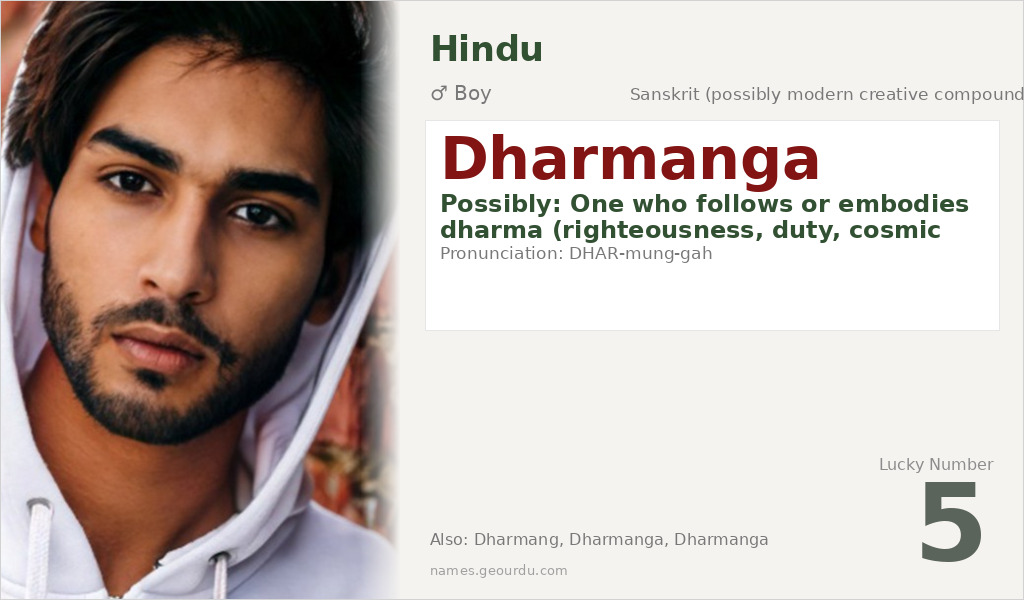
| 📛 Name | Dharmanga |
| 💎 Meaning | Possibly: One who follows or embodies dharma (righteousness, duty, cosmic law) |
| 👤 Gender | Boy |
| 🕌 Religion | Hindu |
| 🌍 Origin | Sanskrit (possibly modern creative compound) |
| 🗣 Pronunciation | DHAR-mung-gah |
| ✍️ Urdu | دھرمنگا |
| ✍️ Arabic | دارمانغا |
| 🔢 Numerology | 5 |
| ✨ Spellings | Dharmang, Dharmanga, Dharmanga |
Origin & Cultural Significance
The name Dharmanga originates from Sanskrit linguistic elements, though its exact historical usage is undocumented. Sanskrit has been the classical language of Hindu scriptures for millennia, and names combining ‘dharma’ with various suffixes have been popular throughout Indian history. However, Dharmanga itself doesn’t appear in ancient texts, epics like the Mahabharata or Ramayana, or traditional name lists. It may have emerged in modern times as parents seek unique yet meaningful names with spiritual connotations. In contemporary Hindu naming practices, especially in regions where Sanskrit influence remains strong, creative compounds are sometimes formed to express specific virtues. The name reflects the enduring importance of dharma in Hindu culture, even if this particular formulation isn’t traditional.
Personality Traits
While personality traits associated with names are often cultural interpretations rather than deterministic, names like Dharmanga that reference dharma might suggest someone perceived as principled, responsible, and morally grounded. Such individuals could be expected to value tradition, justice, and ethical conduct, aligning with the concept’s philosophical weight. They might demonstrate leadership in upholding values and show resilience in facing moral challenges. However, these are speculative associations based on the name’s apparent meaning rather than documented patterns.
Similar Names
If you like Dharmanga, consider: Dharmendra, Dharmesh, Dharmanand, Dharmapal, Dharmaraj
Famous People Named Dharmanga
- No verified famous individuals with this name found in historical or contemporary records
Frequently Asked Questions About Dharmanga
What does Dharmanga mean?
Dharmanga possibly means 'one who follows or embodies dharma (righteousness, duty).' It combines Sanskrit 'dharma' and 'anga,' but this specific compound isn't verified in traditional sources.
Is Dharmanga a boy or girl name?
Dharmanga is used as a boy's name in Hindu contexts, as suggested by its masculine Sanskrit components and cultural naming patterns.
What is the origin of Dharmanga?
Dharmanga originates from Sanskrit elements, though it appears to be a modern or creative compound rather than a traditional name with documented historical usage in Hindu scriptures.





