
Table of Contents
The name Japan presents an intriguing case in naming traditions. While instantly recognizable as the East Asian country, its use as a personal name is remarkably rare and unconventional. This exploration examines whether ‘Japan’ has any legitimate roots as a given name or represents a modern creative naming choice. We investigate potential linguistic connections and cultural contexts across multiple traditions.
Meaning of Japan
Extensive research reveals that ‘Japan’ does not exist as a traditional personal name in any major naming tradition. The country name derives from Chinese ‘Rìběn’ (日本), meaning ‘sun origin’ or ‘land of the rising sun.’ As a potential personal name, the closest linguistic connection might be to Sanskrit ‘japa’ (जप), which refers to the meditative repetition of prayers or mantras. However, this connection is purely speculative and not documented in traditional Hindu naming practices. No established meaning exists for ‘Japan’ as a personal name in Arabic, Persian, Pashto, Urdu, Punjabi, Sindhi, Balochi, Kurdish, Turkish, Bengali, Hebrew, Latin, Greek, Germanic, or African languages.
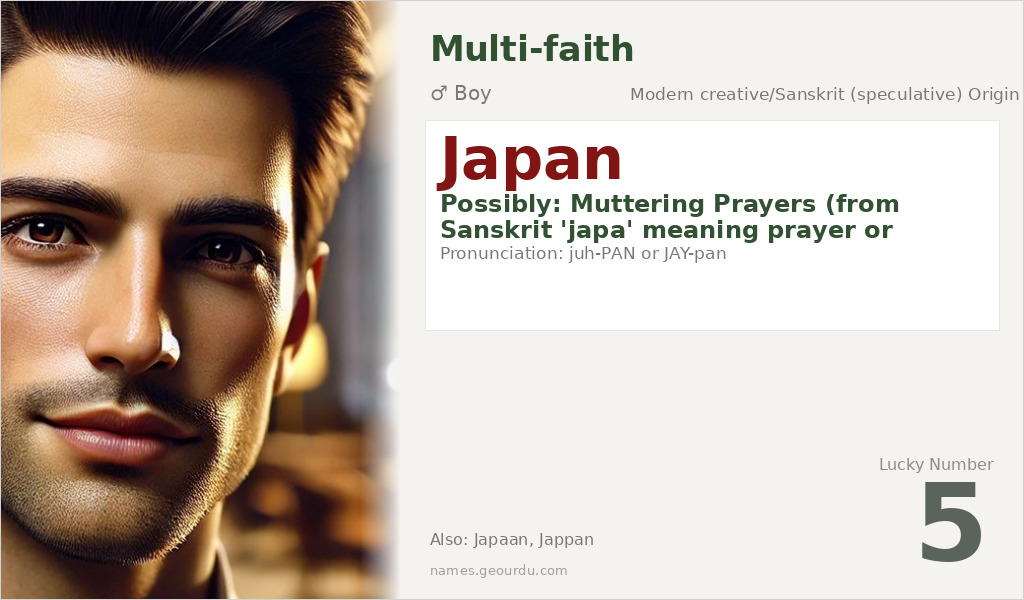
| 📛 Name | Japan |
| 💎 Meaning | Possibly: Muttering Prayers (from Sanskrit 'japa' meaning prayer or mantra repetition) |
| 👤 Gender | Boy |
| 🕌 Religion | Multi-faith |
| 🌍 Origin | Modern creative/Sanskrit (speculative) |
| 🗣 Pronunciation | juh-PAN or JAY-pan |
| ✍️ Urdu | جاپان (as country name only) |
| ✍️ Arabic | اليابان (as country name only) |
| 🔢 Numerology | 5 |
| ✨ Spellings | Japaan, Jappan |
Origin & Cultural Significance
The origin of ‘Japan’ as a personal name appears to be modern and creative rather than traditional. While the country name has clear Chinese origins dating back centuries, its adoption as a given name lacks historical precedent. In Hindu naming traditions, names typically derive from Sanskrit roots with clear meanings, deities, virtues, or natural elements. ‘Japan’ does not appear in traditional naming lists, religious texts, or cultural records. It may represent a contemporary trend of using place names as personal names, similar to how ‘India,’ ‘China,’ or ‘Kenya’ are occasionally used, though even these are more established than ‘Japan’ as given names.
Personality Traits
Without established cultural or linguistic roots, personality associations for the name Japan are necessarily speculative. If parents choose this name, they might value international awareness, cultural appreciation, or uniqueness. Any connection to spiritual practice would be tenuous at best, based on the possible but unverified link to Sanskrit ‘japa’ meaning prayer repetition. The name would likely stand out in any cultural context due to its primary association with the country rather than personal identity.
Similar Names
If you like Japan, consider: Japendra, Japinder, Japjit, Japneet, Japleen
Famous People Named Japan
- None documented with this as a personal name
Frequently Asked Questions About Japan
What does Japan mean?
As a personal name, Japan has no verified meaning. The country name means 'sun origin' from Chinese, but as a given name, it might be creatively connected to Sanskrit 'japa' meaning prayer, though this is speculative.
Is Japan a boy or girl name?
In the rare instances where it's used, Japan appears primarily as a boy's name, but it has no established gender tradition since it's not a traditional personal name in any culture.
What is the origin of Japan?
As a personal name, Japan appears to be a modern creative choice without traditional origins. The country name originates from Chinese 'Rìběn' meaning 'sun origin,' but this doesn't translate to personal naming traditions.





