
Table of Contents
Jagannatha is a powerful Sanskrit name with deep roots in Hindu spirituality and culture. Meaning ‘Lord of the Universe’, this name carries the weight of divine protection and universal sovereignty. Primarily associated with the revered deity worshipped at Puri’s famous temple, Jagannatha represents one of Hinduism’s most significant religious figures. Parents choosing this name often seek to imbue their child with spiritual strength and protective qualities.
Meaning of Jagannatha
Jagannatha is a classical Sanskrit compound name with precise etymological roots. It combines ‘jagat’ (जगत्), which refers to the moving world, universe, or all of creation, with ‘nātha’ (नाथ), meaning lord, master, or protector. This creates the literal translation ‘Lord of the Universe’ or ‘Master of the World’. In Hindu theology, this title specifically denotes Lord Vishnu in his form as the sustainer and protector of cosmic order. The name appears in numerous Sanskrit texts including the Puranas, where it describes the supreme deity who oversees all existence. Unlike many names that have evolved meanings, Jagannatha maintains its original theological significance across centuries of usage.
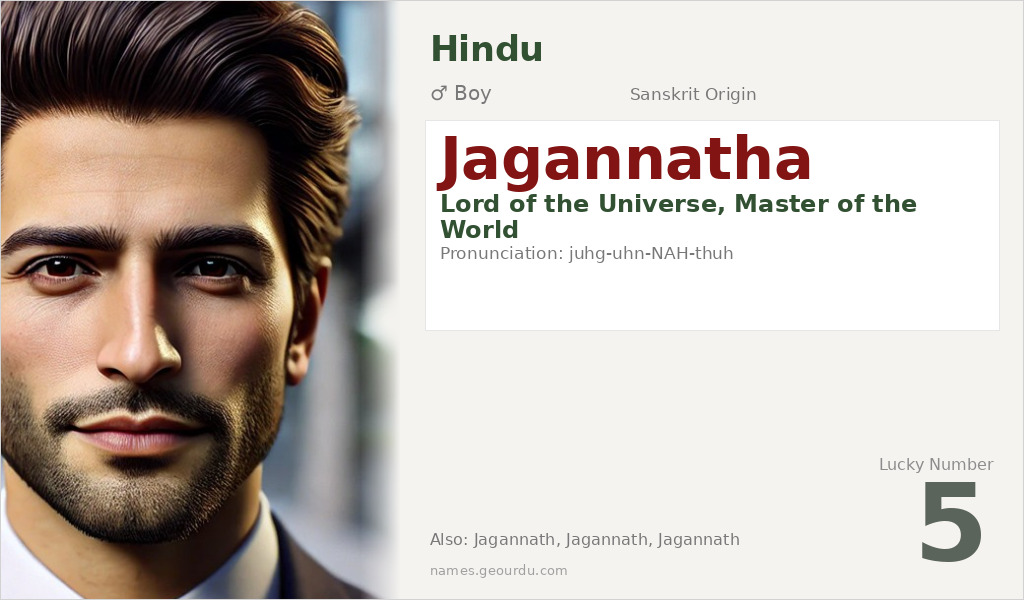
| 📛 Name | Jagannatha |
| 💎 Meaning | Lord of the Universe, Master of the World |
| 👤 Gender | Boy |
| 🕌 Religion | Hindu |
| 🌍 Origin | Sanskrit |
| 🗣 Pronunciation | juhg-uhn-NAH-thuh |
| ✍️ Urdu | جگن ناتھ |
| ✍️ Arabic | جاغاناثا |
| 🔢 Numerology | 5 |
| ✨ Spellings | Jagannath, Jagannath, Jagannath, Jagannath |
Origin & Cultural Significance
Jagannatha originates from ancient Sanskrit, the liturgical language of Hinduism, with its earliest documented usage in Hindu scriptures. The name gained particular prominence through the Jagannath Temple in Puri, Odisha, which has been a major pilgrimage site since at least the 12th century. This temple tradition represents a unique syncretic form of Hinduism that incorporates elements of tribal, Buddhist, and Vaishnavite traditions. The annual Rath Yatra (chariot festival) of Lord Jagannath in Puri attracts millions of devotees, making this one of India’s most visible religious traditions. While the name is used across India, it has special cultural significance in Odisha and eastern Indian states where the Jagannath cult is particularly strong.
Personality Traits
The name Jagannatha suggests personality traits aligned with protection, authority, and spiritual awareness. Those bearing this name are often expected to demonstrate leadership qualities and a caring nature toward others. The association with the universal lord implies someone with broad perspectives and wisdom in handling worldly matters. While these are cultural associations rather than deterministic traits, the name carries expectations of responsibility and guardianship in many Hindu families.
Similar Names
If you like Jagannatha, consider: Jagadish, Jagdish, Vishnu, Narayana, Krishna
Famous People Named Jagannatha
- Jagannath Temple Deity — The principal deity worshipped in Puri, Odisha, one of the Char Dham pilgrimage sites
- Jagannath Shankarseth — 19th century Indian philanthropist and social reformer from Mumbai
Frequently Asked Questions About Jagannatha
What does Jagannatha mean?
Jagannatha means 'Lord of the Universe' or 'Master of the World'. It is a Sanskrit compound name from 'jagat' (world/universe) and 'nātha' (lord/master).
Is Jagannatha a boy or girl name?
Jagannatha is exclusively a boy's name in Hindu tradition, as it refers to the male deity Lord Vishnu/Jagannath worshipped at Puri Temple.
What is the origin of Jagannatha?
Jagannatha originates from Sanskrit, the ancient language of Hindu scriptures. It specifically gained prominence through the Jagannath Temple tradition in Puri, Odisha, India.





