
Table of Contents
Havish is a traditional Hindu boy name with deep roots in ancient Vedic culture. Derived from Sanskrit, this name carries profound religious significance connected to ritual worship and spiritual offerings. Unlike many modern names, Havish maintains a direct link to India’s oldest religious texts and practices. Parents choosing this name often seek to honor their child with a meaningful connection to Hindu heritage.
Meaning of Havish
The name Havish originates from the Sanskrit word ‘havis’ (हविस्), which specifically refers to the sacrificial offering or oblation made during Hindu rituals. In Vedic tradition, havis typically consisted of ghee (clarified butter), grains, milk, or other sacred substances that were offered into the sacred fire (Agni) during yajnas (fire ceremonies). This term appears extensively in the Rigveda, the oldest of the Vedas, where it denotes the material offered to deities through fire. The concept of havis is central to Vedic worship, representing the bridge between humans and the divine through ritual sacrifice. As a name, Havish symbolizes devotion, spiritual offering, and connection to ancient religious practices that have sustained Hindu tradition for millennia.
| 📛 Name | Havish |
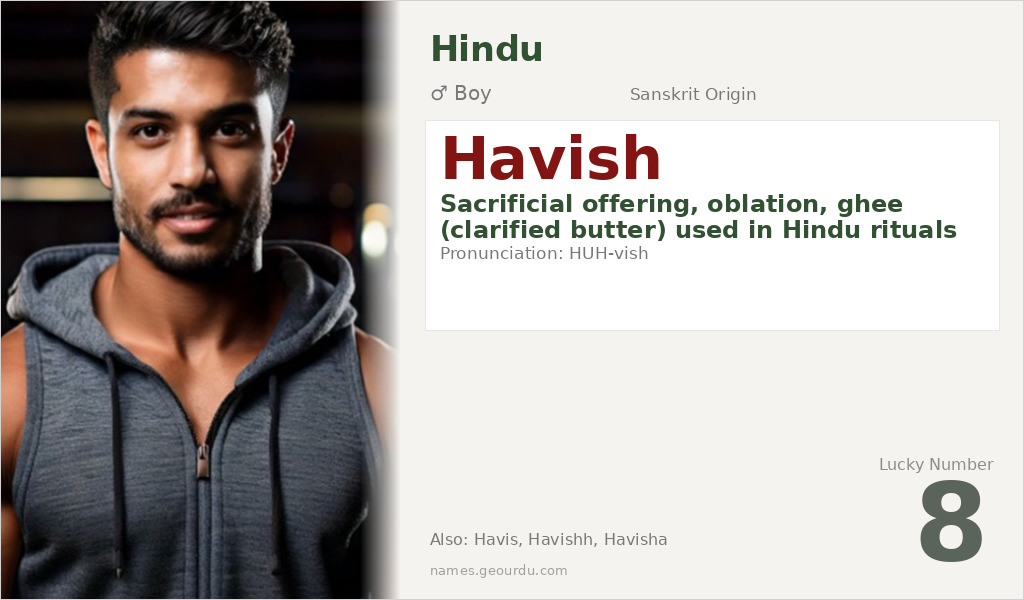
| 💎 Meaning | Sacrificial offering, oblation, ghee (clarified butter) used in Hindu rituals |
| 👤 Gender | Boy |
| 🕌 Religion | Hindu |
| 🌍 Origin | Sanskrit |
| 🗣 Pronunciation | HUH-vish |
| ✍️ Urdu | حویش |
| ✍️ Arabic | هافيش |
| 🔢 Numerology | 8 |
| ✨ Spellings | Havis, Havishh, Havisha |
Origin & Cultural Significance
Havish has its origins in ancient Sanskrit, the classical language of India and the primary liturgical language of Hinduism. The name emerges directly from Vedic texts dating back over 3,000 years, where ‘havis’ was a technical term for ritual offerings. Unlike names that evolved through regional languages or folk traditions, Havish maintains a pure Sanskrit etymology with documented usage in religious scriptures. The name is predominantly used within Hindu communities, particularly among those who value traditional Sanskrit names with clear religious meanings. While not among the most common names, it has seen consistent usage among families seeking names with authentic Vedic connections and spiritual depth.
Personality Traits
Those named Havish are often perceived as individuals with strong spiritual inclinations and respect for tradition. Their name’s connection to ritual offerings suggests qualities of devotion, sacrifice, and commitment to higher principles. They may exhibit thoughtful, contemplative personalities with an appreciation for cultural heritage and religious practices. The name’s Vedic origins often translate into a personality that values discipline, ritual, and meaningful connections to family and community traditions.
Similar Names
If you like Havish, consider: Havan, Havishek, Havishkar, Havishya, Havishnu
Famous People Named Havish
- Havish Kotian — Indian television actor known for roles in Hindi TV series
- Havish Malhotra — Emerging Indian actor and model in the entertainment industry
Frequently Asked Questions About Havish
What does Havish mean?
Havish means 'sacrificial offering' or 'oblation' in Sanskrit, specifically referring to the ghee, grains, or other substances offered in Hindu fire rituals.
Is Havish a boy or girl name?
Havish is exclusively a boy's name in Hindu naming tradition, derived from masculine Sanskrit grammatical forms and used historically for males.
What is the origin of Havish?
Havish originates from Sanskrit, the ancient Indian language of Hindu scriptures, specifically from the Vedic term 'havis' meaning ritual offering.





