
Table of Contents
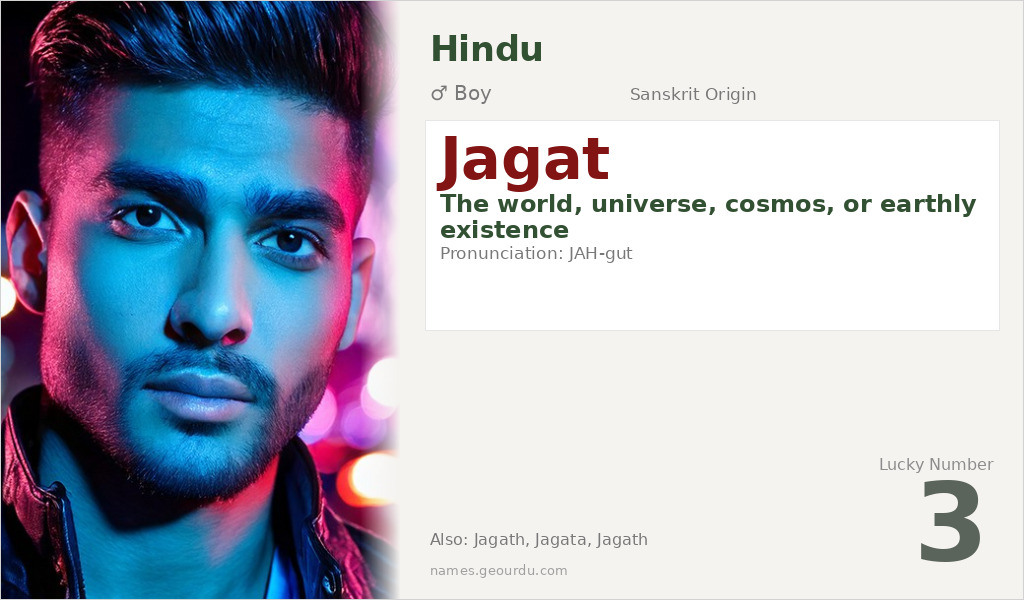
Jagat is a profound Sanskrit name that carries the weight of cosmic meaning. Derived from ancient Hindu scriptures, this name represents the dynamic, ever-changing universe and worldly existence. Popular among Hindu families, Jagat embodies philosophical depth while remaining accessible as a modern given name. Its rich etymology connects contemporary bearers to millennia of spiritual and cultural tradition.
Meaning of Jagat
The name Jagat comes directly from Sanskrit, one of the world’s oldest languages and the liturgical language of Hinduism. It originates from the verbal root ‘jag’ (√गम्) meaning ‘to go’ or ‘to move’, with the suffix ‘-at’ forming a present participle. Thus, ‘jagat’ literally means ‘that which moves’ or ‘the moving one’. In Hindu philosophy, this specifically refers to the manifest universe—the cosmos in constant motion and change. The term appears in foundational texts like the Rigveda and Upanishads, where it distinguishes the temporal world from eternal reality. This linguistic construction gives the name both poetic resonance and philosophical precision, making it a meaningful choice for parents seeking a name with spiritual depth.
| 📛 Name | Jagat |
| 💎 Meaning | The world, universe, cosmos, or earthly existence |
| 👤 Gender | Boy |
| 🕌 Religion | Hindu |
| 🌍 Origin | Sanskrit |
| 🗣 Pronunciation | JAH-gut |
| ✍️ Urdu | جگت |
| ✍️ Arabic | جاجات |
| 🔢 Numerology | 3 |
| ✨ Spellings | Jagath, Jagata, Jagath, Jagat |
Origin & Cultural Significance
Jagat has its origins in ancient India, emerging from Sanskrit literature and Hindu religious texts. As a given name, it gained popularity through its usage in Hindu communities across the Indian subcontinent. The name reflects core Hindu concepts about the nature of reality, particularly the distinction between the eternal (Brahman) and the temporal (jagat). Historically, the term appears in philosophical discussions about maya (illusion) and the nature of worldly existence. While primarily used in Hindu contexts, the name has also appeared in Jain and Buddhist texts with similar cosmological meanings. Today, it remains particularly common in regions with strong Sanskrit traditions, including India, Nepal, and diaspora communities worldwide.
Personality Traits
Those named Jagat often develop personality traits that reflect their name’s cosmic meaning. They frequently exhibit broad perspectives, intellectual curiosity, and adaptability to life’s changes. The name’s association with the moving universe suggests dynamic energy and progressive thinking. Many Jagats demonstrate leadership qualities and philosophical inclinations, with a natural ability to see connections between disparate ideas. Their worldview tends to be expansive, mirroring the universal scope of their name’s meaning.
Similar Names
If you like Jagat, consider: Jagdish, Jagannath, Jagadish, Jagmohan, Jagrit
Famous People Named Jagat
- Jagat Singh — 18th century ruler of Amber kingdom in Rajasthan, India
- Jagat Narain — Indian journalist and founder of Punjab Kesari newspaper
Frequently Asked Questions About Jagat
What does Jagat mean?
Jagat means 'the world', 'universe', or 'cosmos' in Sanskrit. It comes from the root 'jag' meaning 'to move', referring to the dynamic, ever-changing nature of worldly existence.
Is Jagat a boy or girl name?
Jagat is traditionally a masculine name in Hindu naming traditions. While Sanskrit nouns have gender, and 'jagat' is neuter grammatically, as a personal name it has historically been used for boys.
What is the origin of Jagat?
Jagat originates from Sanskrit, the ancient liturgical language of Hinduism. It appears in Hindu scriptures like the Vedas and Upanishads, where it describes the physical cosmos and worldly existence.





