
Table of Contents
Jagatguru is a profound Sanskrit term that resonates through centuries of Indian spiritual tradition. While sometimes presented as a personal name, it is primarily an honorific title bestowed upon supreme spiritual masters. This compound word beautifully combines cosmic and pedagogical elements, representing the highest ideal of spiritual guidance. Understanding Jagatguru requires exploring its linguistic roots and cultural context beyond simplistic name classifications.
Meaning of Jagatguru
Jagatguru derives from classical Sanskrit, combining ‘Jagat’ (जगत्) meaning ‘the moving world, universe, cosmos’ and ‘Guru’ (गुरु) meaning ‘teacher, spiritual preceptor’. Linguistically, ‘Jagat’ comes from the Sanskrit root √gam (to go), referring to the dynamic, ever-changing nature of existence. ‘Guru’ originates from √gṝ (to praise, to lift up), describing one who elevates disciples from ignorance to enlightenment. The complete term thus signifies ‘World Teacher’ or ‘Universal Preceptor’, someone whose wisdom encompasses all existence. This title has been used across Hindu, Jain, and Buddhist traditions to honor spiritual leaders who provide guidance applicable to all humanity.
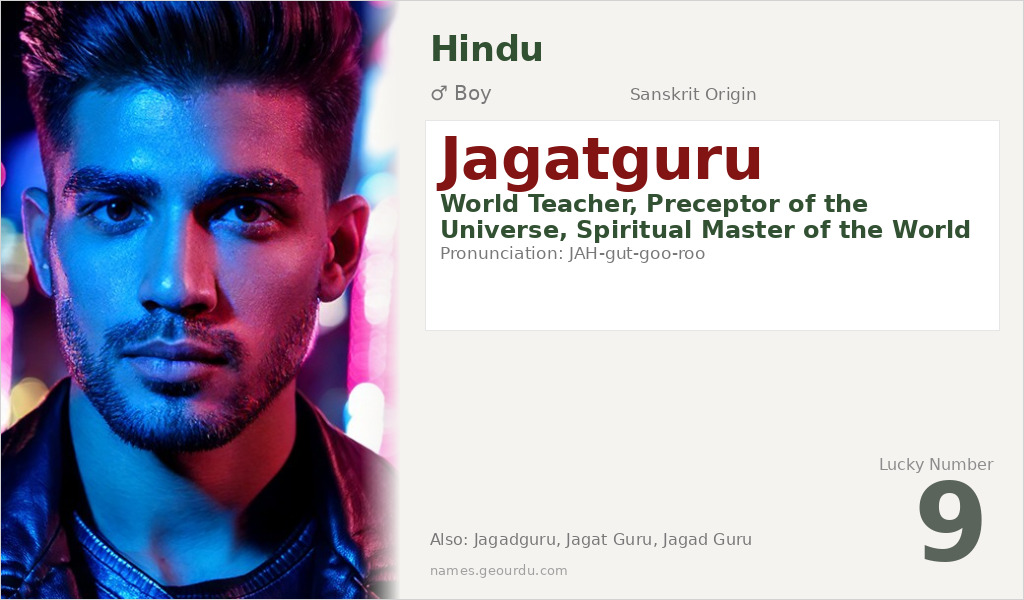
| 📛 Name | Jagatguru |
| 💎 Meaning | World Teacher, Preceptor of the Universe, Spiritual Master of the World |
| 👤 Gender | Boy |
| 🕌 Religion | Hindu |
| 🌍 Origin | Sanskrit |
| 🗣 Pronunciation | JAH-gut-goo-roo |
| ✍️ Urdu | جگت گرو |
| ✍️ Arabic | جاجاتغورو |
| 🔢 Numerology | 9 |
| ✨ Spellings | Jagadguru, Jagat Guru, Jagad Guru |
Origin & Cultural Significance
The term Jagatguru originates from ancient Sanskrit texts and has been used for over a millennium in Indian spiritual traditions. Historically, it appears in scriptures and philosophical works as an honorific for enlightened masters rather than as a common personal name. In Hinduism, prominent figures like Adi Shankaracharya (8th century CE) have been referred to as Jagadguru for their comprehensive spiritual teachings. The title carries particular weight in monastic traditions where it denotes the highest spiritual authority. While occasionally used as a given name in modern times, its primary cultural function remains as a reverential title for spiritual leaders who guide not just individuals but humanity as a whole.
Personality Traits
While Jagatguru is primarily a title rather than a personal name, individuals associated with it typically embody wisdom, spiritual depth, and universal compassion. They are often perceived as natural leaders with philosophical insight and a desire to uplift others. The name suggests someone with broad perspective, intellectual rigor, and moral authority. Such individuals tend to approach life with contemplative depth rather than superficial engagement.
Similar Names
If you like Jagatguru, consider: Jagdish, Jagannath, Gurudev, Gurubhakta, Vishwaguru
Famous People Named Jagatguru
- Adi Shankaracharya — 8th century Hindu philosopher and theologian, often referred to as Jagadguru
- Jagadguru Kripalu Ji Maharaj — 20th century Hindu spiritual leader and founder of Jagadguru Kripalu Parishat
Frequently Asked Questions About Jagatguru
What does Jagatguru mean?
Jagatguru means 'World Teacher' or 'Universal Preceptor' in Sanskrit, combining 'Jagat' (world/universe) and 'Guru' (teacher/spiritual master).
Is Jagatguru a boy or girl name?
Jagatguru is traditionally masculine and used as an honorific title for male spiritual leaders in Hindu, Jain, and Buddhist traditions, though it is rarely used as a personal name.
What is the origin of Jagatguru?
Jagatguru originates from Sanskrit, the classical language of ancient India, and has been used for centuries as a spiritual title in Hindu, Jain, and Buddhist traditions.





