
Table of Contents
Indraarjun is a powerful Sanskrit compound name that brings together two of Hinduism’s most celebrated figures: Indra, the king of gods, and Arjuna, the legendary archer prince. This modern name creation embodies divine authority combined with heroic skill and moral depth. Popular among Hindu families seeking a name with strong mythological resonance, Indraarjun represents the fusion of celestial power and human excellence. As a contemporary name with ancient roots, it carries forward India’s rich storytelling tradition into modern naming practices.
Meaning of Indraarjun
Indraarjun is a compound Sanskrit name meaning ‘Indra’s Arjun’ or ‘Arjun who is like Indra’. The first component, ‘Indra’ (इन्द्र), derives from the Sanskrit root ‘ind’ meaning ‘to drop’ or ‘to bestow’, referring to the god who bestows rain. In Vedic mythology, Indra is the king of the Devas, wielder of the thunderbolt (vajra), and ruler of the heavens. The second component, ‘Arjun’ (अर्जुन), comes from the Sanskrit root ‘arj’ meaning ‘to earn, gain, or win’, with the name specifically meaning ‘white’, ‘clear’, or ‘bright’, describing both physical appearance and moral clarity. Together, these elements create a name that suggests someone possessing both divine authority and exceptional human skill, particularly in archery or focused pursuits.
| 📛 Name | Indraarjun |
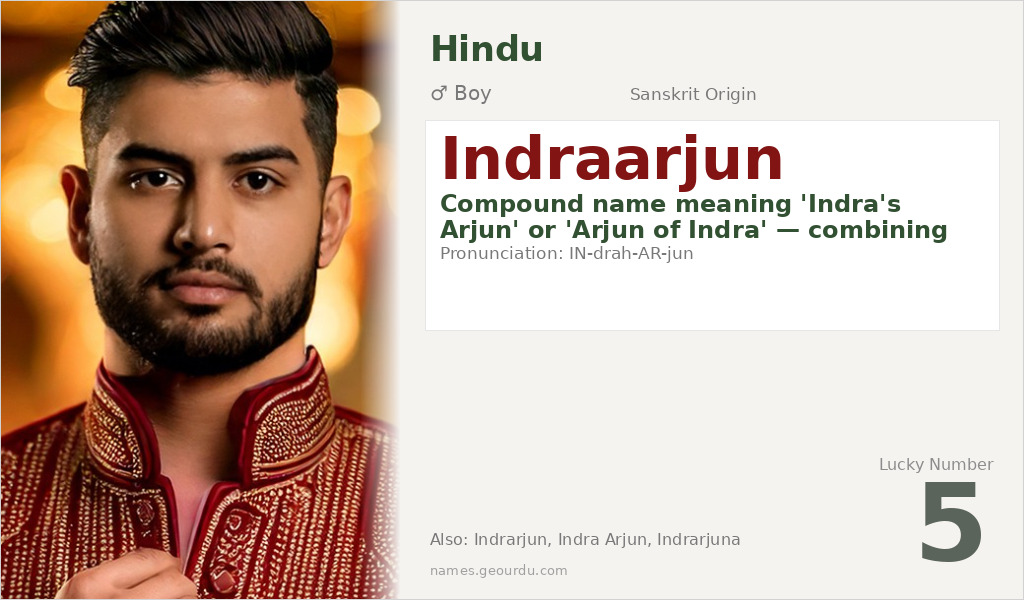
| 💎 Meaning | Compound name meaning 'Indra's Arjun' or 'Arjun of Indra' — combining the names of two major Hindu deities/heroes: Indra (king of gods) and Arjun (third Pandava prince and archer hero) |
| 👤 Gender | Boy |
| 🕌 Religion | Hindu |
| 🌍 Origin | Sanskrit |
| 🗣 Pronunciation | IN-drah-AR-jun |
| ✍️ Urdu | اندرارجن |
| ✍️ Arabic | إندرارجون |
| 🔢 Numerology | 5 |
| ✨ Spellings | Indrarjun, Indra Arjun, Indrarjuna |
Origin & Cultural Significance
Indraarjun originates from Sanskrit, the classical language of ancient India, though as a specific compound name it represents a modern creation rather than a name found in historical texts. The name combines elements from Hindu mythology: Indra appears prominently in the Rigveda (c. 1500-1200 BCE) as the most important Vedic deity, while Arjuna is central to the Mahabharata epic (c. 400 BCE-400 CE). This blending reflects contemporary Hindu naming practices where parents combine elements from different mythological figures to create unique names with layered meanings. The name is primarily used in India and among Hindu diaspora communities, particularly in regions with strong Sanskrit naming traditions. It represents how ancient mythological elements continue to inspire modern personal names in Hindu culture.
Personality Traits
Those named Indraarjun are often associated with dual qualities of leadership and specialized skill. Like Indra, they may exhibit natural authority, confidence, and protective instincts. Like Arjuna, they might demonstrate focus, precision in their pursuits, and a tendency toward moral contemplation. This combination can create individuals who are both decisive leaders and thoughtful practitioners, excelling in fields requiring both strategic vision and technical expertise. The name suggests someone who balances celestial inspiration with human dedication.
Similar Names
If you like Indraarjun, consider: Arjuna, Indrajit, Arindam, Indraneel, Arjun
Famous People Named Indraarjun
- Indraarjun (fictional) — A character in some modern Indian literature and media combining attributes of both mythological figures
- Note: This is primarily a modern compound name, so no widely known historical figures bear this exact name
Frequently Asked Questions About Indraarjun
What does Indraarjun mean?
Indraarjun means 'Indra's Arjun' — a Sanskrit compound name combining the names of two Hindu mythological figures: Indra (king of gods) and Arjun (the archer hero prince from Mahabharata).
Is Indraarjun a boy or girl name?
Indraarjun is exclusively a boy's name in Hindu naming tradition, as both component names (Indra and Arjun) are masculine deities/heroes in Hindu mythology.
What is the origin of Indraarjun?
Indraarjun originates from Sanskrit, the classical language of ancient India, though as a specific compound it's a modern creation that combines elements from Hindu mythology dating back to Vedic texts (Indra) and the Mahabharata epic (Arjuna).





