
Table of Contents
Hemnath is a beautiful and meaningful Sanskrit name for boys that carries deep spiritual significance in Hinduism. Derived from ancient roots, this name poetically references Lord Shiva as the divine ruler of the snow-capped Himalayas. With its connection to one of Hinduism’s principal deities, Hemnath embodies qualities of serenity, strength, and spiritual mastery. Parents choosing this name often seek to instill these noble attributes in their child.
Meaning of Hemnath
Hemnath is a compound Sanskrit name with two distinct elements: ‘Hema’ (हिम) and ‘Nath’ (नाथ). ‘Hema’ primarily means ‘snow’ or ‘winter’, but can also signify ‘gold’ in certain contexts, representing purity and value. ‘Nath’ translates to ‘lord’, ‘master’, or ‘protector’, denoting authority and guardianship. When combined, Hemnath literally means ‘Lord of Snow’ or ‘Lord of Winter’, which is a direct reference to Lord Shiva’s abode in the Himalayan mountains. This epithet highlights Shiva’s association with Mount Kailash, the snow-clad peak where he meditates. The name is particularly significant in Shaivism, where Shiva is venerated as the supreme deity, and names containing ‘nath’ are common among his devotees.
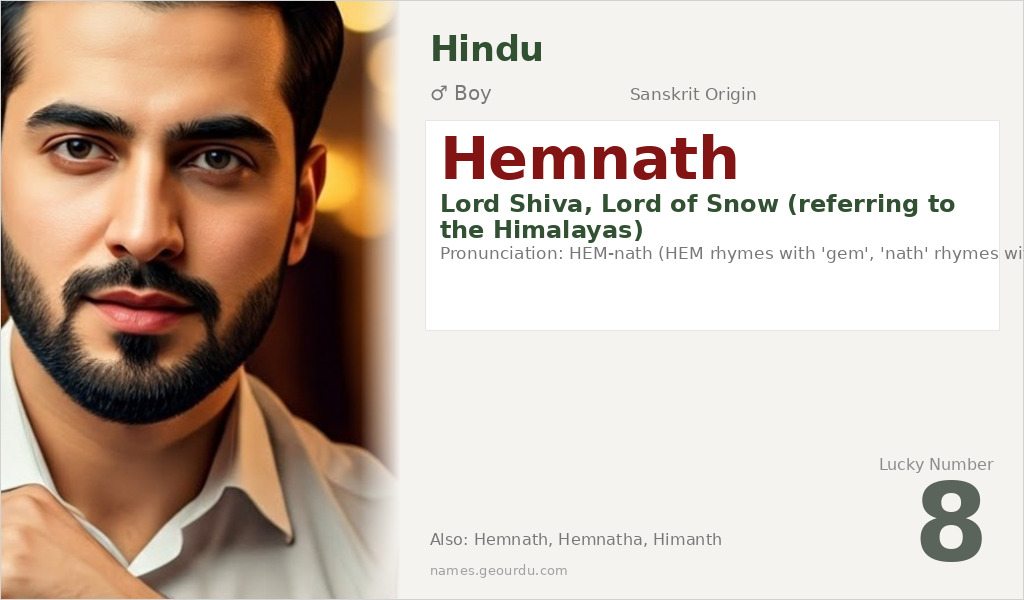
| 📛 Name | Hemnath |
| 💎 Meaning | Lord Shiva, Lord of Snow (referring to the Himalayas) |
| 👤 Gender | Boy |
| 🕌 Religion | Hindu |
| 🌍 Origin | Sanskrit |
| 🗣 Pronunciation | HEM-nath (HEM rhymes with 'gem', 'nath' rhymes with 'path') |
| ✍️ Urdu | ہیم ناتھ |
| ✍️ Arabic | هيمناث |
| 🔢 Numerology | 8 |
| ✨ Spellings | Hemnath, Hemnatha, Himanth, Himantha |
Origin & Cultural Significance
Hemnath originates from classical Sanskrit, the ancient liturgical language of Hinduism, and is deeply rooted in Indian religious and cultural traditions. It emerges from Hindu mythology, specifically from descriptions of Lord Shiva as ‘Himavan-natha’ or ‘Himadri-natha’ (Lord of the Snowy Mountains). The name gained popularity as a given name in Hindu communities across India, particularly in regions with strong Shaivite traditions. While it is most commonly found in India and among the Hindu diaspora, the name’s Sanskrit foundation gives it a timeless, classical appeal. Unlike some names that have cross-cultural variations, Hemnath remains distinctly Hindu in its origin and usage, reflecting the enduring influence of Sanskrit and Hindu theology on naming practices.
Personality Traits
Those named Hemnath are often associated with the tranquil yet powerful essence of Lord Shiva and the Himalayas. They may exhibit a calm, meditative nature, combined with inner strength and resilience. The ‘nath’ component suggests natural leadership qualities, while ‘hema’ implies a cool, composed demeanor, making them balanced individuals who can handle challenges with grace. This name inspires a personality that values spirituality, introspection, and a connection to nature’s majesty.
Similar Names
If you like Hemnath, consider: Himanshu, Himadri, Himavat, Shiva, Nath, Hemant, Hemanth
Famous People Named Hemnath
- Hemnath M. Rao — Indian film director and screenwriter known for Telugu cinema
- Hemnath — Character in Indian mythology and literature referencing Lord Shiva
Frequently Asked Questions About Hemnath
What does Hemnath mean?
Hemnath means 'Lord of Snow' in Sanskrit, referring to Lord Shiva who resides in the snow-capped Himalayas. It is a compound of 'hema' (snow) and 'nath' (lord).
Is Hemnath a boy or girl name?
Hemnath is exclusively a boy's name in Hindu naming traditions. It carries masculine connotations through its meaning ('lord') and association with the male deity Lord Shiva.
What is the origin of Hemnath?
Hemnath originates from Sanskrit, the ancient language of Hinduism. It is derived from Hindu mythology, specifically from epithets for Lord Shiva as the ruler of the Himalayan mountains.





