Table of Contents
Hind is a beautiful and historically significant name that carries deep geographical and cultural meaning. Primarily used as a feminine name in Arabic and Islamic cultures, it refers to the Indian subcontinent and has been borne by notable historical figures. This name connects the bearer to rich cross-cultural heritage and historical narratives that span continents and centuries.
Meaning of Hind
The name Hind has a clear and well-documented etymology tracing back to ancient geographical terminology. It originates from the Persian word ‘Hindū,’ which itself derives from the Sanskrit ‘Sindhu’ meaning ‘river,’ specifically referring to the Indus River. Through linguistic evolution in Persian and later Arabic, the term came to denote the land beyond the Indus River – essentially what we now call the Indian subcontinent. As a personal name, Hind carries this geographical significance, connecting the bearer to this vast and culturally rich region. The name appears in historical records and literature as both a geographical reference and personal identifier.
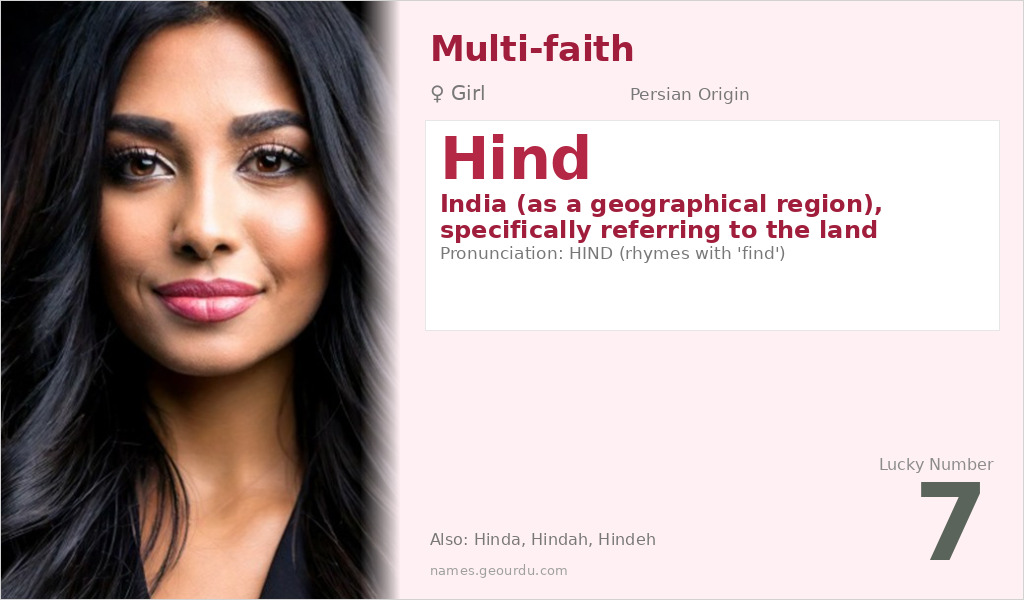
| 📛 Name | Hind |
| 💎 Meaning | India (as a geographical region), specifically referring to the land beyond the Indus River |
| 👤 Gender | Girl |
| 🕌 Religion | Multi-faith |
| 🌍 Origin | Persian |
| 🗣 Pronunciation | HIND (rhymes with 'find') |
| ✍️ Urdu | ہند |
| ✍️ Arabic | هند |
| 🔢 Numerology | 7 |
| ✨ Spellings | Hinda, Hindah, Hindeh |
Origin & Cultural Significance
Hind has its roots in Persian language and culture, where it was used to describe the Indian subcontinent. The name gained prominence in Arabic and Islamic cultures through historical contact and cultural exchange between the Middle East and South Asia. It became particularly notable through early Islamic history, most famously borne by Hind bint Utbah, a significant figure in early Islam who was originally opposed to the Prophet Muhammad but later converted. The name’s usage reflects historical connections between Arab and Indian civilizations, trade routes, and cultural interchanges that have shaped the region’s history for millennia.
Personality Traits
Those named Hind often embody strength, cultural sophistication, and historical awareness. The name’s association with powerful historical female figures suggests qualities of leadership, intelligence, and resilience. Individuals with this name may feel connected to cross-cultural heritage and demonstrate adaptability in diverse environments, reflecting the name’s geographical origins that bridge different civilizations and traditions.
Similar Names
If you like Hind, consider: India, Hindustan, Hind bint Utbah, Hind al-Hunnud, Hind bint Abi Umayyah
Famous People Named Hind
- Hind bint Utbah — Prominent early Muslim woman, wife of Abu Sufyan and mother of Muawiyah I, known for her conversion to Islam and historical significance
- Hind Laroussi — Dutch-Moroccan singer and television presenter known for her music career in the Netherlands
Frequently Asked Questions About Hind
What does Hind mean?
Hind means 'India' or specifically refers to the Indian subcontinent. It originates from Persian 'Hindū,' derived from Sanskrit 'Sindhu' meaning 'river,' originally referring to the Indus River and by extension the land beyond it.
Is Hind a boy or girl name?
Hind is primarily a feminine name in Arabic and Islamic cultures. While names can sometimes cross gender boundaries in different cultures, Hind is overwhelmingly used for girls and women in its regions of origin.
What is the origin of Hind?
Hind originates from Persian language, where it referred to the Indian subcontinent. The term entered Arabic through cultural and linguistic exchange and became established as both a geographical term and personal name in Islamic cultures.