
Table of Contents
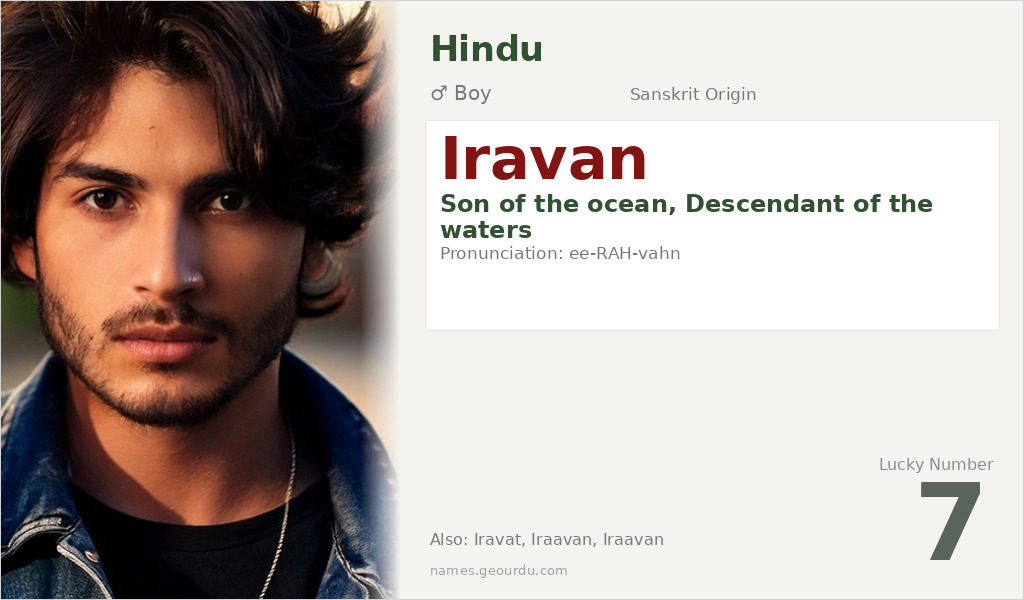
Iravan is a powerful Hindu name with deep roots in ancient Indian mythology and Sanskrit language. Derived from the epic Mahabharata, this name carries the beautiful meaning ‘son of the ocean’ or ‘descendant of the waters.’ As the son of the great warrior Arjuna and the Naga princess Ulupi, Iravan represents courage, sacrifice, and connection to elemental forces.
Meaning of Iravan
The name Iravan originates from the Sanskrit word ‘Iravat’ (इरावत्), which combines ‘irā’ meaning ‘water, liquid, or refreshment’ with the suffix ‘-vat’ indicating possession or descent. This gives the literal meaning ‘possessing water’ or ‘descendant of waters.’ In the context of Hindu mythology, this meaning becomes particularly significant as Iravan was the son of Ulupi, a Naga (serpent) princess associated with water realms. The name appears in the Mahabharata where Iravan plays a crucial role as a warrior who willingly sacrifices himself for the Pandavas’ victory. While sometimes poetically interpreted as ‘King of Ocean,’ the precise etymological meaning remains ‘son of the waters.’
| 📛 Name | Iravan |
| 💎 Meaning | Son of the ocean, Descendant of the waters |
| 👤 Gender | Boy |
| 🕌 Religion | Hindu |
| 🌍 Origin | Sanskrit |
| 🗣 Pronunciation | ee-RAH-vahn |
| ✍️ Urdu | اراون |
| ✍️ Arabic | إيرافان |
| 🔢 Numerology | 7 |
| ✨ Spellings | Iravat, Iraavan, Iraavan, Iraavath |
Origin & Cultural Significance
Iravan has its origins in ancient Sanskrit literature and Hindu mythology, specifically from the Mahabharata epic composed around 400 BCE-400 CE. The name belongs to a significant but often overlooked character—the son of Arjuna (third Pandava prince) and Ulupi (a Naga princess from the underwater kingdom). In South Indian traditions, particularly in Tamil Nadu, Iravan is worshipped as a deity called Koothandavar, with annual festivals celebrating his sacrifice. The name represents the intersection of human and divine realms in Hindu cosmology, connecting terrestrial warriors with aquatic serpent deities. Its continued usage reflects the enduring cultural memory of mythological figures in Hindu naming traditions.
Personality Traits
Drawing from the mythological character, individuals named Iravan are often associated with qualities of bravery, sacrifice, and loyalty. The story of Iravan sacrificing himself for a greater cause suggests someone who puts principles and duty above personal interests. The connection to water elements through his mother Ulupi implies emotional depth, adaptability, and a nurturing nature. These traits combine to create a personality that balances strength with compassion.
Similar Names
If you like Iravan, consider: Arjuna, Bhishma, Abhimanyu, Nakula, Sahadeva
Famous People Named Iravan
- Iravan (Mahabharata) — Warrior son of Arjuna and Ulupi in Hindu epic Mahabharata who sacrificed himself for victory in the Kurukshetra War
- Iravan (Tamil tradition) — Deified form worshipped in Tamil Nadu, particularly in the Koothandavar festival where he is celebrated as a deity of sacrifice
Frequently Asked Questions About Iravan
What does Iravan mean?
Iravan means 'son of the ocean' or 'descendant of the waters' from Sanskrit 'irā' (water) and '-vat' (possessing/descendant).
Is Iravan a boy or girl name?
Iravan is exclusively a boy's name in Hindu tradition, named after the male warrior son of Arjuna in the Mahabharata.
What is the origin of Iravan?
Iravan originates from Sanskrit and Hindu mythology, specifically from the character Iravan in the ancient Indian epic Mahabharata.





