
Table of Contents
Kayilainathan is a profound Tamil name that carries the weight of divine mythology and cultural heritage. Directly translating to ‘Lord of Kailash’, this name invokes the majestic presence of Shiva, the supreme deity in Shaivism. Popular among Tamil-speaking Hindu communities, it symbolizes spiritual authority and connection to sacred geography. Choosing this name reflects a deep reverence for Shiva’s abode and his role as the cosmic ruler.
Meaning of Kayilainathan
Kayilainathan derives from the Tamil words ‘Kayilai’ (Mount Kailash) and ‘Nathan’ (lord or master), creating a compound that means ‘Lord of Kailash’. This refers specifically to Shiva, who is believed to reside on Mount Kailash in Hindu cosmology. The name is exclusively Dravidian in origin, showcasing Tamil linguistic roots rather than Sanskrit, though it aligns with pan-Hindu theology. Unlike many Shiva-related names that use Sanskrit elements like ‘Ishwar’ or ‘Shankar’, Kayilainathan remains purely Tamil, emphasizing regional devotional practices. It appears in Tamil devotional literature and temple inscriptions, particularly in South India and Sri Lanka. The name’s construction follows classic Tamil naming patterns where theophoric elements combine with honorifics to denote divine attributes.
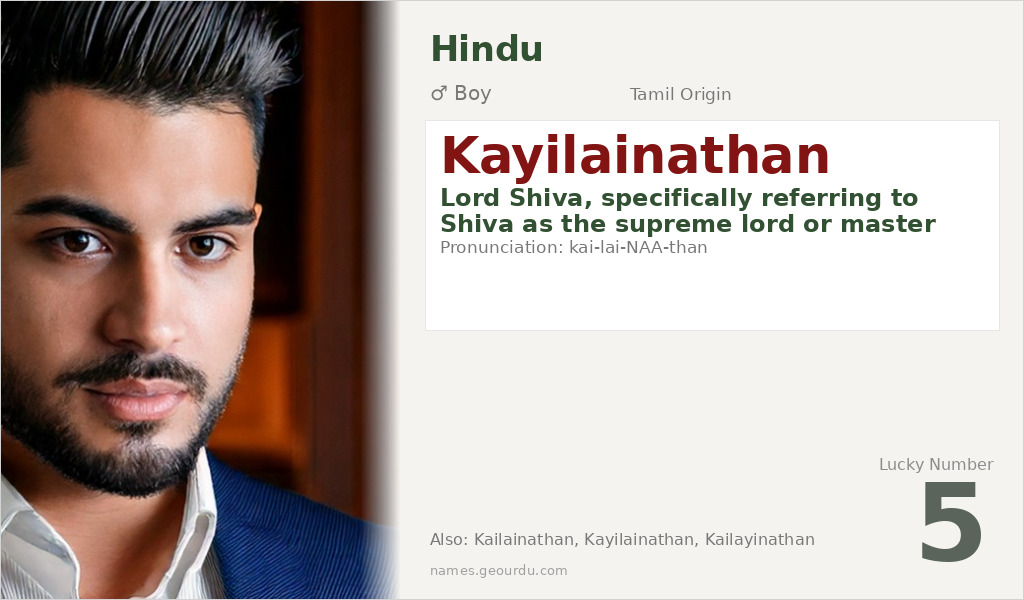
| 📛 Name | Kayilainathan |
| 💎 Meaning | Lord Shiva, specifically referring to Shiva as the supreme lord or master |
| 👤 Gender | Boy |
| 🕌 Religion | Hindu |
| 🌍 Origin | Tamil |
| 🗣 Pronunciation | kai-lai-NAA-than |
| ✍️ Urdu | کائلیناتھن |
| ✍️ Arabic | كايلايناتان |
| 🔢 Numerology | 5 |
| ✨ Spellings | Kailainathan, Kayilainathan, Kailayinathan |
Origin & Cultural Significance
Originating from Tamil Nadu and Tamil-speaking regions of Sri Lanka, Kayilainathan emerged from the Bhakti movement and Shaiva Siddhanta traditions between the 6th and 12th centuries CE. It reflects the Dravidian cultural synthesis of indigenous Tamil devotion with Hindu mythology, where local linguistic forms were used to express universal Hindu concepts. The name gained prominence through Tamil poetic works like the Tevaram hymns, where Shiva is frequently addressed as the lord of Kailash. It remains popular among Tamil Hindus, especially those with family ties to Shaivite temples or lineages. Unlike North Indian Shiva names, Kayilainathan preserves distinct Tamil phonetics and morphological structure, resisting Sanskritization.
Personality Traits
Named after Shiva’s sovereign aspect, Kayilainathan suggests a personality marked by spiritual depth, resilience, and authoritative calm. Such individuals may be drawn to philosophical inquiry, displaying the meditative and transformative qualities associated with Shiva. They often embody a balance of austerity and compassion, leading with quiet strength rather than overt aggression. In social contexts, they might be perceived as traditionalists with a strong sense of duty and moral integrity.
Similar Names
If you like Kayilainathan, consider: Kailashnath, Shivanathan, Muruganathan, Arunachaleshwar, Kedarnath
Famous People Named Kayilainathan
- No widely known contemporary public figures with this exact name found in verified records
- Historical and religious contexts feature this as an epithet for Shiva in Tamil literature
Frequently Asked Questions About Kayilainathan
What does Kayilainathan mean?
Kayilainathan means 'Lord of Kailash' in Tamil, specifically referring to Shiva as the ruler of his mythical abode, Mount Kailash.
Is Kayilainathan a boy or girl name?
Kayilainathan is exclusively a boy's name in Tamil Hindu tradition, reflecting masculine divine attributes of Shiva.
What is the origin of Kayilainathan?
Kayilainathan originates from the Tamil language and Dravidian culture, specifically from Tamil Shaivism in South India and Sri Lanka.





