
Table of Contents
Kedaar is a traditional Hindu boy name with deep roots in Sanskrit language and Hindu spirituality. Meaning ‘field’ or ‘meadow’, this name carries both earthly and divine connections through its association with the sacred Himalayan pilgrimage site Kedarnath. Popular among Hindu families, Kedaar represents a blend of natural simplicity and spiritual significance. Discover the rich history and meaning behind this timeless name.
Meaning of Kedaar
Kedaar derives from the Sanskrit word ‘kedāra’ (केदार), which literally translates to ‘field’, ‘meadow’, or ‘pasture’. This agricultural reference reflects the name’s connection to the earth and cultivation. In Hindu religious context, Kedaar specifically refers to Kedarnath, the famous pilgrimage destination in Uttarakhand where one of Shiva’s twelve Jyotirlingas is located. The name appears in ancient scriptures including the Skanda Purana and Mahabharata, where the Kedarnath region is described as Shiva’s sacred abode. While the word itself means ‘field’, its religious significance comes from the geographical location rather than the literal meaning. This dual meaning makes Kedaar both a simple, nature-inspired name and one with profound spiritual connotations.
| 📛 Name | Kedaar |
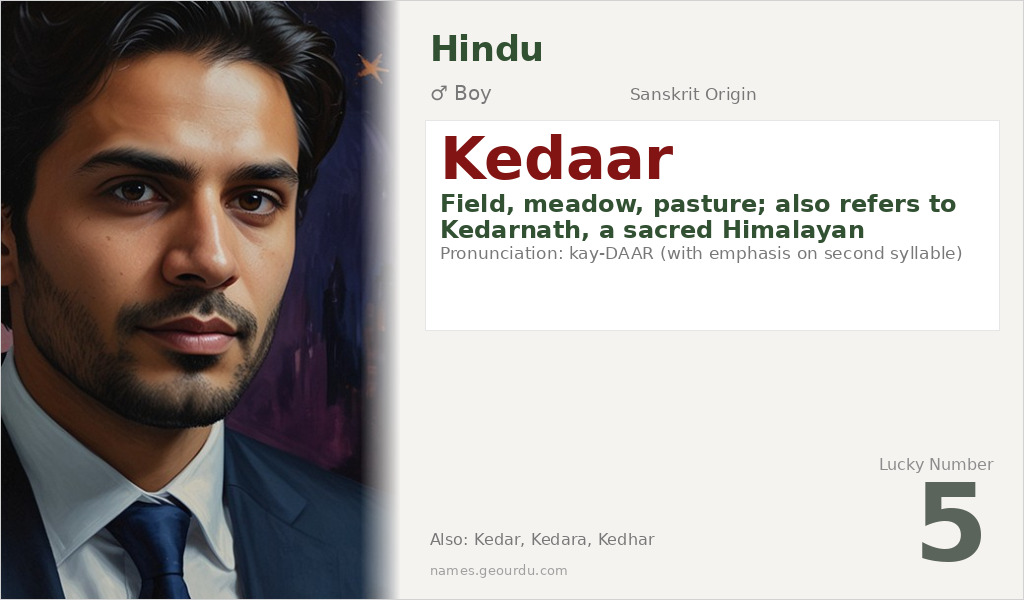
| 💎 Meaning | Field, meadow, pasture; also refers to Kedarnath, a sacred Himalayan pilgrimage site dedicated to Lord Shiva |
| 👤 Gender | Boy |
| 🕌 Religion | Hindu |
| 🌍 Origin | Sanskrit |
| 🗣 Pronunciation | kay-DAAR (with emphasis on second syllable) |
| ✍️ Urdu | کیڈار |
| ✍️ Arabic | كيدار |
| 🔢 Numerology | 5 |
| ✨ Spellings | Kedar, Kedara, Kedhar, Kedarnath |
Origin & Cultural Significance
Kedaar originates from classical Sanskrit, one of the oldest languages in the Indo-European family. The name has been used for centuries in the Indian subcontinent, particularly within Hindu communities. Its religious significance stems from Kedarnath Temple, one of the four major sites in the Char Dham pilgrimage circuit and one of the twelve Jyotirlingas dedicated to Lord Shiva. According to Hindu mythology, the Pandavas sought Shiva’s blessings at Kedarnath after the Kurukshetra war. The name gained popularity as parents sought to honor this sacred site and invoke Shiva’s blessings. Today, Kedaar remains primarily a Hindu name used across India and the diaspora, maintaining its traditional roots while adapting to modern naming practices.
Personality Traits
Those named Kedaar often exhibit qualities of stability, practicality, and spiritual depth. The name’s meaning of ‘field’ suggests a grounded, nurturing personality with strong connections to nature and tradition. Individuals with this name may demonstrate reliability and hard work, much like a well-tended field yields consistent results. The association with Kedarnath adds a layer of spiritual reverence, often indicating someone who values faith, pilgrimage, and connection to something greater than themselves.
Similar Names
If you like Kedaar, consider: Keshav, Krishna, Kartik, Kailash, Ketan
Famous People Named Kedaar
- Kedar Jadhav — Indian cricketer who played for the Indian national team
- Kedar Shinde — Indian film director and screenwriter in Marathi cinema
Frequently Asked Questions About Kedaar
What does Kedaar mean?
Kedaar means 'field', 'meadow', or 'pasture' in Sanskrit. It also refers to Kedarnath, the sacred Himalayan pilgrimage site dedicated to Lord Shiva.
Is Kedaar a boy or girl name?
Kedaar is traditionally a boy name in Hindu culture. While names can sometimes be used across genders, Kedaar is overwhelmingly masculine in usage and cultural context.
What is the origin of Kedaar?
Kedaar originates from Sanskrit, an ancient Indian language. It comes from the word 'kedāra' meaning field or meadow, and has special significance in Hinduism through its connection to the Kedarnath pilgrimage site.





